Air Traffic Controller Training and Careers: How to Become an ATC in 2026
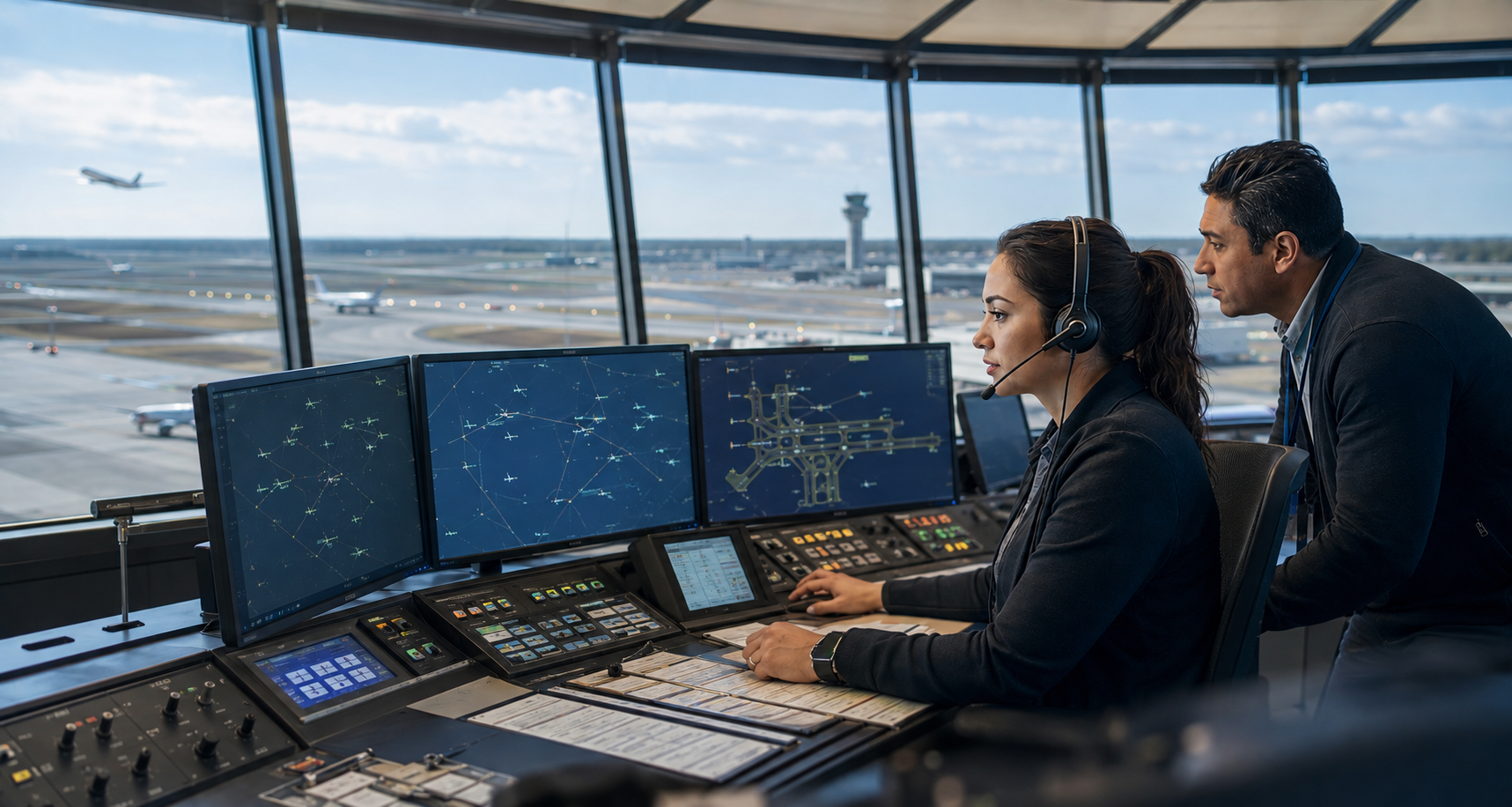
Air traffic controllers help keep aircraft safely separated as they travel through one of the world’s busiest and most complex airspace systems.
Controllers issue clearances, monitor aircraft, manage arrivals and departures, coordinate with other facilities, and respond when weather, traffic congestion, emergencies, or changing airport conditions affect a flight.
The career offers competitive federal benefits, paid training, and the opportunity to play a direct role in aviation safety. However, the selection and training process is demanding, and applicants must meet strict age, medical, security, communication, and performance requirements.
This guide explains how to become an air traffic controller in 2026, what students learn during ATC training, how the FAA Academy and collegiate training pathways work, and what prospective controllers should consider before pursuing the career.
What Does an Air Traffic Controller Do?
Air traffic controllers coordinate aircraft movements to maintain safe separation and keep traffic flowing efficiently.
Depending on the facility and assigned position, controllers may:
- Issue takeoff and landing clearances
- Provide taxi instructions
- Assign headings, altitudes, and routes
- Sequence arriving and departing aircraft
- Monitor aircraft on radar displays
- Transfer aircraft between sectors and facilities
- Communicate weather and airport information
- Coordinate with adjacent controllers
- Manage runway crossings and ground vehicles
- Respond to aircraft emergencies
- Adjust traffic flows during severe weather
- Assist pilots experiencing navigational or operational difficulties
The work requires continuous attention, clear communication, rapid information processing, and sound judgment.
Where Do Air Traffic Controllers Work?
Air traffic controllers work in several types of facilities. The training and certification process depends partly on the type of facility to which a new controller is assigned.
Airport Traffic Control Towers
Tower controllers manage aircraft and authorized vehicles on airport movement areas and aircraft operating immediately around the airport.
Tower positions can include:
- Clearance delivery
- Flight data
- Ground control
- Local control
Ground controllers direct aircraft between gates, ramps, taxiways, and runways. Local controllers issue takeoff and landing clearances and manage aircraft operating on active runways and in the immediate airport traffic area.
Terminal Radar Approach Control Facilities
Terminal Radar Approach Control facilities—commonly known as TRACONs—manage aircraft arriving at, departing from, or passing through the airspace surrounding one or more airports.
These controllers use surveillance displays and radio communications to:
- Assign headings and altitudes
- Sequence arriving aircraft
- Separate departures
- Coordinate instrument approaches
- Transfer aircraft to towers or en route centers
Air Route Traffic Control Centers
En route controllers work in Air Route Traffic Control Centers and manage aircraft traveling between terminal areas.
They monitor large sectors of airspace and coordinate aircraft operating at higher altitudes. En route teams use radar, surveillance technology, flight data, and radio communications to maintain separation and organize traffic flows.
FAA guidance defines specific responsibilities for tower, terminal radar, and en route controller teams, including ensuring separation, issuing control instructions, monitoring radios, coordinating handoffs, and managing flight information.
Air Traffic Controller vs. Aircraft Dispatcher
Air traffic controllers and aircraft dispatchers both support safe flights, but they perform different jobs.
An air traffic controller works within the air traffic system and communicates directly with pilots to maintain aircraft separation and manage traffic.
An aircraft dispatcher works for an airline and helps plan, release, and monitor airline flights. Dispatchers evaluate weather, fuel, routes, alternates, maintenance restrictions, and other operational factors.
Air traffic controllers manage aircraft movement. Dispatchers manage the airline’s operational planning and flight-monitoring responsibilities.
Basic FAA Air Traffic Controller Qualifications
Requirements can vary by hiring pathway and vacancy announcement. For a typical entry-level FAA air traffic controller position, applicants generally must:
- Be a United States citizen
- Be younger than 31 when applying, subject to limited exceptions
- Speak English clearly enough to be understood over communications equipment
- Pass an FAA medical examination
- Pass a federal security investigation
- Pass required pre-employment testing, including the ATSA
- Meet the education or work-experience requirement
- Be willing to accept placement based on FAA staffing needs
The FAA’s current general qualifications allow applicants to qualify through one year of progressively responsible work experience, a bachelor’s degree, or a combination of postsecondary education and qualifying work experience totaling one year. The exact vacancy announcement controls eligibility.
Experienced military controllers and controllers from certain private-sector facilities may qualify through separate hiring announcements with different requirements.
The Age Limit for Air Traffic Controllers
Most entry-level applicants must be younger than 31 when they apply. Limited exceptions may apply to candidates with previous qualifying air traffic control experience or eligibility under another specialized hiring authority.
Federal air traffic controllers are generally subject to mandatory retirement at age 56, although limited extensions or exceptions may apply.
The age restrictions reflect the length and intensity of controller training and the federal retirement structure associated with the occupation.
Prospective students should understand the age requirements before investing in an air traffic control degree or training program.
Do You Need a College Degree?
A college degree is not required for every entry-level FAA air traffic controller hiring pathway.
Applicants may be able to qualify through:
- Relevant or progressively responsible work experience
- A bachelor’s degree
- A combination of education and work experience
- Graduation from an approved AT-CTI program
- Qualifying military or civilian controller experience
Although a degree is not always mandatory, attending an FAA-partnered Air Traffic Collegiate Training Initiative school can provide structured aviation education and an introduction to air traffic control systems, procedures, phraseology, weather, and airspace.
Step-by-Step: How to Become an Air Traffic Controller
Step 1: Determine Your Eligibility
Before enrolling in a program or applying for an FAA position, review the current eligibility requirements.
Confirm that you meet—or will be able to meet—the:
- Citizenship requirement
- Age requirement
- Education or work-experience requirement
- English-language requirement
- Medical standards
- Security requirements
- Relocation expectations
Air traffic controller hiring is competitive, and meeting the minimum requirements does not guarantee selection.
Step 2: Choose an Entry Path
There are several ways to enter the air traffic control profession.
Common pathways include:
- Applying through an entry-level FAA public hiring announcement
- Completing a Standard AT-CTI college program
- Completing an Enhanced AT-CTI program
- Entering through qualifying military controller experience
- Training for the Federal Contract Tower system
- Applying through an experienced-controller announcement
Your best pathway will depend on your age, education, experience, location, finances, and career goals.
Step 3: Apply Through USAJobs
FAA air traffic controller positions are generally advertised through USAJobs.
Applicants must carefully follow the vacancy instructions and submit all required materials. These may include:
- A federal résumé
- Employment history
- College transcripts
- AT-CTI documentation
- Military service records
- Veterans’ preference documents
- Previous controller credentials
Missing or incomplete information can affect eligibility.
Because hiring windows can be limited, prospective applicants should prepare their USAJobs account and documents before an announcement opens.
Step 4: Take the ATSA
Qualified candidates may be invited to take the Air Traffic Skills Assessment, commonly called the ATSA.
The ATSA evaluates abilities associated with successful controller training, including:
- Memory
- Spatial awareness
- Logical reasoning
- Attention
- Decision-making
- Multitasking
- Reading comprehension
- Personality and work-style characteristics
The current FAA hiring process describes the ATSA as an approximately 3.5-hour, computer-based assessment administered at an approved testing location.
The ATSA is not primarily an aviation-knowledge examination. It evaluates cognitive abilities and behavioral characteristics relevant to air traffic control.
Step 5: Complete Medical and Security Screening
Candidates who move forward may receive a tentative offer and begin the clearance process.
Screening can include:
- An FAA medical examination
- Vision and hearing evaluation
- Drug testing
- Psychological evaluation
- Fingerprinting
- Federal background investigation
- Review of employment and legal history
Applicants should provide complete and accurate information throughout the process. A medical condition does not automatically disqualify every applicant, but the FAA must determine that a candidate can safely perform controller duties.
Step 6: Complete Initial FAA Training
Entry-level employees who follow the traditional FAA pathway begin with foundational air traffic instruction and then continue to option-specific training.
The FAA currently pays entry-level employees during initial controller training. AT Basics may be completed virtually from the trainee’s home location, followed by additional instruction at the FAA Academy in Oklahoma City. Eligible trainees receive pay while attending the Academy and may qualify for long-term per diem.
Academy training is intensive and performance-based. Students must meet academic, simulation, procedural, and practical standards to continue.
Step 7: Receive a Facility Assignment
After successfully completing the required initial training, trainees are assigned to an air traffic facility based largely on FAA staffing needs.
Assignments may be made to:
- An airport traffic control tower
- A TRACON
- An en route center
- A combined tower and radar facility
Applicants should be prepared to relocate. A preferred city, state, or facility is not guaranteed.
Step 8: Complete Facility Training
Graduating from initial training does not make someone a fully certified controller.
New controllers continue with classroom, laboratory, simulation, and on-the-job training at their assigned facilities. They must learn:
- Local airspace
- Airport layouts
- Sector boundaries
- Frequencies
- Facility procedures
- Letters of agreement
- Traffic flows
- Emergency procedures
- Weather patterns
- Equipment and automation
Facility training is conducted under the supervision of experienced controllers and instructors.
The FAA states that facility training commonly takes another two to three years before a trainee becomes a Certified Professional Controller. Controllers then participate in continuing proficiency training throughout their careers.
What Is the FAA Academy?
The FAA Academy in Oklahoma City provides initial qualification training for many newly hired controllers.
Training may include:
- Air traffic fundamentals
- Aviation weather
- Aircraft characteristics
- Airspace
- Navigation
- Federal aviation regulations
- Controller phraseology
- Separation standards
- Radar procedures
- Nonradar procedures
- Tower operations
- Emergency procedures
- High-fidelity simulations
Students are evaluated throughout the program. Performance in classroom examinations and simulations determines whether a trainee progresses.
Academy admission is typically connected to FAA employment. It is not generally a school that members of the public independently attend and pay for as ordinary students.
Standard AT-CTI Programs
The Air Traffic Collegiate Training Initiative is a partnership between the FAA and approved colleges and universities.
Standard AT-CTI schools offer two- and four-year aviation degrees incorporating air traffic control and aviation-administration subjects.
Graduates from qualifying Standard AT-CTI programs may bypass the introductory Air Traffic Basics portion of FAA Academy training. They must still be hired by the FAA, satisfy all employment requirements, and complete the appropriate terminal or en route training at the Academy.
Completing an AT-CTI program does not guarantee employment.
Enhanced AT-CTI Programs
The Enhanced Air Traffic Collegiate Training Initiative is a newer pathway that allows qualified institutions to provide training equivalent to portions of the FAA Academy curriculum.
Qualified Enhanced AT-CTI graduates who are hired and meet FAA requirements may proceed directly to facility training instead of completing initial qualification training at the Oklahoma City Academy.
Enhanced-program students must still:
- Pass the ATSA
- Meet medical requirements
- Meet security requirements
- Complete performance verifications
- Receive the required endorsement
- Be selected and hired by the FAA
The FAA continued expanding the Enhanced AT-CTI network during 2026.
Students should confirm whether a school is a Standard or Enhanced AT-CTI institution because the two pathways provide different training and Academy benefits.
Control Tower Operator Training
Another pathway involves training for a Control Tower Operator certificate and pursuing employment at a Federal Contract Tower.
The FAA’s Control Tower Operator Partnership Program works with approved schools to incorporate technical training into college programs. Graduates may become eligible to begin on-the-job training at participating contract towers.
A Certified Professional Controller who gains qualifying Federal Contract Tower experience may later become eligible for direct-hire opportunities with the FAA.
This pathway is focused primarily on tower operations and is different from the broader terminal-radar and en route training paths.
What Do Students Learn in ATC Training?
Air traffic control education may include:
Aviation Fundamentals
Students learn about aircraft performance, navigation, weather, airports, airspace, flight planning, and the National Airspace System.
Controller Phraseology
Controllers must communicate clearly, efficiently, and consistently. Students practice standard terminology and radio procedures used to issue clearances, instructions, traffic advisories, and safety alerts.
Aircraft Separation
Students learn the rules and techniques used to maintain safe distances between aircraft.
Training can cover:
- Visual separation
- Radar separation
- Wake turbulence
- Runway separation
- Longitudinal separation
- Vertical separation
- Lateral separation
Tower Operations
Tower training may include:
- Clearance delivery
- Flight data
- Ground control
- Local control
- Runway crossings
- Airport vehicles
- Traffic-pattern sequencing
- Arrivals and departures
Radar Operations
Radar training may cover:
- Aircraft identification
- Vectoring
- Speed control
- Altitude assignments
- Instrument approaches
- Arrival sequencing
- Departure procedures
- Handoffs between sectors
Emergency Procedures
Students practice responses to situations such as:
- Radio failures
- Aircraft emergencies
- Medical emergencies
- Equipment outages
- Severe weather
- Fuel emergencies
- Lost aircraft
- Runway incursions
- Unlawful interference
Human Factors
Human-factors training addresses:
- Fatigue
- Stress
- Workload management
- Situational awareness
- Communication
- Team coordination
- Decision-making
- Error prevention
What Skills Make a Good Air Traffic Controller?
Successful controllers generally demonstrate:
- Strong concentration
- Clear verbal communication
- Rapid information processing
- Spatial awareness
- Short-term memory
- Decisive judgment
- Emotional control
- Multitasking ability
- Teamwork
- Adaptability
- Attention to detail
- Willingness to accept feedback
Controllers must make accurate decisions without allowing speed to compromise safety.
Air Traffic Controller Work Schedules
Air traffic control facilities operate continuously, including nights, weekends, and holidays.
Controllers may work:
- Early mornings
- Evenings
- Overnight shifts
- Weekends
- Holidays
- Rotating schedules
Shift assignments may be influenced by facility staffing, qualifications, and seniority.
The work requires intense concentration. Controllers receive breaks during their shifts, but the schedule and responsibility can still be physically and mentally demanding.
Air Traffic Controller Salary and Job Outlook
According to the Bureau of Labor Statistics, the median annual wage for air traffic controllers was $144,580 in May 2024. Compensation varies by employer, experience, certification level, facility complexity, location, overtime, and premium pay.
Trainees generally earn less while completing Academy and facility training. Pay increases as controllers complete certification stages and qualify on additional positions.
The Bureau of Labor Statistics projects approximately 2,200 air traffic controller openings per year, on average, from 2024 through 2034. Many openings are expected to result from retirements and workers leaving the occupation.
Is FAA Air Traffic Controller Training Paid?
The traditional FAA entry-level training pathway is paid employment.
Qualified trainees receive an hourly salary during initial instruction and Academy training. Eligible trainees attending the Academy in Oklahoma City may also receive long-term per diem unless their home is within the applicable local area.
This differs from college-based AT-CTI programs. Students attending a college or university are generally responsible for tuition, fees, housing, and other educational expenses until they are hired by the FAA.
How to Choose an Air Traffic Control School
When comparing air traffic control programs, consider:
FAA Partnership Status
Verify whether the institution is:
- A Standard AT-CTI school
- An Enhanced AT-CTI school
- A Control Tower Operator partner
- A general aviation school without an FAA air traffic partnership
Do not assume that every program using “air traffic control” in its name provides an FAA-recognized hiring benefit.
Training Equipment
Look for programs with:
- Tower simulators
- Radar simulators
- Communications systems
- Electronic flight strips
- Realistic airport scenarios
- Experienced controller instructors
Program Outcomes
Ask about:
- Graduation rates
- ATSA preparation
- FAA hiring outcomes
- Simulation hours
- Instructor experience
- Internship opportunities
- Graduate career paths
Schools should not guarantee FAA employment.
Total Cost
Review:
- Tuition
- Fees
- Equipment
- Housing
- Transportation
- Financial aid
- Scholarship opportunities
- Refund policies
Compare the cost with the specific benefit provided by the school’s FAA partnership.
Common Mistakes to Avoid
Prospective controllers should avoid:
- Enrolling without checking the FAA age limit
- Assuming a degree guarantees FAA employment
- Confusing Standard and Enhanced AT-CTI programs
- Assuming facility placement will be near home
- Underestimating the medical and security process
- Preparing only for aviation questions on the ATSA
- Ignoring rotating-shift requirements
- Failing to follow USAJobs résumé instructions
- Choosing a school without verifying its FAA status
- Assuming Academy graduation completes all controller training
Frequently Asked Questions
Do I need previous aviation experience?
Previous aviation experience is not required for every entry-level hiring pathway. Applicants must meet the education or work-experience requirements in the vacancy announcement.
Must I be younger than 31?
Most entry-level applicants must be younger than 31 at the applicable point in the hiring process. Limited exceptions exist for certain experienced controllers and other qualifying candidates.
Is a college degree required?
Not for every entry-level announcement. Applicants may qualify through education, work experience, or an approved combination. AT-CTI degrees provide a separate structured pathway.
Does attending an AT-CTI school guarantee an FAA job?
No. Graduates must still apply, meet the announcement requirements, pass required assessments, complete medical and security screening, and be selected by the FAA.
How long does training take?
Initial instruction and Academy training can take several months. Facility training generally requires another two to three years, depending on the facility, complexity, position, and individual progress.
Can I choose where I work?
Facility assignments are primarily based on FAA staffing needs. Applicants should be prepared to relocate anywhere in the United States.
Is air traffic control stressful?
The job requires sustained concentration and carries significant responsibility. Training emphasizes workload management, communication, teamwork, fatigue awareness, and decision-making.
Is the ATSA an aviation-knowledge test?
The ATSA primarily evaluates cognitive abilities, attention, reasoning, memory, multitasking, and other characteristics related to controller training. Aviation knowledge alone is not sufficient preparation.
Find Air Traffic Controller Training with Aviation Schools Online
Air traffic control is a demanding career that combines aviation knowledge, technology, communication, and real-time decision-making.
Choosing the right training pathway begins with understanding the differences between public FAA hiring, Standard AT-CTI programs, Enhanced AT-CTI programs, and Control Tower Operator training.
Aviation Schools Online helps prospective students research air traffic control schools, compare aviation programs, and connect with colleges and academies offering specialized training.
Search air traffic controller training programs on Aviation Schools Online and begin preparing for a career protecting the safety and efficiency of the National Airspace System.