Section 5: Aircraft Weight, Balance & Performance: Pilot Training Guide | ASO
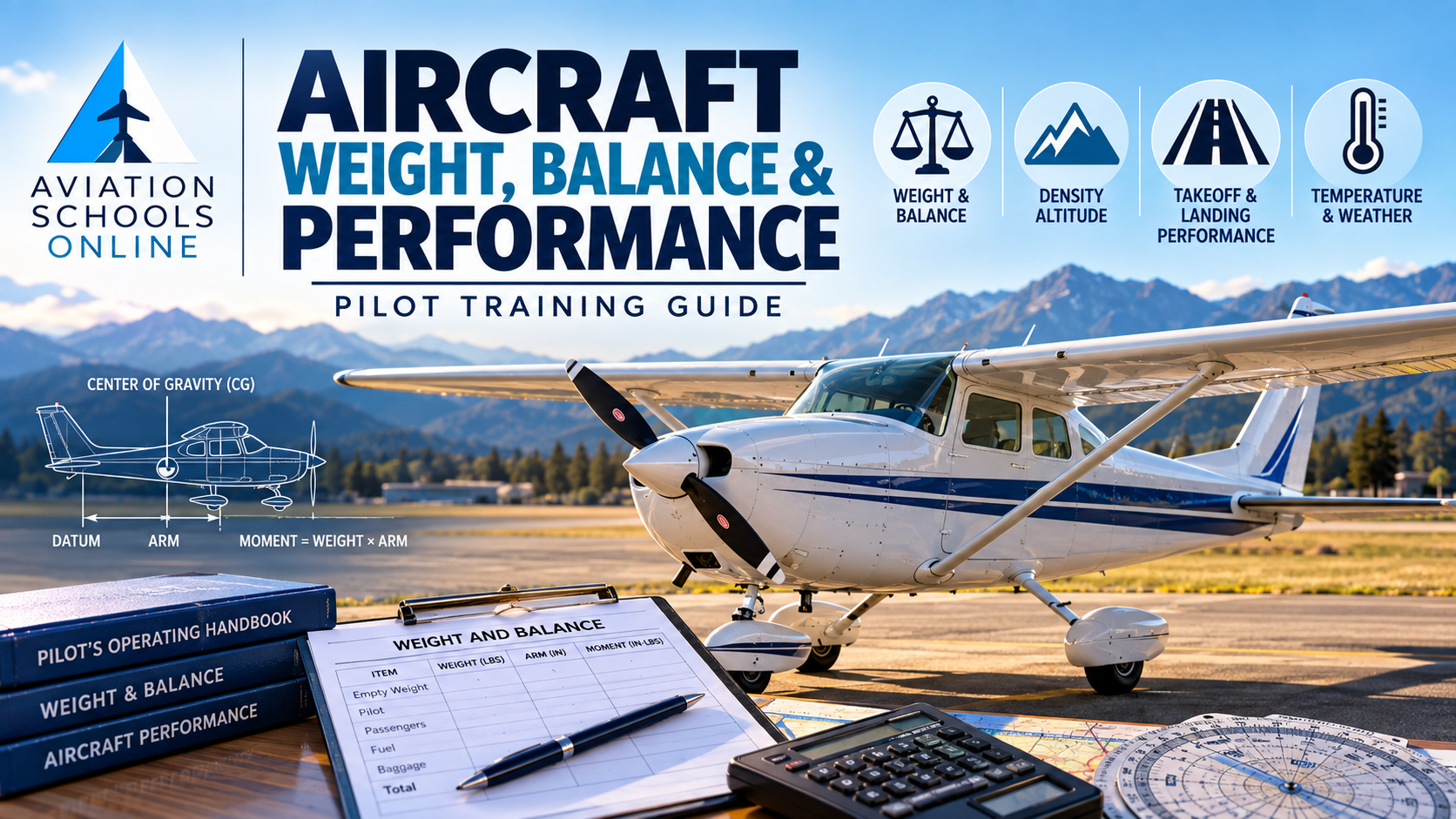
An airplane may be mechanically capable of flight and still be unsafe to operate because of improper loading or inadequate performance.
Before every flight, the pilot must determine whether the aircraft is properly loaded and whether it can safely take off, climb, cruise, and land under the expected conditions.
This means understanding three closely related subjects:
-
Aircraft weight
-
Center of gravity and balance
-
Aircraft performance
These are not simply calculations for the FAA knowledge test. They are essential parts of real-world preflight planning and aeronautical decision-making.
Why Weight and Balance Matter
Every aircraft has specific limitations established by its manufacturer.
These may include:
-
Maximum ramp weight
-
Maximum takeoff weight
-
Maximum landing weight
-
Baggage compartment limits
-
Fuel capacity
-
Center-of-gravity limits
-
Structural loading limits
Operating an aircraft outside these limitations can reduce performance, change handling characteristics, overstress the aircraft, and potentially make the airplane uncontrollable.
A pilot must determine that the aircraft remains within its approved limitations for the flight.
Understanding Aircraft Weight
Several different weight terms may appear in an aircraft's Pilot's Operating Handbook or Airplane Flight Manual.
Empty Weight
The exact definition depends on the aircraft and certification basis.
For many modern general aviation airplanes, the aircraft's published basic empty weight generally includes the aircraft, permanently installed equipment, unusable fuel, and full operating fluids as defined by the applicable certification standard.
Always use the specific weight-and-balance information supplied for the individual aircraft.
Useful Load
Useful load represents the amount of weight that can be added to the aircraft after accounting for its empty weight.
Depending on the aircraft, useful load may include:
-
Pilot
-
Passengers
-
Usable fuel
-
Baggage
-
Cargo
A large useful-load number does not mean that everything can simply be loaded anywhere in the airplane.
The aircraft must meet both:
Weight limits and center-of-gravity limits.
Maximum Takeoff Weight
The maximum takeoff weight is the maximum approved weight at which the aircraft may begin its takeoff under the applicable operating limitations.
Exceeding maximum takeoff weight can negatively affect:
-
Takeoff distance
-
Acceleration
-
Rate of climb
-
Service ceiling
-
Stall speed
-
Maneuverability
-
Structural loading
-
Landing performance
Flying overweight should never be treated as simply accepting slightly poorer performance.
It can place the aircraft outside its approved operating envelope.
Fuel Weight
Fuel contributes significantly to aircraft weight.
For many aviation calculations, a commonly used approximate weight for aviation gasoline is:
6 pounds per U.S. gallon
However, pilots should use the appropriate data and procedures provided for their aircraft and fuel type.
Example
If an airplane carries:
40 gallons × 6 pounds per gallon = 240 pounds of fuel
That 240 pounds must be included in the aircraft's weight-and-balance calculation.
Because fuel is consumed during flight, both aircraft weight and—in some aircraft—the center of gravity may change during the flight.
What Is Center of Gravity?
The center of gravity, or CG, is the theoretical point at which the aircraft would balance if suspended.
Where that point is located has a major effect on:
-
Stability
-
Controllability
-
Stall characteristics
-
Takeoff performance
-
Landing characteristics
-
Control forces
Aircraft manufacturers establish an approved CG envelope.
The aircraft must remain within that envelope.
Arm, Weight, and Moment
Weight-and-balance calculations generally involve three important terms:
Weight
The amount of force caused by gravity acting on an item.
Examples include:
-
Pilot weight
-
Passenger weight
-
Baggage weight
-
Fuel weight
Arm
The arm is the horizontal distance from a specified reference point called the datum to the center of gravity of an item.
The aircraft manufacturer establishes the datum.
Moment
A moment represents the tendency of a weight to produce rotation around a reference point.
The basic relationship is:
Moment = Weight × Arm
For example:
180 pounds × 37 inches = 6,660 pound-inches
Some aircraft manufacturers divide moments by 100 or 1,000 to make the numbers easier to work with.
Always follow the aircraft manufacturer's published method.
Calculating Center of Gravity
A typical weight-and-balance calculation follows this process:
-
Determine the weight of each item.
-
Determine the arm for each item.
-
Calculate or obtain the moment for each item.
-
Add all weights.
-
Add all moments.
-
Determine the aircraft's loaded center of gravity.
-
Compare total weight and CG with the approved limits.
The fundamental CG relationship is:
Center of Gravity = Total Moment ÷ Total Weight
Example Weight-and-Balance Calculation
Consider a simplified training airplane.
| Item | Weight | Arm | Moment |
|---|---|---|---|
| Basic Empty Aircraft | 1,650 lb | 39.0 in | 64,350 lb-in |
| Pilot & Front Passenger | 350 lb | 37.0 in | 12,950 lb-in |
| Rear Passenger | 150 lb | 73.0 in | 10,950 lb-in |
| Baggage | 30 lb | 95.0 in | 2,850 lb-in |
| Fuel | 240 lb | 48.0 in | 11,520 lb-in |
Total Weight
1,650 + 350 + 150 + 30 + 240 =
2,420 pounds
Total Moment
64,350 + 12,950 + 10,950 + 2,850 + 11,520 =
102,620 pound-inches
Loaded CG
102,620 ÷ 2,420 = approximately
42.4 inches
The pilot would then compare the calculated weight and CG against the approved envelope for that specific aircraft.
This example is for instructional purposes only. Actual aircraft loading calculations must use the weight, arms, moments, and limitations for the individual airplane being flown.
Forward Center of Gravity
A forward CG occurs when the aircraft's center of gravity is toward the forward portion of the allowable range.
A forward CG generally increases longitudinal stability but can have disadvantages.
Potential effects include:
-
Increased control forces
-
Longer takeoff roll
-
Reduced climb performance
-
Increased stall speed in some conditions due to higher required wing loading
-
Greater difficulty raising the nose during takeoff
-
Greater difficulty flaring during landing
An excessively forward CG may leave insufficient elevator authority for certain phases of flight.
Aft Center of Gravity
An aft CG moves the aircraft's center of gravity toward the rear of the allowable range.
An aft CG may reduce some control forces and can reduce the amount of tail-down force required during flight.
However, it also reduces longitudinal stability.
Potential consequences include:
-
Reduced stability
-
More sensitive pitch response
-
Greater difficulty recovering from stalls
-
Greater difficulty recovering from spins
-
Potential loss of adequate control if the aft CG limit is exceeded
An aircraft loaded beyond its aft CG limit can become extremely dangerous.
Weight Can Be Legal but Balance Can Still Be Unsafe
One of the most important concepts in weight-and-balance planning is:
An aircraft can be below maximum gross weight and still be improperly loaded.
For example, placing excessive baggage in an aft baggage compartment could move the CG behind the aft limit even though the airplane remains below its maximum allowable weight.
Pilots must check both:
Total weight AND center of gravity.
How Fuel Burn Changes Weight and Balance
Aircraft weight decreases as fuel is consumed.
Whether the CG moves forward or aft depends on where the aircraft's fuel tanks are located relative to its center of gravity.
For some aircraft, the CG movement may be relatively small.
For others, fuel burn can significantly affect balance.
Pilots should consider the aircraft's weight and CG not only at takeoff, but also during the flight and at landing when necessary.
Aircraft Performance
Once the airplane is properly loaded, the pilot must determine whether it can safely accomplish the planned flight.
Performance planning includes factors such as:
-
Takeoff distance
-
Landing distance
-
Rate of climb
-
Cruise performance
-
Fuel consumption
-
Range
-
Endurance
-
Glide performance
These values are determined using manufacturer-approved performance charts, tables, graphs, or electronic data.
Factors Affecting Aircraft Performance
Aircraft performance is affected by much more than aircraft weight.
Important factors include:
-
Aircraft weight
-
Temperature
-
Pressure altitude
-
Density altitude
-
Wind
-
Runway length
-
Runway slope
-
Runway surface
-
Obstacles
-
Aircraft configuration
-
Aircraft condition
-
Pilot technique
A performance calculation that ignores any important factor may provide a misleading picture of the airplane's actual capability.
Pressure Altitude
Pressure altitude is the altitude indicated when the altimeter is set to:
29.92 inches of mercury
Pressure altitude is commonly used in aircraft performance calculations and in determining density altitude.
If atmospheric pressure differs from standard pressure, pressure altitude can differ significantly from the airport's actual elevation.
Density Altitude
Density altitude is pressure altitude corrected for nonstandard temperature.
A useful way for student pilots to think about density altitude is:
Density altitude tells you how the airplane "feels" the altitude from a performance standpoint.
High density altitude means the air is less dense.
Aircraft performance decreases as density altitude increases.
What Causes High Density Altitude?
Density altitude increases with:
-
Higher altitude
-
Higher temperature
-
Lower atmospheric pressure
Humidity can also reduce air density and affect performance, although temperature and pressure are the primary variables used in standard density-altitude calculations.
A combination of a high-elevation airport and hot summer temperatures can produce very high density altitude.
Effects of High Density Altitude
At high density altitude, an airplane may experience:
-
Reduced engine power in normally aspirated engines
-
Reduced propeller efficiency
-
Reduced wing performance for a given true airspeed
-
Longer takeoff roll
-
Reduced climb rate
-
Reduced climb angle
The airplane may require a much greater distance to clear obstacles after takeoff.
This makes density altitude especially important at:
-
High-elevation airports
-
Mountain airports
-
Short runways
-
Hot-weather airports
-
Heavily loaded aircraft
Takeoff Performance
Before departure, the pilot should determine the expected takeoff distance using the aircraft's approved performance information.
Takeoff calculations may require consideration of:
-
Aircraft weight
-
Pressure altitude
-
Temperature
-
Wind
-
Runway slope
-
Runway surface
-
Aircraft configuration
-
Obstacles
Performance information may provide:
Ground roll — distance traveled while the aircraft remains on the runway.
Distance over a 50-foot obstacle — total distance required to take off and climb over a 50-foot obstacle.
These are different values and should not be confused.
Headwind and Tailwind Effects
A headwind generally reduces the ground distance required for takeoff and landing.
A tailwind generally increases those distances.
Even a relatively small tailwind can have an important effect on runway requirements.
Pilots should use manufacturer performance data whenever available rather than relying on rough assumptions.
Runway Surface
Performance charts may be based on specific runway conditions, such as:
Dry, paved, level runway
Actual runway conditions can produce significantly different performance.
Considerations include:
-
Grass
-
Gravel
-
Soft surfaces
-
Wet pavement
-
Standing water
-
Snow
-
Ice
-
Contamination
A surface that increases rolling resistance can substantially increase takeoff distance.
Runway Slope
An uphill runway generally increases takeoff distance.
A downhill runway generally decreases ground acceleration requirements but may introduce other operational considerations.
During landing, slope can also affect stopping distance and visual perception.
Performance planning should use manufacturer information when available.
Landing Performance
Landing performance calculations are just as important as takeoff calculations.
Important factors include:
-
Aircraft weight
-
Wind
-
Density altitude
-
Runway slope
-
Runway surface
-
Approach speed
-
Aircraft configuration
-
Braking effectiveness
Excessive approach speed can greatly increase landing distance.
A stabilized approach flown at the proper speed is a major part of achieving predictable landing performance.
Climb Performance
Two important climb concepts are:
Best Angle of Climb — VX
VX provides the greatest altitude gain over a given horizontal distance.
It is generally used when obstacle clearance is the primary concern.
Best Rate of Climb — VY
VY provides the greatest altitude gain over a given amount of time.
It is generally used when the objective is to reach altitude as quickly as possible.
Pilots should use the speeds specified for their aircraft and understand that climb performance and recommended speeds may vary with altitude, weight, and aircraft type.
Absolute Ceiling and Service Ceiling
Service Ceiling
The service ceiling is generally the maximum density altitude at which an aircraft can maintain a specified minimum rate of climb.
For many normally aspirated airplanes, that benchmark is commonly 100 feet per minute.
Absolute Ceiling
The absolute ceiling is the altitude at which the aircraft can no longer climb.
At the absolute ceiling:
Maximum rate of climb = 0 feet per minute
These concepts illustrate how aircraft climb capability decreases as altitude increases.
Range vs. Endurance
These two terms are easy to confuse.
Range
Range refers to how far an aircraft can travel.
Think:
Distance
Endurance
Endurance refers to how long an aircraft can remain airborne.
Think:
Time
Wind can significantly affect range over the ground.
A strong headwind reduces groundspeed and therefore reduces the distance the aircraft can cover during a given amount of time.
Fuel Planning
Pilots must determine whether adequate fuel is available for the planned flight.
Fuel planning should account for:
-
Taxi
-
Takeoff
-
Climb
-
Cruise
-
Descent
-
Expected winds
-
Possible delays
-
Diversions
-
Required reserves
Legal fuel reserves represent minimum regulatory requirements—not necessarily the amount of fuel a prudent pilot should plan to have available.
VFR Fuel Requirements
For airplanes operating under VFR, federal regulations establish minimum fuel requirements.
Generally, the aircraft must have enough fuel to fly to the first point of intended landing and then continue for at least:
Day VFR
30 minutes at normal cruising speed
Night VFR
45 minutes at normal cruising speed
These are regulatory minimums.
Pilots should consider carrying greater reserves based on weather, airport availability, terrain, traffic, expected delays, and personal minimums.
Performance Charts
Student pilots need to become comfortable using aircraft performance charts.
Common charts include:
-
Takeoff distance
-
Landing distance
-
Time, fuel, and distance to climb
-
Cruise performance
-
Range
-
Endurance
-
Density altitude
-
Climb performance
Different manufacturers present information differently.
Charts may require:
-
Finding pressure altitude
-
Finding temperature
-
Interpolating between values
-
Correcting for aircraft weight
-
Correcting for wind
-
Correcting for runway surface
-
Applying other manufacturer-specified adjustments
Do not assume performance data from one aircraft applies to another—even if the airplanes appear similar.
Understanding Interpolation
Performance charts do not always provide the exact temperature, weight, or altitude for the flight.
Pilots may therefore need to interpolate between published values.
For example, if a chart provides performance at:
20°C and 30°C
but the actual temperature is:
25°C
the pilot may need to estimate the performance value between those two published points according to the manufacturer's chart.
Electronic flight-planning tools can perform many calculations automatically, but pilots should still understand what the values mean and verify that correct information has been entered.
Published Performance vs. Real-World Performance
Manufacturer performance figures are based on specific conditions and assumptions.
Actual performance can differ because of:
-
Aircraft age
-
Engine condition
-
Propeller condition
-
Tire condition
-
Pilot technique
-
Runway contamination
-
Winds
-
Turbulence
-
Temperature variations
-
Loading
-
Maintenance condition
Pilots should avoid planning a flight with no safety margin simply because a chart indicates that the airplane can theoretically complete the operation.
Build a Safety Margin
Suppose a performance chart indicates that an airplane requires 2,200 feet to clear a 50-foot obstacle.
Planning to depart from a runway that is exactly 2,200 feet long provides virtually no margin for:
-
Pilot technique
-
Wind variation
-
Surface condition
-
Engine performance
-
Temperature changes
-
Calculation errors
Good aeronautical decision-making includes establishing conservative personal minimums and performance margins.
The FAA's Private Pilot ACS specifically emphasizes evaluating aircraft performance and applying appropriate personal minimums rather than simply completing the calculation.
Scenario: Hot Day, High Airport, Heavy Airplane
Imagine a fully loaded training airplane departing a high-elevation airport on a hot afternoon.
The airplane may be within its legal maximum weight.
However:
-
Density altitude is high.
-
Engine performance is reduced.
-
Propeller efficiency is reduced.
-
Takeoff roll increases.
-
Climb performance decreases.
An airplane being technically "within limits" does not automatically mean the operation is wise.
Possible risk-reduction strategies could include:
-
Departing earlier when temperatures are cooler
-
Reducing baggage
-
Reducing passenger load
-
Reducing fuel when operationally appropriate and maintaining required reserves
-
Using a longer runway
-
Delaying the flight
-
Choosing another airport
Safe pilots evaluate the complete situation rather than looking at a single number.
Weight, Balance, and Performance Work Together
These three subjects should never be viewed independently.
Consider this chain:
More Weight → More Lift Required → Higher Stall Speed → Longer Takeoff Roll → Lower Climb Performance → Longer Landing Distance
At the same time:
High Temperature + High Elevation → Higher Density Altitude → Reduced Aircraft Performance
Add an improperly located load and the aircraft may also have an unfavorable center of gravity.
This is why preflight performance planning is critical.
Common Student Pilot Mistakes
Student pilots should learn to avoid several common errors.
Mistake 1: Checking Only Gross Weight
The aircraft may be under maximum weight but outside the CG envelope.
Mistake 2: Ignoring Density Altitude
Runway length that is more than adequate on a cool day may become inadequate on a hot day.
Mistake 3: Assuming the Airplane Will Match the Book Exactly
Published performance data does not eliminate the need for safety margins.
Mistake 4: Forgetting Baggage
A relatively small amount of baggage placed far from the aircraft's CG can have a significant effect on moment.
Mistake 5: Using Estimated Passenger Weights Without Care
Accurate loading information is essential when aircraft limits are involved.
Mistake 6: Ignoring Fuel Burn
The aircraft's weight and CG may change during flight.
Mistake 7: Treating Regulatory Minimums as Targets
A legal minimum is not necessarily a safe operational target.
FAA Checkride Connection
Weight, balance, and performance are important components of the Private Pilot practical test.
A private pilot applicant should be prepared to demonstrate the ability to:
-
Calculate aircraft weight and balance
-
Recognize an out-of-limit condition
-
Correct an unacceptable loading situation
-
Use manufacturer performance charts
-
Evaluate takeoff and landing performance
-
Account for environmental conditions
-
Understand how loading affects aircraft performance
-
Apply realistic performance margins
The goal is not simply to produce the correct number.
The pilot must be able to use that information to make a safe go/no-go decision.
Section 5 Key Takeaways
Before moving forward, make sure you understand these concepts:
-
Every aircraft has specific weight and center-of-gravity limitations.
-
An airplane can be under maximum gross weight and still be improperly balanced.
-
Moment = Weight × Arm.
-
CG = Total Moment ÷ Total Weight.
-
Forward and aft CG conditions affect stability, controllability, and performance differently.
-
Fuel consumption reduces aircraft weight and may change CG.
-
Higher aircraft weight generally decreases performance.
-
High density altitude reduces takeoff and climb performance.
-
Takeoff and landing calculations must account for actual operating conditions.
-
VX provides the greatest altitude gain over distance.
-
VY provides the greatest altitude gain over time.
-
Range refers to distance; endurance refers to time.
-
FAA fuel-reserve requirements are minimums, not necessarily ideal planning targets.
-
Manufacturer performance data should be combined with realistic safety margins.
-
Good pilots use weight, balance, and performance calculations to make operational decisions—not simply to satisfy a requirement.
FAA Study Resources
Students should study the current FAA material alongside their flight school's curriculum, particularly:
-
Pilot's Handbook of Aeronautical Knowledge — FAA-H-8083-25C
-
Chapter 10: Weight and Balance
-
Chapter 11: Aircraft Performance
-
-
Weight & Balance Handbook — FAA-H-8083-1B
-
Airplane Flying Handbook
-
Private Pilot—Airplane Airman Certification Standards — FAA-S-ACS-6C
-
Aircraft-specific Pilot's Operating Handbook (POH) / Airplane Flight Manual (AFM)
-
Current Federal Aviation Regulations
Always use the approved information for the specific aircraft being flown, because aircraft weights, loading stations, performance figures, speeds, and limitations vary.