Aviation Maintenance Careers: Training Cost vs. Career Outlook
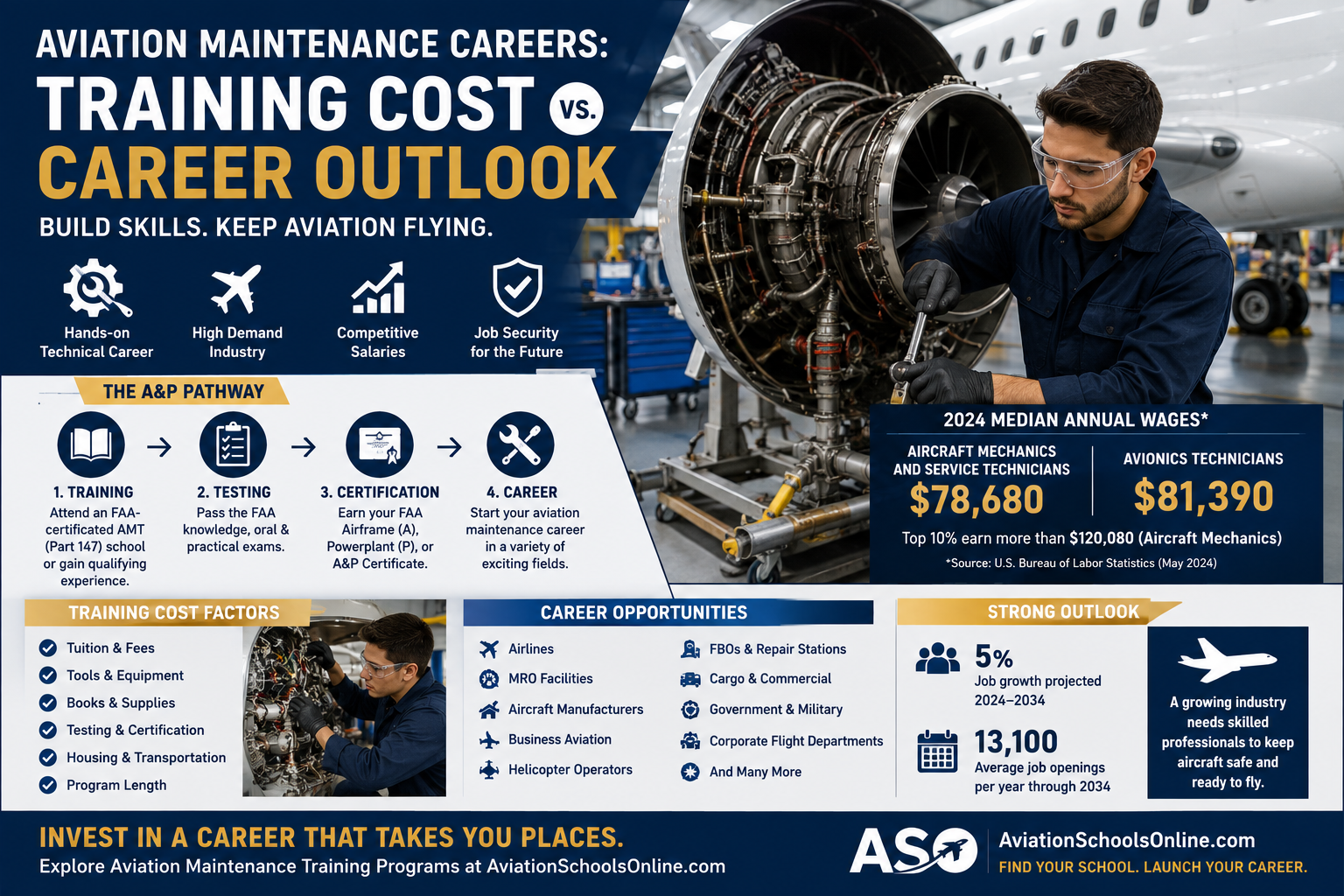
Aviation Maintenance Careers: Training Cost vs. Career Outlook
For someone considering an aviation career, becoming a pilot isn't the only way to build a rewarding future around aircraft.
Every airplane and helicopter operating safely depends on trained maintenance professionals who inspect, maintain, troubleshoot, and repair increasingly sophisticated aircraft and their systems.
That creates another aviation career path worth serious consideration:
Aviation maintenance.
But before enrolling in an Aviation Maintenance Technician School, prospective students usually want answers to two important questions:
How much will aviation maintenance training cost?
and
Will the career opportunities and earning potential justify that investment?
The answer depends on the school, training path, location, employer, specialization, and individual career goals. However, current employment data shows why aviation maintenance deserves consideration by anyone interested in a skilled technical aviation career.
This Aviation Schools Online guide looks at the cost of becoming an aviation maintenance technician, FAA certification requirements, potential earnings, career opportunities, and the long-term outlook for aircraft mechanics and avionics technicians.
What Is an Aviation Maintenance Technician?
An Aviation Maintenance Technician, or AMT, is a maintenance professional who works on aircraft and aircraft systems.
The FAA considers the terms Aviation Mechanic and Aviation Maintenance Technician equivalent.
FAA mechanic certification can include two ratings:
Airframe (A)
The Airframe rating relates primarily to aircraft structures and systems.
Powerplant (P)
The Powerplant rating relates primarily to aircraft engines and associated systems.
A mechanic who holds both ratings is commonly known as an:
A&P Mechanic
A&P stands for Airframe and Powerplant.
For many students pursuing aviation maintenance as a career, earning both ratings provides the broadest range of employment possibilities.
What Do Aircraft Mechanics Actually Do?
Aircraft maintenance involves much more than turning wrenches.
Modern aircraft contain sophisticated mechanical, electrical, hydraulic, electronic, and computerized systems.
Depending on the aircraft and employer, aviation maintenance professionals may:
- Inspect aircraft
- Perform scheduled maintenance
- Diagnose mechanical problems
- Troubleshoot electrical problems
- Repair aircraft structures
- Service engines
- Replace components
- Maintain hydraulic systems
- Inspect flight controls
- Service landing gear and brakes
- Test aircraft systems
- Read technical manuals and maintenance instructions
- Document maintenance and repairs
- Verify completed work meets applicable standards
Some technicians become generalists.
Others specialize.
Potential specialties include:
- Turbine engines
- Reciprocating engines
- Avionics
- Electrical systems
- Structures
- Sheet metal
- Composite materials
- Helicopters
- Business jets
- Commercial airliners
- Unmanned aircraft
- Manufacturing
- Inspection and quality control
That diversity creates several possible career paths from the same basic maintenance foundation.
Where Do Aviation Maintenance Technicians Work?
One advantage of aviation maintenance is the number of different types of employers requiring technical talent.
A&P mechanics and other aviation maintenance professionals may find opportunities with:
- Major airlines
- Regional airlines
- Cargo airlines
- MRO facilities
- FAA-certificated repair stations
- Aircraft manufacturers
- Engine manufacturers
- FBOs
- Corporate flight departments
- Business aviation operators
- Charter companies
- General aviation maintenance shops
- Helicopter operators
- Government agencies
- Military contractors
- Aviation maintenance schools
- Aerospace companies
The FAA also notes that aviation maintenance skills can transfer into other technical industries.
That means becoming an aircraft mechanic can provide more than one possible career destination.
How Do You Become an A&P Mechanic?
Unlike many occupations requiring a traditional four-year college degree, there are multiple ways to qualify for FAA mechanic certification.
Two of the primary pathways are:
1. Attend an FAA-Certificated Aviation Maintenance Technician School
An FAA-certificated Aviation Maintenance Technician School (AMTS)—often referred to as a Part 147 school—provides an approved curriculum designed to prepare students for aviation maintenance careers.
Schools may be certificated to offer:
- Airframe
- Powerplant
- Airframe and Powerplant
After successfully completing the appropriate approved curriculum and meeting the other eligibility requirements, the school's documentation can establish eligibility to take the applicable FAA mechanic certification tests.
For many students starting without previous aircraft-maintenance experience, this is the most straightforward path.
2. Gain Practical Maintenance Experience
Attending an AMTS isn't the only route.
The FAA also allows qualifying applicants to establish eligibility through documented practical experience.
For one rating—Airframe or Powerplant—the FAA requires at least 18 months of qualifying practical experience.
For both Airframe and Powerplant ratings, the FAA requires at least 30 months of qualifying experience performing the appropriate duties concurrently.
Military aviation maintenance experience may also qualify when applicable requirements are met.
This means prospective mechanics should compare the cost of formal education with the time and accessibility of an experience-based route.
FAA Eligibility Requirements
To qualify for an FAA Aviation Mechanic Certificate, applicants generally must:
- Be at least 18 years old
- Be able to read, write, speak, and understand English, subject to applicable exceptions
- Establish eligibility through approved education or qualifying experience
- Pass the applicable FAA knowledge tests
- Pass the required oral examination
- Pass the required practical examination
Students seeking both Airframe and Powerplant ratings commonly refer to the resulting qualification as their A&P Certificate.
What Does Aviation Maintenance Training Cost?
This is where prospective students need to do their homework.
There is no single national price for A&P training.
Training costs can vary dramatically depending on:
- Type of school
- Program length
- Public vs. private institution
- In-state vs. out-of-state tuition
- Geographic location
- Certificate vs. degree program
- Tools
- Books
- Lab fees
- Testing costs
- Housing
- Transportation
- Financial aid eligibility
A community college aviation maintenance program can have a very different total cost from a private technical school.
Likewise, a student living at home may face a very different total investment from someone relocating across the country for training.
That's why comparing only advertised tuition can be misleading.
Calculate the Real Cost of A&P Training
Before enrolling, prospective students should request a complete estimated cost of attendance.
Consider:
Tuition
What does the entire Airframe and Powerplant program cost—not just the first semester?
Tools
Will you need to purchase your own mechanic's tools?
Ask whether the school provides tools during training and what graduates are expected to own when entering the workforce.
Books and Training Materials
Include textbooks, online learning systems, manuals, and required supplies.
Lab and Program Fees
Some schools charge fees in addition to tuition.
FAA Testing
FAA mechanic certification involves applicable knowledge, oral, and practical testing.
Knowledge tests are administered through commercial FAA-approved testing centers, and oral and practical tests conducted by Designated Mechanic Examiners involve fees.
Housing
If you relocate for training, housing can become one of your largest expenses.
Transportation
Consider commuting costs as well as transportation to testing facilities or training locations.
Lost Income
A full-time training program can affect how many hours you're able to work while attending school.
That is a real economic cost even though it doesn't appear on the school's tuition statement.
Certificate Program vs. College Degree
Not every aviation maintenance student needs the same educational path.
Some programs focus primarily on preparing students to become FAA-certificated mechanics.
Others combine maintenance training with:
- Associate degrees
- Bachelor's degrees
- Management coursework
- General education
- Additional technical specialties
The right choice depends on your career objectives.
If your immediate goal is to become an A&P mechanic and enter the workforce as quickly and economically as possible, compare certificate-focused programs carefully.
If you eventually want to move toward:
- Maintenance management
- Operations
- Engineering-related roles
- Corporate leadership
- Aviation administration
a degree may provide additional value depending on the employer and position.
Don't automatically assume the most expensive program is the best program.
Ask:
What credential am I earning, what will it qualify me to do, how much will it cost, and what are graduates actually doing after completion?
Scholarships and Financial Aid for Aviation Maintenance Students
Students shouldn't assume they have to pay the entire cost out of pocket.
Depending on the school and individual eligibility, funding resources may include:
- Federal financial aid
- State financial aid
- Institutional scholarships
- Aviation maintenance scholarships
- Industry scholarships
- Employer tuition assistance
- Workforce-development programs
- Veterans education benefits
- Payment plans
- Private education financing
Organizations within aviation also offer scholarships specifically for maintenance students.
A student comparing schools should ask every financial aid office:
What scholarships are specifically available to aviation maintenance students?
Don't limit your search to scholarships offered directly by the school.
Training Cost vs. Starting Your Career
This is where aviation maintenance becomes particularly interesting as an education decision.
Traditional bachelor's-degree programs generally require four academic years.
An aviation maintenance pathway can potentially lead to a skilled technical career without requiring the same educational structure as a traditional four-year degree.
That doesn't automatically make A&P training inexpensive.
It means students should evaluate the investment differently.
Instead of asking only:
"How much does school cost?"
also ask:
"How quickly can this training realistically put me into the workforce?"
The time required to reach employment can significantly affect the overall return on your education investment.
What Do Aircraft Mechanics Earn?
Current Bureau of Labor Statistics data provides a useful benchmark.
The median annual wage for aircraft mechanics and service technicians was $78,680 in May 2024. (Bureau of Labor Statistics)
That means half of workers in the occupation earned more than the median and half earned less.
The highest-paid 10% earned more than $120,080, while the lowest-paid 10% earned less than $47,790. (Bureau of Labor Statistics)
Those numbers shouldn't be interpreted as guaranteed starting salaries.
New graduates generally shouldn't expect to walk directly into the industry's highest-paying positions.
Experience matters.
Employer matters.
Location matters.
Aircraft experience matters.
Shift and overtime opportunities can matter.
Specialization can matter.
But the data demonstrates that aviation maintenance has significant long-term earning potential.
Employer Type Can Make a Big Difference
Not every A&P mechanic earns the same amount.
BLS data shows substantial differences among industries.
For aircraft mechanics and service technicians, May 2024 median wages included:
Air transportation — $95,320
Couriers and express delivery services — $89,220
Aerospace product and parts manufacturing — $82,560
Federal government — $72,920
Support activities for air transportation — $66,960 (Bureau of Labor Statistics)
This is an important lesson for students.
Your first aviation maintenance job doesn't necessarily determine where your career ends.
Experience can create opportunities to move into different employers, aircraft types, specialties, and positions.
What About Avionics?
Students interested in electronics and technology should also investigate avionics careers.
Avionics technicians work with aircraft electronic systems and may install, test, troubleshoot, repair, or replace equipment and components.
The BLS reported a $81,390 median annual wage for avionics technicians in May 2024. (Bureau of Labor Statistics)
In air transportation specifically, the median was $99,150.
The BLS also projects avionics technician employment to grow 8% from 2024 through 2034, faster than its projection for aircraft mechanics specifically. (Bureau of Labor Statistics)
As aircraft continue to incorporate sophisticated digital systems, avionics represents an important maintenance specialization to explore.
Aviation Maintenance Career Outlook
The overall employment outlook is positive.
The Bureau of Labor Statistics projects employment of aircraft and avionics equipment mechanics and technicians to increase 5% between 2024 and 2034, compared with 3% projected for all occupations. (Bureau of Labor Statistics)
More importantly for someone deciding whether to enter the field, BLS projects approximately 13,100 openings each year on average for aircraft and avionics equipment mechanics and technicians over the decade. (Bureau of Labor Statistics)
Not all of those openings represent newly created jobs.
Many are expected to result from workers:
- Retiring
- Leaving the labor force
- Moving into different occupations
That's still meaningful to someone entering the industry.
Employers need people not only because aviation grows, but also because experienced technicians eventually leave positions that must be filled.
Why Will Aviation Continue to Need Maintenance Professionals?
Aircraft don't stop needing maintenance.
Airplanes require inspections, scheduled maintenance, repairs, troubleshooting, component replacement, and regulatory compliance throughout their operating lives.
The BLS points to several factors supporting demand, including growth in passenger travel and goods transportation, increasing aircraft use, greater aircraft-system complexity, and growth within the space industry. (Bureau of Labor Statistics)
Aviation maintenance also has a characteristic that distinguishes it from many occupations affected by automation:
Aircraft maintenance involves substantial hands-on work in safety-critical environments.
Technology will continue changing how technicians diagnose problems and perform maintenance, but aircraft still require qualified people to inspect, troubleshoot, repair, verify, and document that work.
Where Are the Jobs?
The largest employers of aircraft mechanics and service technicians include several major aviation sectors.
According to BLS 2024 employment data:
- 32% worked in support activities for air transportation
- 26% worked in air transportation
- 16% worked in aerospace product and parts manufacturing
- 10% worked for the federal government (Bureau of Labor Statistics)
That gives graduates considerably more options than simply applying to a passenger airline.
Airline Maintenance Careers
Major and regional airlines operate large fleets requiring continuous maintenance.
Potential advantages can include:
- Strong compensation potential
- Benefits
- Large maintenance organizations
- Specialized career tracks
- Advancement opportunities
- Experience on sophisticated aircraft
Airline operations run around the clock, however.
New mechanics should be prepared for the possibility of:
- Night shifts
- Weekends
- Holidays
- Shift bidding
- Outdoor work
- Time-sensitive maintenance
Seniority can play an important role at some employers.
MRO and Repair Station Careers
Maintenance, Repair and Overhaul organizations—commonly called MROs—provide another major employment path.
An MRO may maintain aircraft for multiple customers rather than one airline's fleet.
Depending on the facility, technicians may gain experience with:
- Multiple aircraft types
- Heavy maintenance
- Inspections
- Modifications
- Structures
- Engines
- Components
- Avionics
For someone who wants broad maintenance exposure, MRO employment can be an attractive option.
General Aviation Maintenance
Not everyone wants to work on a Boeing or Airbus.
General aviation creates opportunities to maintain:
- Piston airplanes
- Turboprops
- Business jets
- Flight-school aircraft
- Privately owned aircraft
Technicians working in smaller maintenance organizations may have opportunities to become familiar with a wide variety of aircraft and systems.
Business Aviation
Corporate and business aviation represents another potential career path.
Business aircraft require highly skilled technicians capable of maintaining sophisticated airframes, turbine engines, avionics, interiors, and onboard systems.
Experience with particular business-jet manufacturers or aircraft families can become valuable as a technician's career develops.
Aircraft Manufacturing
Mechanics and technicians also work for aircraft, engine, and component manufacturers.
Careers can involve:
- Aircraft assembly
- Production
- Testing
- Quality assurance
- Troubleshooting
- Technical support
- Modification
- Research and development support
Aviation maintenance skills aren't limited to maintaining aircraft already in service.
Can an A&P Career Lead to Management?
Absolutely.
An A&P Certificate doesn't mean spending an entire career in the same mechanic position.
With experience and additional qualifications, technicians may progress into positions such as:
- Lead mechanic
- Crew chief
- Lead inspector
- Quality-control inspector
- Maintenance supervisor
- Maintenance planner
- Maintenance controller
- Shop supervisor
- Director of Maintenance
- Maintenance manager
- Technical representative
- Instructor
The BLS specifically notes that experienced mechanics may advance into lead mechanic, lead inspector, or shop-supervisor roles. (Bureau of Labor Statistics)
Students interested in leadership may also consider business, communication, and management education as their careers progress.
Inspection Authorization
Experienced A&P mechanics may eventually qualify for an Inspection Authorization (IA) after meeting applicable FAA requirements.
An IA provides additional inspection and approval privileges involving certain maintenance activities, major repairs, alterations, and annual inspections.
For mechanics planning a long-term career in general aviation maintenance, earning an IA can be an important professional milestone.
What Is the Work Environment Really Like?
Aviation maintenance can be rewarding, but students should understand the realities of the occupation.
This isn't typically a desk job.
Mechanics may work:
- In hangars
- At repair stations
- On airport ramps
- Outdoors
- On ladders or scaffolds
- Under aircraft
- Inside confined aircraft areas
- Around loud machinery
The work can involve crouching, reaching, climbing, lifting, and working in uncomfortable positions.
Maintenance professionals also work under significant responsibility.
Aircraft must be safe.
Documentation must be correct.
Maintenance standards must be followed.
Deadlines matter—but safety comes first.
BLS reports that most aircraft and avionics technicians work full time and that schedules may include 8- or 10-hour shifts, nights, weekends, and holidays. (Bureau of Labor Statistics)
Students should consider these lifestyle factors alongside salary.