Aviation Maintenance Training & Certification in Florida
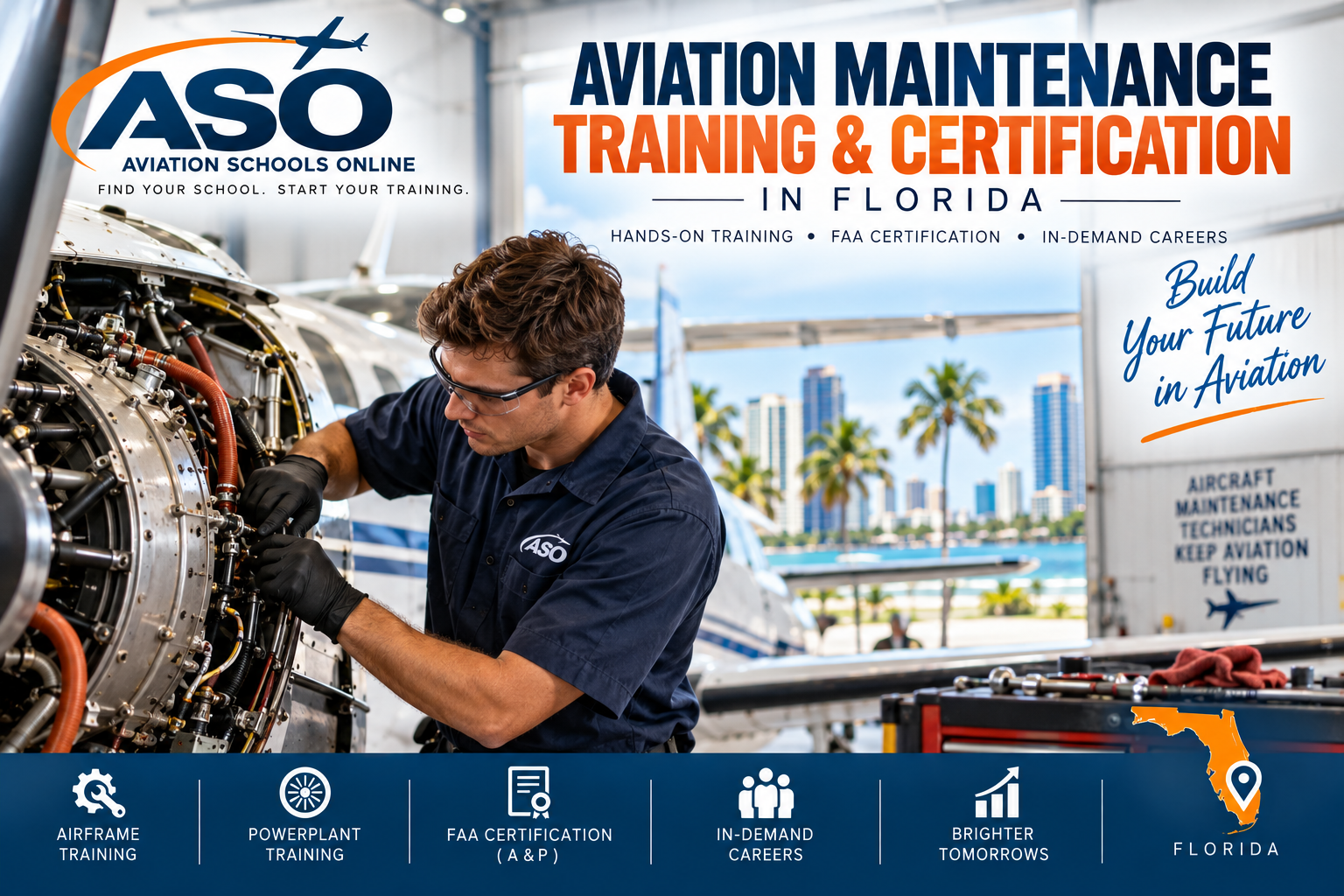
Find Aircraft Mechanic and A&P Schools in Florida
Florida is one of the most active aviation states in the country, making it an excellent place to begin training for a career in aircraft maintenance, aviation mechanics, avionics, and aerospace technology.
From major airline hubs and international airports to general aviation facilities, corporate aircraft operations, repair stations, flight schools, and aerospace companies, Florida supports a broad aviation ecosystem that depends on qualified maintenance professionals.
If you enjoy working with your hands, solving mechanical problems, understanding how aircraft systems operate, and want to pursue an aviation career without becoming a pilot, aviation maintenance training in Florida could be your path into the industry.
Aviation Schools Online (ASO) can help prospective students find and compare aviation maintenance schools, A&P programs, avionics training, and FAA-certificated Aviation Maintenance Technician Schools throughout Florida.
What Is an Aviation Maintenance Technician?
An Aviation Maintenance Technician (AMT)—often called an aircraft mechanic—helps inspect, maintain, troubleshoot, repair, and return aircraft and aircraft systems to service.
Aircraft maintenance professionals may work on everything from small training airplanes and business jets to helicopters, commercial airliners, cargo aircraft, and advanced aerospace equipment.
Typical responsibilities can include:
-
Inspecting aircraft structures and systems
-
Troubleshooting mechanical or electrical problems
-
Repairing or replacing aircraft components
-
Maintaining engines and propulsion systems
-
Inspecting brakes, landing gear, flight controls, and hydraulics
-
Testing aircraft systems and equipment
-
Reading technical manuals and maintenance documentation
-
Performing required inspections
-
Recording completed maintenance
-
Helping ensure aircraft meet applicable safety requirements
The U.S. Bureau of Labor Statistics describes aircraft mechanics as professionals who diagnose mechanical or electrical problems, repair aircraft components, inspect replacement parts, test aircraft systems, perform inspections, and maintain repair records. (Bureau of Labor Statistics)
For students who prefer technical, hands-on work, aircraft maintenance can provide a direct route into professional aviation.
What Is an A&P Certificate?
One of the most important credentials in U.S. aircraft maintenance is the FAA Aviation Mechanic Certificate.
The FAA issues two mechanic ratings:
Airframe — A
The Airframe rating focuses primarily on the aircraft itself and its associated structures and systems.
Training may include areas such as:
-
Aircraft structures
-
Sheet metal
-
Composite materials
-
Hydraulics
-
Pneumatics
-
Landing gear
-
Flight controls
-
Electrical systems
-
Cabin systems
-
Inspection procedures
Powerplant — P
The Powerplant rating focuses primarily on aircraft engines and associated systems.
Training may include:
-
Reciprocating engines
-
Turbine engines
-
Engine inspection
-
Fuel systems
-
Ignition systems
-
Lubrication systems
-
Cooling systems
-
Propellers
-
Engine instruments
-
Engine troubleshooting
Airframe + Powerplant = A&P
When a mechanic holds both ratings, the credential is commonly called an:
A&P Certificate
The FAA officially issues one Aviation Mechanic certificate with an Airframe rating, Powerplant rating, or both ratings. Holding both is commonly referred to as having an A&P Certificate. (FAA)
For students pursuing long-term careers in aircraft maintenance, earning both ratings can significantly broaden the types of maintenance work they may be qualified to perform.
How to Become an Aircraft Mechanic in Florida
There are several steps on the path toward becoming an FAA-certificated aircraft mechanic.
Step 1: Choose Your Training Path
The FAA recognizes two primary ways to obtain the training and experience necessary to qualify for an Aviation Mechanic certificate:
Option 1: Attend an FAA-Certificated Aviation Maintenance Technician School
These schools are commonly referred to as:
AMTS programs
or
FAA Part 147 schools.
Aviation Maintenance Technician Schools are certificated by the FAA under 14 CFR Part 147. They provide organized training specifically designed for prospective aircraft mechanics. (FAA)
For many students starting their aviation careers, this is the most straightforward route.
According to the FAA, most Part 147 programs take approximately 18 to 24 months to complete, depending on the ratings pursued and individual school's curriculum. (FAA)
Option 2: Gain Qualifying Practical Experience
Another pathway involves gaining qualifying practical maintenance experience.
FAA requirements generally call for at least:
18 months of practical experience for either the Airframe or Powerplant rating
or
30 months of concurrent practical experience covering both Airframe and Powerplant duties.
The experience must involve appropriate procedures, practices, materials, tools, machines, and equipment used in constructing, maintaining, or altering aircraft or engines. (FAA)
Students pursuing this route should maintain thorough records documenting their experience.
FAA Requirements for an Aviation Mechanic Certificate
Applicants seeking an FAA Aviation Mechanic certificate generally must:
-
Be at least 18 years old
-
Be able to read, write, speak, and understand English, subject to applicable FAA exceptions
-
Meet the applicable training or practical-experience requirements
-
Pass the required FAA testing for the rating or ratings being pursued
Students who successfully graduate from an FAA-certificated Aviation Maintenance Technician School may use their graduation credentials to establish eligibility to take the applicable mechanic examinations, provided they satisfy the other FAA requirements. (FAA)
FAA Aircraft Mechanic Testing
After becoming eligible, applicants must complete the applicable FAA testing process.
Depending on the rating pursued, testing includes applicable:
Knowledge Tests
These evaluate the applicant's technical knowledge.
Oral Examination
A Designated Mechanic Examiner evaluates the applicant's understanding of aviation maintenance topics.
Practical Examination
Applicants must demonstrate required maintenance skills and procedures.
FAA practical test standards exist for:
-
Aviation Mechanic General
-
Aviation Mechanic Airframe
-
Aviation Mechanic Powerplant
The FAA's mechanic testing standards were updated as recently as June 3, 2026, reinforcing the importance of using current training materials when preparing for certification. (FAA)
Applicants must complete the prescribed testing requirements within the FAA's applicable timeframe. (FAA)
Why Study Aviation Maintenance in Florida?
Florida provides an unusually broad aviation environment for maintenance students.
Across the state, aviation activity includes:
-
Major commercial airlines
-
International airports
-
Regional airports
-
General aviation airports
-
Business aviation
-
Charter operations
-
Aircraft repair stations
-
Fixed-base operators
-
Helicopter operators
-
Flight schools
-
Aircraft manufacturers and suppliers
-
Cargo aviation
-
Government aviation
-
Aerospace organizations
-
Space-related industries
That diversity can expose students to many different parts of the aviation industry.
Florida's aviation activity is particularly concentrated around areas such as:
Miami • Fort Lauderdale • West Palm Beach • Orlando • Tampa • Jacksonville • Daytona Beach • Melbourne • Lakeland • Pensacola • Fort Myers • Sarasota
Students should not assume that the closest school is automatically the best fit. Compare programs according to certification, training equipment, facilities, completion rates, costs, scheduling, and career objectives.
Florida Aircraft Mechanic Career Opportunities
Aircraft maintenance professionals may work in many different sectors.
Potential employers can include:
-
Commercial airlines
-
Regional airlines
-
Aircraft maintenance facilities
-
FAA repair stations
-
Business aviation operators
-
Corporate flight departments
-
Aircraft manufacturers
-
Engine manufacturers
-
Cargo carriers
-
Fixed-base operators
-
Helicopter operators
-
Flight schools
-
Government agencies
-
Defense contractors
-
Aerospace companies
Some technicians specialize in one type of aircraft or system, while others build broad experience across several categories of aircraft.
Aviation Maintenance Career Outlook
Demand for qualified aircraft maintenance professionals remains significant.
According to the latest Bureau of Labor Statistics Occupational Outlook Handbook, published in 2026, overall employment of aircraft and avionics equipment mechanics and technicians is projected to grow 6% from 2025 through 2035, faster than the projected 3% average for all occupations. (Bureau of Labor Statistics)
The BLS projects approximately:
13,100 aircraft and avionics technician openings each year
on average during that period.
Those openings are expected to result from both industry growth and the need to replace workers who retire or leave the occupation. (Bureau of Labor Statistics)
Aircraft systems are also becoming increasingly sophisticated, which continues to increase the value of technicians with strong mechanical, electrical, digital, and avionics skills.
How Much Can Aircraft Mechanics Earn?
Compensation varies considerably according to experience, employer, location, certification, specialization, shift schedule, overtime, union agreements, and type of aircraft.
According to the latest 2026 BLS occupational data:
Aircraft mechanics and service technicians:
Median annual wage: $79,870
Avionics technicians:
Median annual wage: $82,280
The broader aircraft and avionics mechanic and technician category had a median annual wage of approximately $80,180 in May 2025. (Bureau of Labor Statistics)
Aircraft mechanic earnings can be considerably higher in certain industries.
For example, the BLS reported a median annual wage of approximately $96,170 for aircraft mechanics working in air transportation in May 2025. (Bureau of Labor Statistics)
Actual Florida wages can differ significantly by employer, experience level, metropolitan area, certifications, overtime opportunities, and specialization.
Students should view salary statistics as career-planning information—not guaranteed starting salaries.
What Do You Learn in an A&P Program?
Curriculum varies by school, but aviation maintenance students may receive training in topics such as:
General Aviation Maintenance
-
Aviation regulations
-
Mathematics
-
Physics
-
Maintenance publications
-
Technical drawings
-
Aircraft weight and balance
-
Ground operations
-
Materials and processes
-
Corrosion control
-
Maintenance documentation
Airframe Systems
-
Aircraft structures
-
Sheet metal repair
-
Welding
-
Composite structures
-
Hydraulic systems
-
Pneumatic systems
-
Landing gear
-
Aircraft electrical systems
-
Cabin systems
-
Flight controls
-
Aircraft inspections
Powerplant Systems
-
Reciprocating engines
-
Turbine engines
-
Fuel systems
-
Ignition systems
-
Engine electrical systems
-
Lubrication
-
Engine cooling
-
Propellers
-
Engine instruments
-
Engine troubleshooting
The objective is not simply to memorize how an aircraft works.
Good maintenance education teaches students how to inspect, troubleshoot, repair, document, and safely evaluate aircraft systems.
Avionics Training in Florida
Modern aircraft depend heavily on sophisticated electronics.
Students interested in technology may want to investigate programs that include avionics training.
Avionics technicians may work with systems such as:
-
Aircraft navigation
-
Communication equipment
-
GPS systems
-
Radar
-
Electronic flight displays
-
Autopilot systems
-
Aircraft electrical systems
-
Flight management systems
-
Weather systems
-
Sensors and instrumentation
The BLS projects employment for avionics technicians to grow approximately 9% between 2025 and 2035, faster than the projection for aircraft mechanics overall. (Bureau of Labor Statistics)
FAA guidance notes that there is not a separate FAA mechanic certificate specifically required solely to perform avionics work. However, the privileges under which maintenance is performed and approved for return to service are governed by applicable FAA certification rules, and employers commonly establish additional qualification requirements for avionics positions. (FAA)
For students interested in the intersection of aircraft maintenance and electronics, avionics can be an attractive specialization.
Aircraft Mechanic vs. Avionics Technician
These careers overlap, but their primary focus can differ.
Aircraft Mechanic
Typically works extensively with:
-
Aircraft structures
-
Engines
-
Hydraulics
-
Flight controls
-
Landing gear
-
Mechanical systems
-
Aircraft inspections
Avionics Technician
Typically focuses more heavily on:
-
Electrical systems
-
Electronic instruments
-
Navigation equipment
-
Communication systems
-
Flight computers
-
Sensors
-
Digital avionics
Some professionals build skills in both areas.
A&P School vs. College Aviation Maintenance Program
Students may encounter several types of programs when searching for aircraft mechanic training in Florida.
These may include:
FAA Part 147 Aviation Maintenance Technician Schools
Programs specifically certificated by the FAA to provide aviation maintenance training.
Technical Colleges
Some technical colleges operate FAA-approved aviation maintenance programs.
Community Colleges
Certain colleges combine A&P training with an associate degree.
Aviation Universities
Some institutions combine maintenance training with broader aviation, engineering, business, or aerospace education.
Your best choice depends on your career goals.
If your primary goal is to obtain the qualifications needed to pursue FAA mechanic certification as efficiently as possible, an AMTS program may be appealing.
If you also want a college degree, investigate programs combining maintenance training with an associate or bachelor's degree.
How Long Is Aircraft Mechanic School?
According to the FAA, most Aviation Maintenance Technician Schools estimate approximately:
18–24 months
for completion, depending on which ratings are pursued and the specific school's program. (FAA)
Program schedules may include:
-
Day classes
-
Evening classes
-
Full-time training
-
Accelerated schedules
Before enrolling, ask the school about its actual program duration and weekly time commitment.
How Much Does A&P School Cost in Florida?
There is no single Florida A&P school price.
Your total education cost can depend on:
-
Tuition
-
Tools
-
Books
-
Lab fees
-
Uniforms
-
Testing fees
-
FAA examination expenses
-
Housing
-
Transportation
-
Living expenses
-
Financial-aid eligibility
When comparing schools, avoid looking only at advertised tuition.
Instead ask:
“What is the estimated total cost from enrollment through FAA certification?”
That provides a much more useful comparison.
Financial Aid and Aviation Maintenance Training
Depending on the institution and student's eligibility, financial assistance may include:
-
Federal financial aid
-
Student loans
-
Scholarships
-
School payment plans
-
Employer-sponsored programs
-
Workforce-development programs
-
Military education benefits
-
Veterans education benefits
Availability varies by school and student.
Students interested in veterans benefits should verify the individual program directly through the appropriate VA and school resources rather than assuming that every aviation maintenance program qualifies.
Choosing an Aviation Maintenance School in Florida
Choosing the right school can affect your training experience and your preparation for FAA certification.
Before enrolling, ask:
Is the program an FAA-certificated Aviation Maintenance Technician School?
Confirm the school's current FAA status when applicable.
Does the school offer both Airframe and Powerplant training?
If your goal is an A&P Certificate, make sure the program supports both ratings.
What equipment will I train on?
Ask whether students receive hands-on experience with:
-
Aircraft
-
Reciprocating engines
-
Turbine engines
-
Electrical systems
-
Hydraulic systems
-
Sheet metal
-
Composite materials
-
Avionics equipment
How much hands-on training is included?
Aircraft maintenance is a practical occupation. Training should go beyond classroom instruction.
What are the FAA testing results?
Ask about student outcomes and certification success.
What does the program actually cost?
Request an itemized estimate.
Does the school offer career assistance?
Career services might include:
-
Resume preparation
-
Employer recruiting events
-
Interview preparation
-
Job placement assistance
-
Industry partnerships
Students should understand exactly what services are offered rather than relying solely on employment claims.
Questions to Ask Before Enrolling
Before choosing a Florida aviation maintenance school, consider asking:
-
Is this program currently FAA-certificated under Part 147?
-
Does it prepare students for both Airframe and Powerplant ratings?
-
How long does the program take?
-
What is the full estimated program cost?
-
Are tools included?
-
Are FAA testing costs included?
-
What aircraft and engines will I train on?
-
How much hands-on laboratory training is provided?
-
Are day and evening classes available?
-
Does the school offer avionics training?
-
What financial-aid programs are available?
-
Are scholarships available?
-
Does the school work with local aviation employers?
-
What career services are available?
-
Where are recent graduates working?
Compare answers from several programs before making a decision.
Is Aircraft Maintenance a Good Career?
For the right person, it can be an excellent aviation career path.
Aircraft maintenance may appeal to someone who:
-
Enjoys mechanical work
-
Likes troubleshooting
-
Is detail-oriented
-
Takes safety seriously
-
Enjoys technology
-
Wants a hands-on career
-
Is interested in aircraft
-
Does not necessarily want to become a pilot
-
Wants opportunities throughout the aviation industry
Aircraft maintenance also offers something many occupations cannot:
Your work directly contributes to keeping aircraft safe and operational.
Every flight depends on properly maintained equipment.
Where Can an A&P Mechanic Work?
An FAA-certificated mechanic may eventually pursue opportunities working with:
Airlines • Corporate Aviation • Business Jets • General Aviation • Cargo Aircraft • Helicopters • Flight Schools • Repair Stations • Government Aircraft • Aircraft Manufacturing • Engine Companies • Aerospace Organizations
Experience and additional training can eventually lead to specialized or supervisory positions.
Potential long-term career directions can include:
-
Lead mechanic
-
Crew chief
-
Inspector
-
Quality-control technician
-
Maintenance supervisor
-
Maintenance manager
-
Director of maintenance
-
Technical representative
-
Aircraft maintenance instructor
Individual job requirements differ considerably by employer.
Can A&P Mechanics Work for Airlines?
Yes.
Commercial airlines are major employers of aircraft maintenance professionals.
Large airline operations require technicians to perform scheduled and unscheduled maintenance, troubleshooting, inspections, component replacement, and other tasks required to keep aircraft operating safely.
Competition and hiring qualifications vary among employers, and graduating from an A&P program does not guarantee airline employment.
However, FAA certification combined with technical skills and experience can provide a strong foundation for pursuing airline maintenance positions.
Can You Work on Helicopters With an A&P Certificate?
Aviation maintenance credentials are not limited to airplanes.
Aircraft mechanics may work in helicopter sectors including:
-
Air ambulance
-
Law enforcement
-
Offshore operations
-
Charter
-
Flight training
-
Utility aviation
-
Tourism
-
Corporate aviation
-
Government operations
Specific employers may require experience with particular helicopter types or systems.
Florida's significant helicopter and general aviation activity provides another reason students interested in rotorcraft maintenance may consider training in the state.
Aviation Maintenance Training in Miami and South Florida
South Florida supports one of the most concentrated aviation environments in the state.
Students searching for aviation maintenance programs may investigate training opportunities around:
-
Miami
-
Fort Lauderdale
-
Hollywood
-
Pembroke Pines
-
West Palm Beach
-
Boca Raton
The region includes commercial airports, business aviation, international operators, general aviation airports, repair facilities, and flight-training organizations.
Useful searches include:
A&P schools Miami Florida
aircraft mechanic schools Miami
aviation maintenance schools Fort Lauderdale
A&P training South Florida
Aviation Maintenance Training in Orlando and Central Florida
Central Florida also supports a significant aviation and aerospace industry.
Students may search in areas including:
-
Orlando
-
Kissimmee
-
Sanford
-
Daytona Beach
-
Lakeland
-
Melbourne
-
Titusville
Central Florida's combination of aviation, aerospace, airports, educational institutions, and Florida's Space Coast can make the region attractive to technically minded students.
Useful searches include:
A&P schools Orlando Florida
aircraft mechanic training Orlando
aviation maintenance schools Central Florida
Part 147 schools Orlando
Aviation Maintenance Training in Tampa and West Florida
Students on Florida's Gulf Coast can investigate programs around:
-
Tampa
-
Clearwater
-
St. Petersburg
-
Sarasota
-
Lakeland
-
Fort Myers
Potential aviation employers throughout the region include general aviation facilities, commercial operations, maintenance facilities, charter providers, corporate aviation organizations, and other aviation service companies.
Aviation Maintenance Training in Jacksonville and North Florida
North Florida students may find aviation maintenance opportunities around:
-
Jacksonville
-
Gainesville
-
Tallahassee
-
Pensacola
-
Northeast Florida
-
Northwest Florida
Military aviation also has a substantial presence in parts of northern Florida, which contributes to the state's broader aviation maintenance workforce and technical culture.
Frequently Asked Questions About Aviation Maintenance Training in Florida
How long does it take to become an A&P mechanic in Florida?
FAA-certificated Aviation Maintenance Technician School programs commonly take approximately 18 to 24 months, although actual program length varies. (FAA)
Do I need a college degree to become an aircraft mechanic?
A four-year college degree is not generally required to obtain an FAA Aviation Mechanic certificate. Students can qualify through an FAA-certificated AMTS or qualifying practical experience and must satisfy FAA testing and eligibility requirements. (FAA)
Is A&P the same as aircraft mechanic certification?
The FAA issues an Aviation Mechanic certificate with an Airframe rating, Powerplant rating, or both. Holding both ratings is commonly called an A&P Certificate. (FAA)
Can I get only an Airframe or Powerplant rating?
Yes. The FAA does not require mechanics to hold both ratings. However, many students pursue both because the combination can broaden employment opportunities. (FAA)
How old must I be to earn an A&P Certificate?
Applicants must generally be at least 18 years old to qualify for an FAA Aviation Mechanic certificate. (FAA)
Are aircraft mechanics in demand?
The BLS projects overall aircraft and avionics mechanic and technician employment to grow 6% from 2025 to 2035, with approximately 13,100 openings annually on average. (Bureau of Labor Statistics)
How much do aircraft mechanics make?
The national median annual wage for aircraft mechanics and service technicians was $79,870 in May 2025, while avionics technicians earned a national median of $82,280. Pay varies substantially by employer, location, experience, specialization, and overtime. (Bureau of Labor Statistics)
Do aircraft mechanics have to be pilots?
No. You do not need a pilot certificate to pursue an aviation maintenance career.
Can veterans become aircraft mechanics?
Yes. Military aviation maintenance experience may help some applicants establish eligibility, and the FAA also recognizes the Joint Service Aviation Maintenance Technician Certification Council training pathway for qualifying military personnel. (FAA)
Find Aviation Maintenance Schools in Florida
Choosing an aviation maintenance program is an important first step toward a technical aviation career.
Aviation Schools Online has been helping future aviation professionals connect with schools and training providers since 2001.
Use ASO to research and compare:
-
Aviation Maintenance Technician Schools
-
FAA Part 147 schools
-
A&P mechanic programs
-
Airframe training
-
Powerplant training
-
Avionics programs
-
Aircraft maintenance programs
-
Aviation technical colleges
-
Aerospace training programs
Whether your goal is to work with airliners, business jets, helicopters, general aviation aircraft, avionics, engines, or advanced aerospace systems, the right education can help you begin building your aviation future.
Start Your Aviation Maintenance Career in Florida
Find Aviation Maintenance Training in Florida with Aviation Schools Online.