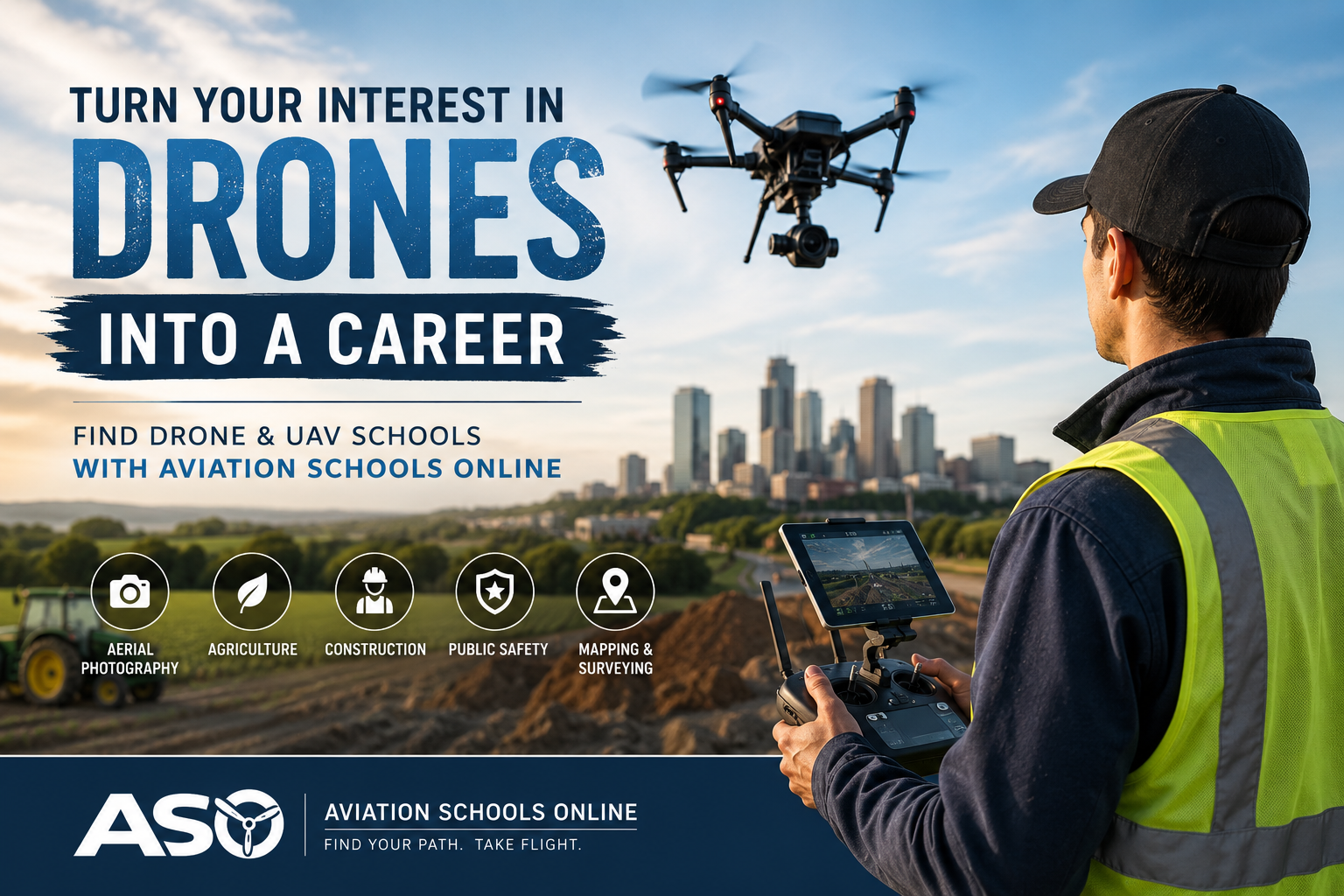
Turn Your Interest in Drones Into a Career: Find Drone & UAV Schools with Aviation Schools Online
Flying a drone can be fun.
Learning how to use one professionally can open the door to something much bigger.
Drones and unmanned aircraft systems—commonly called UAVs or UAS—are now used for photography, construction, mapping, surveying, agriculture, inspections, public safety, emergency response, real estate, infrastructure, utilities, and many other applications.
That means learning to operate a drone can be more than a hobby.
It can become a professional skill.
If you're wondering where to begin, Aviation Schools Online (ASO) makes it easier to explore Drone and UAV schools, compare training options, and connect with programs that match your goals.
Instead of searching for drone schools one at a time, start your search in one place.
Find a Drone/UAV school. Explore your options. Apply through Aviation Schools Online.
Why Learn to Fly Drones Professionally?
Modern drones can do far more than capture impressive aerial video.
Businesses and government agencies increasingly use unmanned aircraft to collect information, inspect assets, document projects, create maps, improve safety, and reach locations that may be difficult, expensive, or dangerous for people to access.
Behind those aircraft are trained operators.
Depending on the industry and job, drone professionals may need to understand:
-
Airspace
-
Weather
-
Aviation regulations
-
Flight planning
-
Aircraft systems
-
Risk management
-
Emergency procedures
-
Cameras and sensors
-
Mapping software
-
Data collection
-
Photogrammetry
-
Thermal imaging
-
Inspection procedures
A professional Drone/UAV school can help you move beyond simply knowing how to make a drone take off and land.
What Is a Drone/UAV School?
A Drone or UAV school provides education and training related to unmanned aircraft operations.
Programs vary significantly.
Some focus primarily on preparing students for the FAA Part 107 Remote Pilot Certificate knowledge test.
Others provide hands-on flight instruction.
More advanced programs may teach students how to apply drones within specific industries.
Aviation Schools Online currently includes UAV/Drone as one of its major aviation training categories, with student interests including Commercial Drone Programs, Remote Pilot Certification Prep, Pilot training, Advanced Air Mobility Training, and Online Training. (aviationschoolsonline.com)
That makes ASO a natural place to begin comparing your options.
Do You Need an FAA Drone Pilot Certificate?
If you're planning to fly drones commercially in the United States under the FAA's Small UAS Rule—Part 107—you generally need a Remote Pilot Certificate.
The FAA says first-time applicants must be at least 16 years old, be able to read, speak, write, and understand English, be in a physical and mental condition to safely fly a drone, and pass the initial aeronautical knowledge exam. (faa.gov)
Earning the certificate is an important milestone.
But think of Part 107 as a starting point, not necessarily the end of your drone education.
Passing a knowledge test and knowing how to perform specialized commercial drone work are two different things.
That's where additional training can become valuable.
What Can You Learn at a Drone School?
Your training should depend on what you ultimately want to do with drones.
Part 107 Preparation
If you're beginning a commercial drone career in the United States, Part 107 exam preparation may be your first step.
Training can cover subjects such as:
-
FAA regulations
-
Airspace classifications
-
Weather
-
Airport operations
-
Loading and performance
-
Emergency procedures
-
Crew resource management
-
Aeronautical decision-making
Some students choose online test preparation, while others prefer classroom instruction or a program that combines Part 107 preparation with hands-on flight training.
Hands-On Drone Flight Training
Knowing regulations doesn't automatically make someone a skilled drone pilot.
Hands-on training can help you develop practical operating experience.
Depending on the school, students may practice:
-
Preflight inspections
-
Basic flight maneuvers
-
Precision flying
-
Mission planning
-
Emergency procedures
-
Automated flight operations
-
Camera operations
-
Commercial workflows
If practical flying experience is important to you, ask schools exactly how much hands-on flight instruction their program includes.
Drone Mapping and Photogrammetry
Some students want to do more than fly.
They want to turn aerial imagery into useful information.
Drone mapping and photogrammetry programs may introduce students to:
Flight Planning → Image Collection → Data Processing → Orthomosaics → 3D Models → Measurements → Deliverables
These skills can be useful in fields such as construction, surveying, engineering, mining, agriculture, and land management.
Drone Inspection Training
Drones can help inspect locations that are expensive, difficult, or potentially dangerous to access.
Depending on the operator's qualifications and industry requirements, commercial applications can include inspections involving:
-
Roofs
-
Buildings
-
Bridges
-
Towers
-
Solar installations
-
Utilities
-
Industrial facilities
-
Construction sites
-
Infrastructure
Specialized schools may combine drone flight skills with cameras, thermal sensors, data collection, inspection procedures, and industry-specific workflows.
Public Safety Drone Training
Police departments, fire departments, emergency-management organizations, and search-and-rescue teams increasingly use drones as operational tools.
Training may include:
-
Search and rescue
-
Emergency response
-
Scene documentation
-
Situational awareness
-
Thermal imaging
-
Night operations
-
Mission planning
-
Public safety procedures
If public safety is your goal, look for a program specifically designed around those operations rather than choosing training based only on general drone flight.
Aerial Photography and Video
Maybe your interest in drones began with a camera.
Professional aerial photography can support industries including:
Real Estate · Film · Television · Tourism · Marketing · Construction · Events · Commercial Media
Training can help students understand not only how to fly but how to plan shots, operate camera systems, manage exposure, fly smoothly, and produce useful visual content.
Agriculture and Precision Farming
Agriculture is another important application for unmanned aircraft.
Depending on the technology, regulations, and operation, drones can support activities involving:
-
Crop monitoring
-
Field mapping
-
Multispectral imagery
-
Plant-health analysis
-
Livestock monitoring
-
Precision agriculture
-
Agricultural spraying
Specialized agricultural drone operations can involve additional equipment, regulations, and qualifications, so students should seek training appropriate to the specific work they intend to perform.
Thermal Imaging
A standard camera sees visible light.
A thermal sensor can reveal temperature differences.
That capability can make drones useful in areas such as building inspections, energy applications, solar inspections, public safety, and search and rescue.
Thermal imaging is a specialized skill.
Learning to collect an image is only part of the process. Understanding what the data means can require additional education and industry knowledge.
What Drone Career Is Right for You?
Before choosing a school, think about the type of work that interests you.
Ask yourself:
Do I want to fly drones professionally?
Am I interested in photography or video?
Would I rather work with mapping and data?
Am I interested in construction?
Surveying?
Agriculture?
Public safety?
Inspections?
Starting my own drone business?
Your answer can help determine the type of school you should consider.
Someone interested in aerial cinematography may need very different training from someone planning to work with LiDAR or utility inspections.
How to Choose the Right Drone/UAV School
Not every Drone/UAV school offers the same training.
Before applying, compare programs carefully.
Look at the Curriculum
What will you actually learn?
Don't assume a course titled "Professional Drone Training" includes everything you're expecting.
Ask for a detailed curriculum.
Online or Hands-On?
Online education can be an excellent option for regulations, Part 107 preparation, software instruction, and theoretical knowledge.
But if you want practical flight experience, determine whether the school provides hands-on instruction.
Some programs combine both.
Ask About Equipment
What aircraft will you use?
Will you train with professional camera drones?
Mapping platforms?
Thermal cameras?
Multispectral sensors?
Enterprise aircraft?
The answer should match your career objective.
Research the Instructors
Find out who will teach you.
Look for relevant aviation, drone, and industry experience—not simply the ability to operate a drone.
Compare Costs
Don't choose a school based only on the lowest advertised price.
Determine exactly what's included.
Does tuition include:
-
Aircraft use?
-
Flight instruction?
-
Software?
-
Equipment?
-
Study materials?
-
Certification preparation?
-
Exams?
-
Additional flight time?
Compare the total training value rather than one headline price.
College Drone Programs vs. Private Drone Schools
You may have more choices than you realize.
Private drone academies can be attractive for focused, career-specific, or accelerated training.
Colleges and universities may offer UAS certificates, minors, associate degrees, bachelor's programs, or drone courses integrated into aviation, engineering, surveying, agriculture, public safety, or autonomous-systems education.
Online schools can provide flexibility for students who need to train around work or family commitments.
There's no single right option.
The right program depends on what you want to accomplish.
Use Aviation Schools Online to Find Drone/UAV Training
Searching for “drone schools near me” can produce a confusing mix of training companies, recreational businesses, online courses, equipment retailers, and unrelated results.
Aviation Schools Online gives prospective students a more focused place to begin.
ASO's school directory currently includes nearly 2,000 aviation schools and training locations across its broader aviation categories, and students can search by training category, school name, and location. (aviationschoolsonline.com)
For Drone/UAV students, the process is simple:
1. Decide what kind of drone training interests you.
2. Search for Drone/UAV schools and programs.
3. Compare the schools that match your goals.
4. Request information from programs you're interested in.
5. Talk directly with the schools before deciding where to enroll.
Instead of randomly contacting training providers, you can begin with programs already relevant to your aviation interests.
Apply to Drone/UAV Schools Through ASO
Once you're ready to hear from schools, ASO provides a student application designed to connect prospective students with aviation training opportunities.
The current ASO application lets Drone/UAV students select interests including:
-
Commercial Drone Programs
-
Remote Pilot Certification Prep
-
Pilot Training
-
Advanced Air Mobility Training
-
Online Training (aviationschoolsonline.com)
You can also indicate when you're interested in starting school and whether you're willing to relocate.
That information helps identify the type of training you're actually looking for.
Apply for Drone/UAV Training Through Aviation Schools Online
Questions to Ask Before Enrolling in a Drone School
Finding a school is only the first step.
Before paying tuition, ask:
-
What specific drone skills will I learn?
-
Does the program include Part 107 preparation if I need it?
-
How much hands-on flight training is included?
-
What drones and sensors will I use?
-
Does the program teach commercial applications?
-
Do you teach mapping, inspection, thermal imaging, photography, or other specialties?
-
What experience do the instructors have?
-
What is the total cost?
-
What additional expenses should I expect?
-
Is the training online, in person, or hybrid?
-
What certificate or credential do I receive?
-
What careers is the program designed to prepare me for?
-
Does the school provide career or business-development support?
A good school should be willing to explain what its training can—and cannot—do for you.
You Don't Have to Know Your Entire Career Path Yet
Maybe you bought your first drone because flying looked fun.
Maybe you've seen drone operators working at construction sites.
Perhaps you're a photographer who wants to add aerial services.
You might work in public safety and want to develop UAS skills.
Or maybe you're simply fascinated by where unmanned aviation is heading.
You don't need to have everything figured out before you start exploring.
Education can help you discover which part of the industry interests you most.
The important thing is to begin with credible information and compare your options.
Your Drone Career Could Start Here
The future of aviation isn't limited to airplanes and helicopters.
Some of the industry's most interesting opportunities are happening with aircraft that don't have anyone sitting inside them.
Those aircraft still need skilled people.
They need pilots.
Mission planners.
Technicians.
Data specialists.
Photographers.
Mapping professionals.
Inspectors.
Public safety operators.
UAS program managers.
And entrepreneurs who can find entirely new ways to use unmanned aircraft.
The first step toward becoming one of them could be finding the right training.
Find and Apply to Drone/UAV Schools Today
Aviation Schools Online helps aspiring aviation professionals discover training opportunities and connect with schools.
If you're interested in drones, don't stop at watching videos or flying recreationally.
Find out where professional training could take you.
Explore Drone/UAV schools.
Compare training programs.
Request information.
Apply through Aviation Schools Online.
Your interest in drones could become a skill.
That skill could become an opportunity.
And that opportunity could become a career.