Flying in Colorado
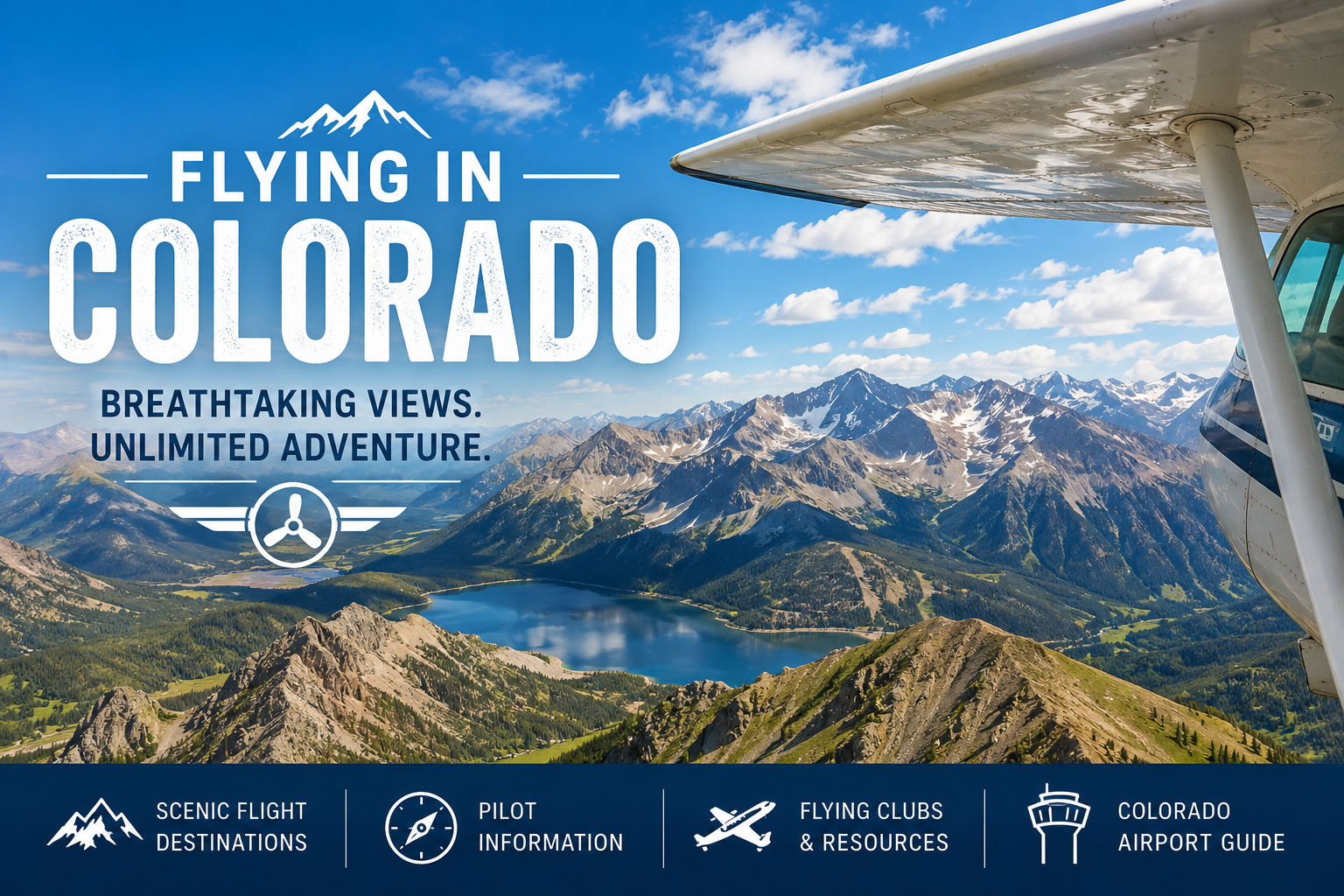
Learn to Fly in Colorado
Flying in Colorado offers student pilots and experienced aviators one of the most challenging and rewarding aviation environments in the United States. With busy metropolitan airspace along the Front Range, high-elevation airports, the Rocky Mountains, rapidly changing weather, and extensive general aviation activity, Colorado provides pilots with opportunities to develop skills that can be valuable throughout an aviation career.
Whether your goal is earning a Private Pilot License, Instrument Rating, Commercial Pilot License, Certified Flight Instructor certificate, or preparing for a professional pilot career, Colorado offers flight schools and aviation training opportunities throughout the state.
Colorado is particularly well known for high-altitude and mountain flying. Pilots operating in the state must understand density altitude, aircraft performance, mountain weather, terrain, winds, and rapidly changing conditions.
For students who receive appropriate instruction, learning to fly in Colorado can provide experience in an unusually diverse aviation environment.
Why Learn to Fly in Colorado?
Colorado offers several advantages for prospective pilots.
The state experiences many sunny days throughout the year, while its geography and four-season climate expose pilots to a wide range of operating conditions.
Students training in Colorado may gain experience with:
- High-altitude airport operations
- Mountain flying
- High-density-altitude conditions
- Controlled and uncontrolled airports
- Busy metropolitan airspace
- Cross-country flying
- Mountain weather
- Winter flight operations
- Strong winds and turbulence
- Complex terrain
- High-elevation airports
- Rapidly changing weather conditions
This combination can help pilots develop aircraft performance knowledge, situational awareness, weather interpretation, and aeronautical decision-making skills.
Flight Training in Colorado
Colorado has a substantial flight training community serving recreational pilots and students preparing for professional aviation careers.
Training programs may include:
- Private Pilot License (PPL)
- Instrument Rating
- Commercial Pilot License (CPL)
- Multi-Engine Rating
- Certified Flight Instructor (CFI)
- Certified Flight Instructor – Instrument (CFII)
- Multi-Engine Instructor (MEI)
- Airline Career Training
- Accelerated Flight Training
- Mountain Flying Training
- High-Altitude Training
- Tailwheel Training
- Discovery Flights
Students should compare flight schools carefully because aircraft availability, instructor experience, scheduling, training structure, financing options, and total program costs can vary considerably.
Aviation Schools Online helps prospective students find and compare flight schools in Colorado based on location, training goals, budget, and career plans.
Where Can You Learn to Fly in Colorado?
Flight training opportunities are available throughout Colorado, with a particularly large concentration along the Front Range.
Denver and the Front Range
The Denver metropolitan region is Colorado’s largest aviation market.
Denver International Airport is the state’s primary commercial airport and one of the busiest airports in the United States.
Most general aviation flight training takes place at surrounding airports, providing students access to a busy metropolitan aviation environment without conducting every training flight from a major airline hub.
Students training along the Front Range can gain experience with air traffic control, complex airspace, high-density-altitude operations, mountain weather, and significant general aviation traffic.
Centennial Airport
Centennial Airport is one of Colorado’s most active general aviation airports and an important center for flight training, corporate aviation, charter operations, aircraft maintenance, and FBO services.
Its location southeast of Denver provides convenient access to both metropolitan airspace and training areas along the Front Range.
Students operating from a busy airport such as Centennial can develop experience communicating with air traffic control and operating around a wide range of aircraft.
Rocky Mountain Metropolitan Airport
Rocky Mountain Metropolitan Airport serves the Denver-Boulder region and supports flight training, corporate aviation, maintenance, and other general aviation activities.
Its location near the foothills provides pilots with immediate visual exposure to the transition between Colorado’s plains and mountain terrain.
Northern Colorado Regional Airport
Northern Colorado Regional Airport serves the Fort Collins-Loveland area and supports general aviation, business aviation, flight training, and other aviation services.
Northern Colorado’s growing population and aviation community provide additional opportunities for student and professional pilots.
Colorado Springs
Colorado Springs has a strong civilian and military aviation presence.
Colorado Springs Airport supports commercial and general aviation activity, while the surrounding region includes flight schools, military aviation facilities, aerospace organizations, and aviation businesses.
Pilots training in the area gain experience operating near significant terrain and within an active aviation environment.
Pueblo
Pueblo Memorial Airport serves commercial and general aviation operations in Southern Colorado.
The region’s location east of the Rocky Mountains provides access to both plains and mountain flying environments.
Grand Junction and Western Colorado
Grand Junction Regional Airport is an important aviation center for Western Colorado.
Flying in this region differs significantly from operating along the Front Range.
Pilots encounter high desert, plateaus, canyons, mountainous terrain, and large areas with relatively few airports.
Careful weather analysis, fuel planning, terrain awareness, and aircraft performance calculations are especially important when flying across Western Colorado.
Mountain Flying in Colorado
Mountain flying is one of the defining characteristics of aviation in Colorado.
The Rocky Mountains contain numerous peaks exceeding 14,000 feet, and much of the state is located at elevations that would be considered mountainous in most other parts of the country.
Flying safely in this environment requires specialized knowledge.
Pilots should understand:
- Mountain winds
- Updrafts and downdrafts
- Mountain waves
- Rotor turbulence
- Ridge crossing techniques
- Canyon flying considerations
- Escape routes
- Terrain clearance
- Weather changes
- Aircraft performance
- Density altitude
- Emergency planning
Student pilots and pilots without mountain experience should receive appropriate mountain-flying instruction before attempting flights across unfamiliar high terrain.
Density Altitude in Colorado
Density altitude is one of the most important considerations when flying in Colorado.
Many airports in the state are located thousands of feet above sea level.
Denver itself is known as the Mile High City, and numerous Colorado airports are significantly higher.
During warm summer weather, the effective density altitude can climb thousands of feet above an airport’s actual elevation.
High density altitude reduces aircraft performance and can result in:
- Longer takeoff rolls
- Reduced climb performance
- Reduced engine performance
- Reduced propeller efficiency
- Reduced aerodynamic performance
The difference can be dramatic.
An aircraft that performs comfortably from a lower-elevation airport may require substantially more runway and climb much more slowly when departing a Colorado airport on a hot afternoon.
Pilots should calculate aircraft performance before departure and consider aircraft weight, runway length, terrain, temperature, and wind.
High-Elevation Airports in Colorado
Colorado is home to some of the highest-elevation airports in North America.
Operating from these airports requires careful planning and an understanding of aircraft performance.
High-altitude airports may present combinations of:
- Reduced aircraft performance
- Mountain terrain
- Shorter runways
- Strong winds
- Turbulence
- Rapid weather changes
- Limited emergency landing options
Pilots unfamiliar with high-elevation operations should obtain appropriate instruction before operating into demanding mountain airports.
Flying Across the Rocky Mountains
Crossing the Rocky Mountains requires significantly more planning than a typical cross-country flight over lower terrain.
A direct line between two airports may not be the safest route.
Pilots may need to consider mountain passes, terrain elevation, winds aloft, cloud cover, turbulence, aircraft performance, oxygen requirements, and emergency landing options.
Safe mountain crossings often depend on choosing an appropriate route rather than simply selecting the shortest distance.
Pilots should also maintain conservative margins and be prepared to turn around if conditions deteriorate.
Colorado Weather and Flying Conditions
Colorado weather can change rapidly.
The state’s elevation and terrain create local weather patterns that can differ substantially across relatively short distances.
Summer Flying
Colorado summers can provide many excellent flying days, but pilots must remain aware of high density altitude and afternoon thunderstorms.
Convective activity can develop rapidly over mountainous terrain.
Thunderstorms can produce:
- Severe turbulence
- Lightning
- Hail
- Heavy precipitation
- Strong downdrafts
- Gust fronts
- Rapidly changing winds
Mountain flying is often best planned earlier in the day when conditions permit, before afternoon heating increases turbulence and thunderstorm potential.
Winter Flying
Winter brings a different set of challenges.
Colorado pilots may encounter:
- Snow
- Ice
- Freezing temperatures
- Reduced visibility
- Mountain obscuration
- Strong winds
- Icing conditions
- Contaminated runways
Winter weather can vary dramatically between the eastern plains, Front Range, mountain regions, and Western Slope.
Wind and Mountain Waves
Strong winds interacting with the Rocky Mountains can produce powerful mountain waves.
Mountain-wave conditions may create severe turbulence, rotor activity, strong updrafts, and strong downdrafts.
Pilots should understand how winds aloft interact with mountain terrain and recognize when conditions exceed their experience or aircraft capabilities.
Oxygen Considerations When Flying in Colorado
Colorado’s high terrain makes supplemental oxygen an important consideration.
Federal aviation regulations establish requirements for supplemental oxygen at certain cabin pressure altitudes and flight durations.
However, pilots may experience the effects of reduced oxygen availability before reaching regulatory limits.
Hypoxia can impair:
- Judgment
- Vision
- Reaction time
- Decision-making
- Coordination
Pilots planning extended operations at higher altitudes should understand both FAA oxygen requirements and the physiological effects of altitude.
Cross-Country Flying in Colorado
Colorado provides excellent opportunities for pilots developing cross-country experience.
Flights can connect Denver-area airports with Colorado Springs, Pueblo, Fort Collins, Grand Junction, and numerous smaller airports.
Longer flights can extend into Wyoming, Utah, New Mexico, Kansas, Nebraska, and other surrounding states.
Cross-country flying helps students develop skills involving:
- Flight planning
- Navigation
- Fuel management
- Weather analysis
- Airspace awareness
- Aircraft performance
- Terrain avoidance
- Diversion planning
- Airport selection
- Aeronautical decision-making
Routes through mountainous regions require significantly different planning from flights over Colorado’s eastern plains.
Flying in Western Colorado
Western Colorado provides a particularly dramatic aviation environment.
Pilots may encounter mountains, mesas, valleys, canyons, high desert, and large remote areas.
Airports can be separated by significant terrain, making fuel planning and alternate airport selection particularly important.
Pilots should carefully consider emergency landing options and survival equipment when operating across remote areas.
Remote Flying and Survival Planning
Colorado’s mountain and remote terrain means pilots should consider what would happen following an emergency landing.
Depending on the route and season, appropriate survival equipment may include:
- Water
- Food
- First-aid supplies
- Warm clothing
- Emergency blankets
- Fire-starting equipment
- Signaling equipment
- Satellite communication equipment
- Personal locator beacon
- Basic survival supplies
Winter conditions make survival planning especially important.
An emergency landing in mountainous terrain can leave occupants exposed to cold temperatures and far from roads or cellular service.
Instrument Training in Colorado
Colorado provides a valuable environment for pilots pursuing an Instrument Rating.
Mountainous terrain makes IFR flight planning particularly important.
Instrument students learn to understand:
- IFR departure procedures
- Instrument approaches
- Minimum en route altitudes
- Minimum obstruction clearance
- Terrain clearance
- Alternate requirements
- Icing conditions
- Weather interpretation
- Air traffic control procedures
An Instrument Rating can be particularly valuable for pilots pursuing professional aviation careers.
However, instrument privileges do not eliminate the hazards associated with thunderstorms, icing, mountain waves, high terrain, or aircraft performance limitations.
Commercial Pilot Training in Colorado
Students pursuing professional aviation careers may continue from private and instrument training into a Commercial Pilot License.
Commercial training develops greater aircraft proficiency while preparing pilots for professional aviation operations.
After earning a commercial certificate, many pilots become flight instructors and begin building experience toward careers in:
- Airlines
- Charter Aviation
- Corporate Aviation
- Cargo Operations
- Air Ambulance
- Aerial Survey
- Government Aviation
- Flight Training
Colorado’s varied aviation environment can provide valuable experience for pilots preparing for professional careers.
How Much Does Flight Training Cost in Colorado?
The cost of learning to fly in Colorado depends on the certificate or rating, aircraft used, flight school’s hourly rates, instructor costs, student proficiency, and frequency of training.
Students should compare the estimated total cost of completing a certificate or rating rather than simply comparing aircraft rental rates.
Expenses may include:
- Aircraft rental
- Flight instruction
- Ground instruction
- Training materials
- FAA knowledge tests
- Medical certification
- Checkride fees
- Aircraft rental for the checkride
- Headset and pilot equipment
Training consistently can sometimes reduce the overall cost because students spend less time reviewing skills between lessons.
Choosing a Flight School in Colorado
Choosing the right flight school is an important part of becoming a pilot.
Prospective students should compare:
- Aircraft availability
- Instructor availability
- Aircraft condition
- Safety practices
- Training structure
- Part 61 versus Part 141 programs
- Training costs
- Financing options
- Career pathways
- Simulator availability
- Maintenance practices
- Graduate outcomes
In Colorado, students should also consider an instructor’s experience with high-density-altitude and mountain operations.
Students planning to fly regularly in the Rockies may benefit from receiving dedicated mountain-flying instruction beyond the minimum requirements for a pilot certificate.
Part 61 vs. Part 141 Flight Schools in Colorado
Flight training can generally be conducted under either FAA Part 61 or Part 141 regulations.
Part 61 flight training can provide greater scheduling flexibility and may appeal to recreational students or professionals training around work and family commitments.
Part 141 flight schools operate FAA-approved structured training programs and may appeal to students pursuing professional aviation careers or attending qualifying aviation colleges.
Neither option is automatically better for every student.
The right choice depends on your career goals, schedule, budget, learning style, and training timeline.
From Student Pilot to Aviation Career
Learning to fly in Colorado can be the beginning of a much larger aviation career.
Professional pilot pathways may include:
- Flight Instructor
- Charter Pilot
- Corporate Pilot
- Cargo Pilot
- Air Ambulance Pilot
- Aerial Survey Pilot
- Regional Airline Pilot
- Major Airline Pilot
- Government Pilot
Pilots can also transition into aviation management, airport operations, safety, training, recruiting, aircraft sales, and other aviation careers.
Find Flight Schools in Colorado
If you’re ready to begin flight training, Aviation Schools Online can help you research and compare flight schools in Colorado.
Whether your goal is taking your first discovery flight, earning a Private Pilot License, adding an Instrument Rating, becoming a Commercial Pilot, receiving mountain-flying instruction, or preparing for an airline career, finding the right training program is an important first step.
Search flight schools in Colorado with Aviation Schools Online and connect with aviation training providers that match your goals, location, budget, and career plans.
Flight schools and aviation training providers can also list their programs with Aviation Schools Online to connect with prospective students actively researching flight training.