High-Wing vs. Low-Wing Airplanes: Which Is Better for Pilot Training?
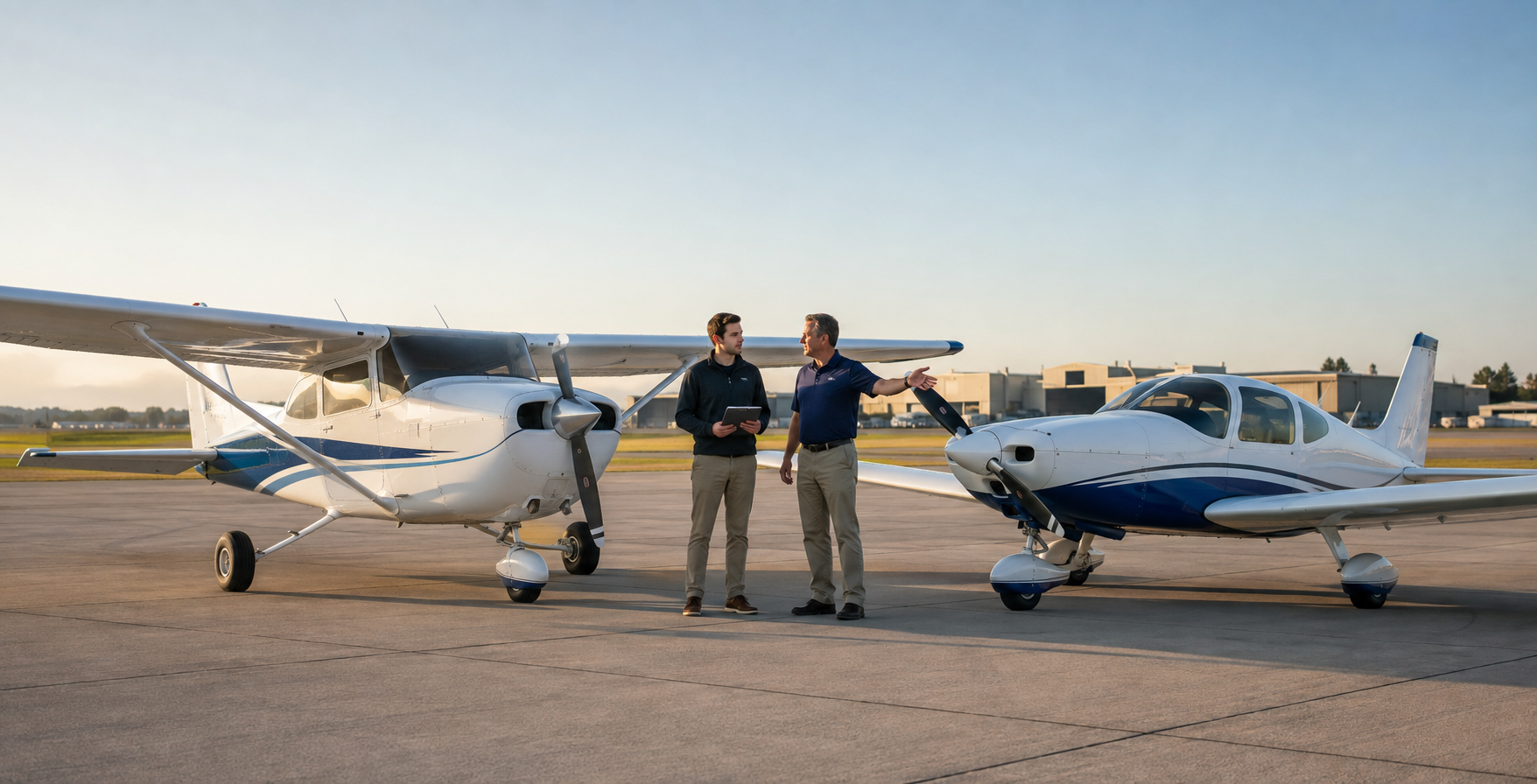
One of the first choices a new student pilot may encounter is whether to learn in a high-wing or low-wing airplane.
High-wing trainers, such as many Cessna models, have their wings mounted above the cabin. Low-wing trainers, including many Piper and Diamond aircraft, have their wings mounted below the cabin.
Both designs are widely used for private pilot training, and both can provide an excellent foundation for an aviation career or recreational flying. The best option usually depends less on wing placement and more on aircraft availability, instructor quality, operating cost, maintenance, cockpit comfort, and how consistently you can train.
Understanding the practical differences can help you choose a flight school and training aircraft with confidence.
What Is a High-Wing Airplane?
A high-wing airplane has its main wings mounted above the fuselage or passenger cabin.
Common high-wing training aircraft include:
-
Cessna 150
-
Cessna 152
-
Cessna 172
-
Cessna 182
-
Tecnam P2010
-
Various light-sport aircraft
Many high-wing trainers use wing struts for structural support, although some high-wing aircraft have strutless designs.
High-wing airplanes are common at flight schools because they are practical, familiar, and well suited to primary training.
What Is a Low-Wing Airplane?
A low-wing airplane has its wings mounted near the bottom of the fuselage.
Common low-wing training aircraft include:
-
Piper Warrior
-
Piper Archer
-
Piper Cherokee
-
Diamond DA20
-
Diamond DA40
-
Cirrus SR20
-
Various light-sport aircraft
Passengers commonly enter a low-wing airplane by stepping onto part of the wing and then lowering themselves into the cockpit.
Low-wing aircraft are also widely used for private, instrument, commercial, and professional pilot training.
High-Wing vs. Low-Wing: Quick Comparison
| Training consideration | High-wing airplane | Low-wing airplane |
|---|---|---|
| Ground visibility | Generally better directly below the aircraft | Wing can block some downward visibility |
| Upward visibility | Wing can block part of the sky above | Generally offers a more open view above |
| Cabin shade | Wing provides natural shade | Cabin may receive more direct sunlight |
| Entry and exit | Often entered through side doors without climbing onto the wing | Usually requires stepping onto the wing |
| Fuel access | Fuel caps may require a ladder or step | Fuel caps are generally easier to reach |
| Ground clearance | Wings are farther from equipment and obstacles | Wings are closer to the ground |
| Rain protection | Wing can provide some shelter when boarding | Less overhead protection |
| Preflight inspection | Underside of the wing is easy to view | Upper surface of the wing is easy to inspect |
| Ground-reference maneuvers | Good downward visibility can be helpful | Wing may block part of the ground view |
| Training availability | Common at many flight schools | Also widely available, depending on location |
These are general differences. Individual aircraft designs, cockpit layouts, landing gear, windows, doors, engines, and handling characteristics can matter more than wing position alone.
Advantages of Learning in a High-Wing Airplane
Better Downward Visibility
High-wing aircraft generally provide a clear view of the ground below and beside the airplane.
This can be helpful when practicing:
-
Ground-reference maneuvers
-
Turns around a point
-
S-turns across a road
-
Pilotage and visual navigation
-
Aerial sightseeing
-
Locating airports and landmarks
Students can often see ground references without having the wing block as much of the view.
Easier Entry for Many Students
Many high-wing trainers have doors on both sides of the cabin. Students and instructors can often enter without climbing onto the wing.
This may be more comfortable for:
-
Taller students
-
Students with limited mobility
-
Passengers unfamiliar with small aircraft
-
Instructors entering and exiting frequently
Cockpit size and door design still vary significantly between aircraft models.
Shade and Weather Protection
The wing creates shade over the cabin and may help keep the cockpit cooler when the aircraft is parked in direct sunlight.
A high wing can also provide limited protection from rain while students complete preflight tasks or enter the cabin.
Greater Wing Clearance
Because the wings are mounted higher, there is more clearance between the wingtips and the ground.
This can be useful when operating around:
-
Fuel trucks
-
Vehicles
-
Ramp equipment
-
Snowbanks
-
Tall grass
-
Airport signs
Students must still remain aware of wingtip clearance during taxiing and ground handling.
Familiarity and Availability
High-wing Cessna trainers are among the most common flight-school aircraft in the United States.
Widespread availability can make it easier to:
-
Find qualified instructors
-
Rent aircraft after certification
-
Schedule lessons
-
Transition between flight schools
-
Locate replacement aircraft when one is unavailable
A large and dependable fleet can be more important to training progress than whether the aircraft is high-wing or low-wing.
Disadvantages of High-Wing Training Aircraft
Reduced Upward Visibility
The wing can block portions of the view above the airplane.
This makes proper clearing procedures especially important before:
-
Turns
-
Climbs
-
Maneuvers
-
Entering the traffic pattern
-
Changing altitude
Every aircraft has blind spots, and students must learn to move their heads, scan carefully, and maintain traffic awareness.
Fueling Can Require a Ladder
Many high-wing airplanes carry fuel in the wings. Checking fuel quantity, inspecting fuel caps, and refueling may require a ladder or built-in step.
Students should be trained to use appropriate equipment and avoid climbing on unstable surfaces.
Wing Struts Can Block Part of the View
Some high-wing trainers have structural wing struts that create additional blind spots.
Students quickly learn to look around these obstructions, especially when scanning for traffic or entering turns.
Advantages of Learning in a Low-Wing Airplane
Better Upward Visibility
Low-wing aircraft generally provide a more open view of the sky above the airplane.
This can improve visibility during:
-
Turns
-
Traffic scanning
-
Climbs
-
Maneuvering
-
Pattern operations
The low wing still creates its own blind spots below and beside the aircraft.
Easier Access to Fuel Tanks
Fuel caps on low-wing airplanes are generally easier to reach because the wings are closer to the ground.
This can simplify:
-
Visual fuel checks
-
Refueling
-
Fuel-cap inspections
-
Checking tank vents
-
Preflight inspections of the wing’s upper surface
Students may still need to step onto designated wing-walk areas.
Familiarity With Many Career-Training Aircraft
Many aircraft used for advanced and professional training have low-wing configurations.
Learning in a low-wing trainer may provide early familiarity with:
-
Wing-walk entry
-
Floor-mounted fuel selectors
-
Different sight pictures
-
Low-wing fuel systems
-
Cockpit layouts used in advanced aircraft
However, students who begin in a high-wing airplane can transition successfully to low-wing aircraft later.
Boarding From the Wing
Some students enjoy stepping onto the wing and entering through a large cockpit door or canopy.
This configuration can provide a spacious opening, although lowering yourself into the seat may be more difficult for some people.
Disadvantages of Low-Wing Training Aircraft
Reduced Downward Visibility
The wing may obstruct portions of the ground view.
Students may need to adjust their position or gently bank the aircraft when appropriate to see:
-
Ground checkpoints
-
Runways
-
Traffic below
-
Training reference points
This makes effective clearing procedures and situational awareness especially important.
Wings Are Closer to Ground Obstacles
Low wings require careful attention around:
-
Fuel pumps
-
Ramp equipment
-
Vehicles
-
Airport signs
-
Snowbanks
-
Tall vegetation
Students must develop good wingtip awareness during taxiing and ground handling.
Entry May Be More Difficult
Many low-wing airplanes require occupants to step onto the wing before entering the cabin.
This may be less convenient for students with limited mobility or balance concerns. It can also make boarding more challenging in rain, snow, or icy conditions.
Does a High-Wing Airplane Handle Differently?
High-wing and low-wing airplanes can feel different, but wing placement is only one part of aircraft design.
Handling is also affected by:
-
Wing shape
-
Aircraft weight
-
Center of gravity
-
Landing gear configuration
-
Control-system design
-
Engine power
-
Flap design
-
Aerodynamics
-
Cabin width
-
Wind conditions
A student should not assume that every high-wing airplane handles one way and every low-wing airplane handles another.
For example, two high-wing trainers can have noticeably different control forces, stall behavior, performance, and landing characteristics. The same is true of two low-wing aircraft.
The individual aircraft model matters more than the general wing category.
Is One Design Easier to Land?
Neither wing configuration is automatically easier to land.
Landing performance depends on:
-
Aircraft design
-
Pilot technique
-
Approach stability
-
Airspeed control
-
Flap setting
-
Crosswind correction
-
Runway conditions
-
Ground effect
-
Sight picture
Low-wing airplanes may experience ground effect differently because their wings are closer to the surface. High-wing and low-wing aircraft can also have different landing sight pictures.
With proper instruction and consistent practice, students can learn to land either design safely and accurately.
Which Is Better in Crosswinds?
Neither high-wing nor low-wing airplanes are universally better in crosswinds.
Crosswind handling depends on:
-
Maximum demonstrated crosswind component
-
Rudder effectiveness
-
Aileron authority
-
Landing gear geometry
-
Wing loading
-
Aircraft weight
-
Pilot technique
Students should compare the operating handbook and performance characteristics of the specific training aircraft rather than making a decision based only on wing position.
Is a High-Wing Airplane Safer?
A high-wing airplane is not automatically safer than a low-wing airplane, and a low-wing aircraft is not automatically more advanced.
Safety depends much more on:
-
Aircraft maintenance
-
Instructor quality
-
Pilot judgment
-
Weather decisions
-
Training consistency
-
Aircraft condition
-
Operating procedures
-
Student preparation
-
School safety culture
Both configurations are used safely for private and professional pilot training.
Will Your Pilot License Be Limited to High-Wing or Low-Wing Aircraft?
No.
A private pilot certificate is not limited according to whether you trained in a high-wing or low-wing airplane.
A pilot who earns a Private Pilot Certificate with an Airplane Single-Engine Land rating can generally fly other single-engine land airplanes when properly qualified.
However, transitioning to another aircraft may require:
-
Aircraft-specific training
-
A flight-school checkout
-
Insurance approval
-
A high-performance endorsement
-
A complex-airplane endorsement
-
A tailwheel endorsement
-
Additional avionics instruction
-
Familiarization with different systems
Wing position alone does not require an FAA endorsement.
Should Career Pilots Train in Both?
Career-minded pilots will likely fly several aircraft types during training and employment.
Learning both configurations can help a pilot become more adaptable and develop experience with different:
-
Sight pictures
-
Fuel systems
-
Cockpit layouts
-
Entry procedures
-
Handling characteristics
-
Preflight inspections
-
Landing techniques
You do not need to switch aircraft simply to gain high-wing and low-wing experience during primary training. Frequent aircraft changes can slow progress and increase costs.
It is usually better to complete a training stage in a consistent aircraft before transitioning to another model.
What Matters More Than Wing Position?
When selecting a flight school, consider the complete training environment.
Instructor Availability
A skilled instructor who is available consistently can have a greater effect on your progress than the aircraft’s wing position.
Aircraft Availability
A school with several dependable training airplanes may provide more consistent scheduling and fewer maintenance-related delays.
Aircraft Condition
Training aircraft do not need to be new, but they should be professionally maintained, clean, organized, and properly equipped.
Total Training Cost
Compare the complete estimated cost—not only the hourly aircraft rate.
Ask whether estimates include:
-
Instructor time
-
Ground instruction
-
Fuel
-
Insurance
-
Books
-
Headsets
-
FAA testing fees
-
Examiner fees
-
Additional training hours
Cockpit Comfort
Sit in the aircraft before enrolling. Make sure you can:
-
Reach the controls
-
Use full rudder travel
-
See the instruments
-
Maintain a proper seating position
-
Enter and exit safely
-
Wear a headset comfortably
Training Consistency
Flying two or three times per week often helps students retain skills and progress more efficiently.
A slightly less-preferred aircraft that is consistently available may be a better training choice than your favorite model if it is difficult to schedule.
Questions to Ask During a Discovery Flight
Before choosing a high-wing or low-wing trainer, ask the school:
-
How many aircraft of this type are available?
-
How often can I realistically schedule lessons?
-
What is the average completion time for private pilot students?
-
What is the estimated total training cost?
-
Are fuel and instructor fees included?
-
How often are aircraft unavailable for maintenance?
-
Can I try both aircraft configurations?
-
Will switching aircraft increase my training cost?
-
Is this aircraft commonly available for rental after certification?
-
Which trainer best fits my height and mobility?
A discovery flight is one of the best ways to determine whether an aircraft feels comfortable.
High-Wing vs. Low-Wing: Which Should You Choose?
Choose a high-wing trainer if you prefer:
-
Better downward visibility
-
Easier entry without climbing onto a wing
-
More shade over the cabin
-
Greater wing clearance
-
Access to a widely available training fleet
Choose a low-wing trainer if you prefer:
-
Better upward visibility
-
Easier access to fuel caps
-
A wing-walk entry configuration
-
Early familiarity with many advanced aircraft layouts
-
The sight picture and cockpit feel of a low-wing aircraft
Most importantly, choose the aircraft and school that provide:
-
A qualified instructor
-
Reliable scheduling
-
Transparent pricing
-
Well-maintained airplanes
-
A strong safety culture
-
A comfortable learning environment
Frequently Asked Questions
Is a Cessna or Piper better for private pilot training?
Both can be excellent training aircraft. The better option depends on the specific model, condition, instructor, school availability, operating cost, and student comfort.
Can I switch from high-wing to low-wing during training?
Yes, but switching aircraft may require additional lessons to become comfortable with the new sight picture, systems, checklists, and handling. Frequent switching can increase training time and cost.
Which configuration has better visibility?
High-wing aircraft generally provide better downward visibility. Low-wing aircraft generally provide better upward visibility. Both have blind spots that require proper scanning and clearing procedures.
Which aircraft is easier to enter?
Many students find high-wing trainers easier because they have side doors and do not require occupants to step onto the wing. Individual mobility and aircraft design make a difference.
Does wing position affect the pilot certificate?
No. The FAA does not issue separate high-wing and low-wing pilot certificates or endorsements.
Should I learn in the aircraft I plan to own?
Training in a similar aircraft can be helpful, but instructor quality, aircraft availability, safety, and total training cost should still guide your decision.
Find the Right Pilot Training Program with Aviation Schools Online
There is no single best aircraft for every student pilot.
High-wing and low-wing airplanes each provide advantages, limitations, and a different training experience. Either design can prepare you to become a safe and confident private pilot.
The best way to decide is to visit several flight schools, sit in the available aircraft, meet the instructors, and schedule a discovery flight.
Aviation Schools Online helps prospective pilots compare flight schools, explore training programs, and connect with aviation academies throughout the United States.
Search pilot training programs on Aviation Schools Online and find the right aircraft, instructor, and flight school for your aviation goals.