Learning to Fly in Fort Lauderdale, Florida: Your Guide to Flight Training in 2026
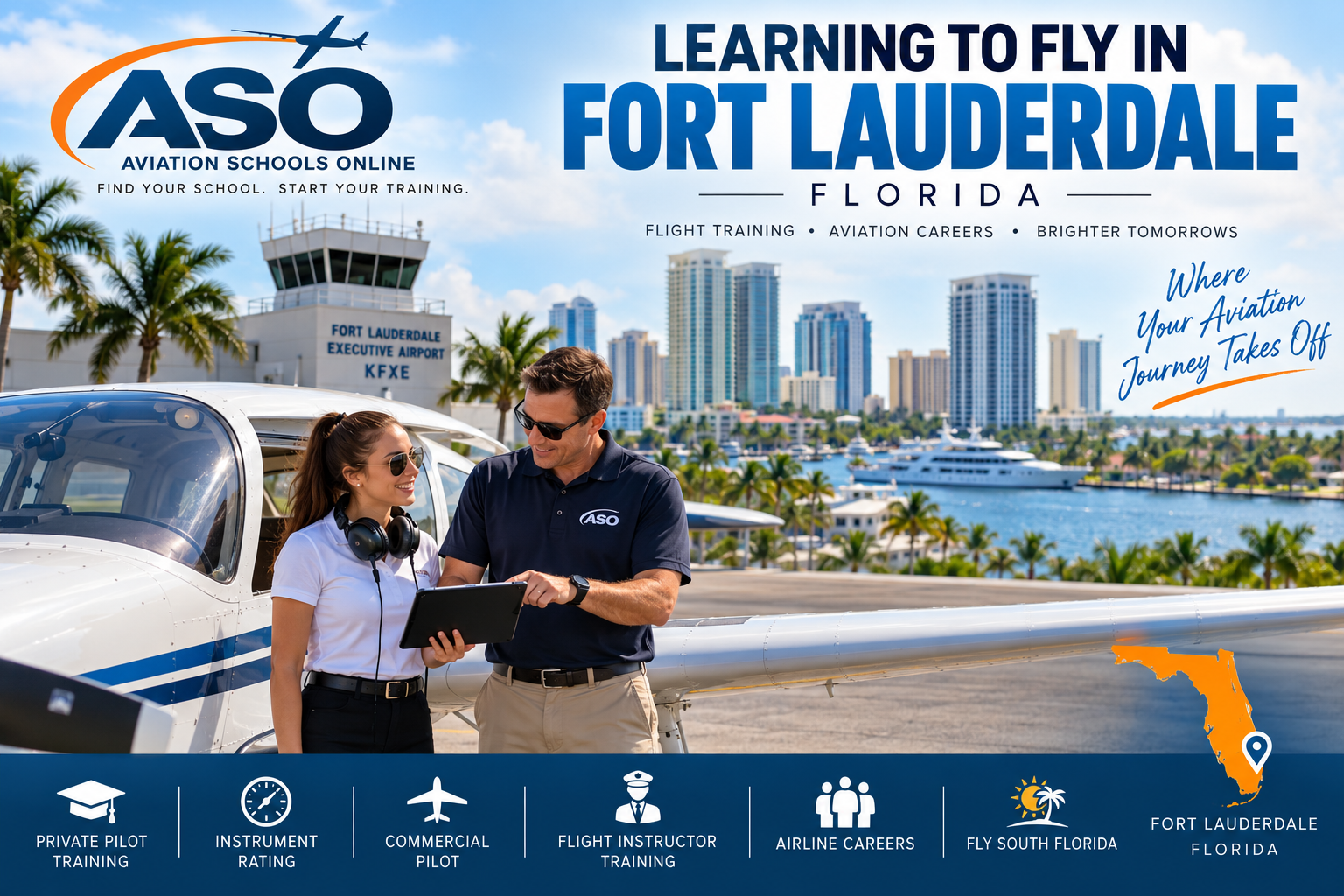
Fort Lauderdale is one of South Florida’s most active aviation communities—and for aspiring pilots, it can be an excellent place to begin flight training. With a strong general aviation presence, multiple nearby airports, year-round flying opportunities, complex airspace, and access to a broad range of flight schools, Fort Lauderdale offers student pilots an environment where they can build both technical skills and real-world experience.
Whether your goal is to earn a Private Pilot Certificate, become a commercial pilot, pursue an airline career, or simply learn to fly for recreation, Aviation Schools Online (ASO) can help you compare flight schools and training programs in the Fort Lauderdale area.
Why Learn to Fly in Fort Lauderdale?
South Florida offers several advantages for student pilots, beginning with the sheer amount of aviation activity in the region.
Fort Lauderdale Executive Airport (FXE), for example, is a dedicated general aviation airport operated by the City of Fort Lauderdale. The airport has a 24-hour FAA air traffic control tower and supports corporate aviation, charter operations, maintenance, fueling and other general aviation activities. (Flyfxe)
For a student pilot, training in an active aviation environment can provide exposure to skills that may become increasingly valuable later in a professional flying career, including:
-
Communicating with air traffic control
-
Operating in controlled airspace
-
Managing higher-density aircraft traffic
-
Reading and interpreting aviation charts
-
Flight planning around neighboring airports and airspace
-
Developing radio communication confidence
-
Understanding weather along a busy coastal region
-
Learning airport and runway procedures
-
Preparing for cross-country flights in a complex operating environment
Fort Lauderdale is also surrounded by several airports, giving instructors opportunities to expose students to different airport environments.
Airports Near Fort Lauderdale for Flight Training
Fort Lauderdale Executive Airport — FXE
Fort Lauderdale Executive Airport (KFXE) is one of the area's principal general aviation airports.
Located just minutes from downtown Fort Lauderdale, FXE is exclusively a general aviation airport rather than a scheduled commercial passenger airport. It includes a 24-hour FAA control tower, multiple FBOs and numerous aviation services. (Flyfxe)
Students training at or near FXE can become accustomed to operating around corporate aircraft, business aviation traffic and other general aviation operations.
Pompano Beach Airpark — PMP
Just north of Fort Lauderdale is Pompano Beach Airpark (KPMP).
The FAA describes PMP as a general and corporate aviation airport located on Florida's east coast. Its proximity to Fort Lauderdale Executive and Boca Raton creates an interesting airspace environment for developing pilots. The airport operates within Class D airspace whose configuration is influenced by neighboring airports. (FAA)
Learning to navigate this type of environment can help students develop stronger situational awareness and radio communication skills.
North Perry Airport — HWO
South of Fort Lauderdale, North Perry Airport (KHWO) in Pembroke Pines is another major general aviation training location.
Broward County identifies flight training as one of North Perry Airport's major aviation activities. The airport has four runways, more than 400 based aircraft and over 40 aviation businesses. Both airplane and helicopter flight training are available through operators based at the airport.
That means students researching Fort Lauderdale flight schools should consider the broader Broward County aviation market rather than limiting their search to schools physically located inside the Fort Lauderdale city limits.
What Type of Pilot Training Can You Complete in Fort Lauderdale?
Depending on the flight school you select, training may be available for several FAA certificates and ratings.
Private Pilot Certificate
For most people, the Private Pilot Certificate is the first major step.
Private pilot training introduces students to:
-
Aircraft controls and systems
-
Takeoffs and landings
-
Airport operations
-
Aerodynamics
-
Navigation
-
Weather
-
Federal Aviation Regulations
-
Radio communication
-
Emergency procedures
-
Night flying
-
Cross-country flight planning
-
Basic instrument flying
Under FAA Part 61 requirements, an airplane private pilot applicant must log at least 40 hours of flight time, including specified amounts of instructor training and solo flight. The FAA notes, however, that the national average for completing a private pilot certificate is approximately 75 flight hours, meaning students should not build their budgets around the regulatory minimum alone. (FAA)
Training time varies significantly according to frequency of lessons, weather, aircraft availability, instructor availability and individual progress.
Instrument Rating
Many pilots continue directly into an Instrument Rating after earning their private pilot certificate.
Instrument training teaches pilots to operate an aircraft primarily by reference to flight instruments and prepares them for flight under Instrument Flight Rules when appropriately qualified and conditions permit.
South Florida's active airspace can give instrument students experience working with air traffic control and navigating an environment containing numerous airports and instrument procedures.
Current FAA terminal procedure listings include instrument procedures serving Fort Lauderdale Executive, Fort Lauderdale-Hollywood International, North Perry and Pompano Beach Airpark. (FAA)
Commercial Pilot Training
If your goal is to fly professionally, the commercial pilot certificate becomes another important milestone.
Commercial training further develops:
-
Aircraft control
-
Precision maneuvering
-
Cross-country planning
-
Professional decision-making
-
Aircraft performance knowledge
-
Advanced flight operations
A Commercial Pilot Certificate may lead toward careers in charter flying, aerial survey, flight instruction and other commercial aviation operations, although individual aviation jobs have their own experience and regulatory requirements.
Certified Flight Instructor Training
Becoming a Certified Flight Instructor (CFI) is a common next step for career-minded pilots.
Flight instruction can allow newly qualified commercial pilots to build flight experience while helping the next generation of students learn to fly.
Depending on the school, additional instructor qualifications may include:
CFII — Certified Flight Instructor–Instrument
and
MEI — Multi-Engine Instructor
Instructor positions can also provide valuable experience with aircraft operations, cockpit decision-making and communication.
Multi-Engine Training
Pilots preparing for professional aviation careers frequently add a Multi-Engine Rating.
Multi-engine training introduces pilots to aircraft with more than one engine and includes critical topics such as:
-
Engine-out procedures
-
Single-engine performance
-
Multi-engine aerodynamics
-
Emergency procedures
-
Systems management
-
Performance calculations
Students interested in airline or corporate aviation should ask prospective Fort Lauderdale flight schools whether multi-engine aircraft are available and how frequently they can be scheduled.
Airline Career Training
Some Fort Lauderdale-area flight schools offer structured programs designed specifically for students pursuing professional or airline careers.
A typical career progression may look like:
Discovery Flight → Private Pilot → Instrument Rating → Commercial Pilot → Multi-Engine Rating → CFI/CFII → Flight-Time Building → Airline Transport Pilot eligibility → Professional Pilot Career
The exact sequence can vary by training program and career objective.
Part 61 vs. Part 141 Flight Schools in Fort Lauderdale
When comparing flight schools, students will often encounter FAA Part 61 and Part 141 programs.
Part 61 Flight Training
Part 61 training can provide greater flexibility for students who want to schedule lessons around work, school or family commitments.
It may work particularly well for:
-
Recreational pilots
-
Working professionals
-
Students training part time
-
Pilots adding an additional certificate or rating
Part 141 Flight Training
FAA-approved Part 141 schools operate under an approved training syllabus and more structured curriculum.
Part 141 training may appeal to:
-
Career-oriented students
-
Full-time flight students
-
Students attending aviation colleges or structured academies
-
Certain students using eligible education or veterans benefits
Neither option is automatically better for every student.
The right program depends on your goals, budget, schedule and intended aviation career.
Flying Weather in Fort Lauderdale
One of South Florida's advantages is the ability to conduct flight training throughout much of the year.
But Florida weather also becomes part of your aviation education.
Student pilots can encounter:
-
Coastal sea breezes
-
Rapidly developing thunderstorms
-
Heavy rain
-
High temperatures
-
Changing winds
-
Tropical weather
-
Low ceilings and reduced visibility
-
Strong convective activity during warmer months
National Weather Service aviation forecasts for South Florida regularly identify afternoon and early-evening thunderstorms as potential sources of temporary flight restrictions and erratic winds during the summer. (National Weather Service)
For students, this creates an opportunity to learn something every pilot needs regardless of location:
how to make safe go/no-go decisions.
Your instructor should teach you not only how to fly an airplane, but also when not to fly.
South Florida Airspace Can Build Valuable Experience
Fort Lauderdale sits within one of America's more active metropolitan aviation environments.
Nearby airports include:
-
Fort Lauderdale Executive Airport
-
Fort Lauderdale-Hollywood International Airport
-
Pompano Beach Airpark
-
North Perry Airport
-
Boca Raton Airport
-
Miami-Opa Locka Executive Airport
-
Miami International Airport
The concentration of aviation activity means students may receive substantial exposure to air traffic control procedures and controlled airspace.
For someone hoping to eventually fly professionally, that experience can be especially useful.
How Much Does Flight School Cost in Fort Lauderdale?
There is no single price for flight training.
Your total cost depends heavily on:
-
Aircraft rental rates
-
Instructor rates
-
Fuel costs
-
Training frequency
-
Aircraft type
-
Ground-school costs
-
Simulator use
-
Medical examinations
-
FAA knowledge-test fees
-
Checkride costs
-
Training materials
-
Number of hours required before reaching proficiency
Because the FAA minimum for an airplane private pilot certificate is 40 flight hours but the FAA reports an average completion time closer to 75 hours, prospective students should ask schools for realistic average completion costs rather than estimates based solely on FAA minimum hours. (FAA)
That question alone can make comparing flight schools much easier.
How to Choose a Flight School in Fort Lauderdale
Before enrolling, visit more than one school when possible.
Ask each school about:
Aircraft availability: How many training airplanes does the school have?
Instructor availability: Can you consistently fly several times per week?
Maintenance: How does the school handle aircraft maintenance and unexpected downtime?
Scheduling: How far in advance must students reserve airplanes?
Instructor turnover: Will you likely train with the same instructor?
Training structure: Is the program Part 61, Part 141 or both?
Career programs: Does the school offer instrument, commercial, multi-engine and instructor training?
Financing: Are financing options available?
Veterans benefits: If applicable, are eligible programs approved for VA education benefits?
International students: Does the school accept international students and support appropriate training requirements?
Total estimated cost: What do typical students actually spend from beginning training through the checkride?
Take a Discovery Flight First
One of the best ways to determine whether flying is right for you is to take a discovery flight.
A discovery flight normally gives a prospective student the opportunity to:
-
Meet a flight instructor
-
See the training aircraft
-
Learn how the flight school operates
-
Experience the cockpit
-
Take the controls under instructor supervision
-
Ask questions about training
-
Discuss career goals and costs
You can also use the experience to evaluate the school itself.
Pay attention to the condition of the aircraft, professionalism of the instructors, organization of the facility and how clearly the school answers your questions.
What Should You Look for in a Training Aircraft?
Common primary trainers can include aircraft such as the:
-
Cessna 152
-
Cessna 172
-
Piper Warrior
-
Piper Archer
-
Diamond DA20
-
Diamond DA40
-
Other modern training aircraft
The specific airplane is usually less important than its maintenance condition, availability and suitability for your training program.
Students planning professional careers should also consider whether the school offers aircraft equipped with modern avionics and glass cockpit systems.
Can You Become an Airline Pilot by Training in Fort Lauderdale?
Yes. Flight training completed in the Fort Lauderdale area can form the foundation of an airline pilot career just as training elsewhere in the United States can.
Your journey begins with FAA pilot certificates and ratings and progresses through additional flight experience.
For many students, the pathway eventually includes:
Private Pilot
↓
Instrument Rating
↓
Commercial Pilot
↓
Multi-Engine Training
↓
Certified Flight Instructor
↓
Build Flight Experience
↓
Airline Transport Pilot Qualification
↓
Regional, Major, Cargo, Charter or Corporate Aviation Career
Training around South Florida's complex airspace can provide a useful operational foundation along the way.
Recreational Flying in South Florida
Not everyone learning to fly wants an airline career.
For private pilots, Fort Lauderdale also offers access to a distinctive flying environment with the Atlantic coastline, the Florida Keys, Gulf Coast destinations and numerous airports throughout Florida.
A private pilot certificate can open the door to flying for:
-
Recreation
-
Personal travel
-
Business transportation
-
Aircraft ownership
-
Flying clubs
-
Continuing aviation education
For many pilots, learning to fly becomes a lifelong activity rather than simply a career qualification.
Find Flight Schools in Fort Lauderdale with Aviation Schools Online
Choosing a flight school may be one of the most important decisions you make at the beginning of your aviation journey.
Aviation Schools Online has been helping aspiring aviation professionals connect with schools and training providers since 2001.
Use ASO to research flight schools, compare training options and connect directly with aviation training providers serving Fort Lauderdale, Broward County and South Florida.
Whether you want to become a:
Private Pilot • Commercial Pilot • Flight Instructor • Corporate Pilot • Charter Pilot • Airline Pilot
your first step is finding the right school.
Ready to Start Flying?
Find Flight Schools in Fort Lauderdale, Florida with Aviation Schools Online.
Find Your School. Start Your Training. Build Your Aviation Future.