Section 2: Aircraft Components & Systems
Private Pilot Ground School — Updated for 2026
An airplane may look simple from the outside, but safe operation depends on several interconnected systems working together.
As a Private Pilot, you don't need to be an aircraft mechanic.
You do need to understand your airplane well enough to recognize normal operation, identify abnormal indications, understand system limitations, and make safe decisions when something doesn't work as expected.
This section introduces the major components and systems found in common general aviation training airplanes such as the:
-
Cessna 152
-
Cessna 172
-
Piper Warrior
-
Piper Archer
-
Diamond DA20
-
Diamond DA40
-
Similar single-engine training aircraft
Exact systems vary by aircraft.
That is why every pilot must ultimately learn the systems of the specific make and model being flown using that aircraft's Pilot's Operating Handbook, commonly called the POH, or FAA-approved Airplane Flight Manual.
What You'll Learn
By the end of this section, you should understand:
-
Major aircraft structural components
-
Fuselage, wings, empennage, and landing gear
-
Primary and secondary flight controls
-
How ailerons, elevator, and rudder control the airplane
-
Trim systems
-
Reciprocating aircraft engines
-
The four-stroke combustion cycle
-
Propeller basics
-
Fixed-pitch and constant-speed propellers
-
Fuel systems
-
Carburetors and fuel injection
-
Carburetor icing
-
Ignition and magnetos
-
Electrical systems
-
Alternators, generators, batteries, buses, circuit protection
-
Engine lubrication
-
Engine cooling
-
Pitot-static systems
-
Vacuum systems where installed
-
Landing gear and brakes
-
Cabin heat
-
Common system failures
-
How to use the POH during normal and abnormal operations
Most importantly:
You'll learn how aircraft systems affect pilot decisions.
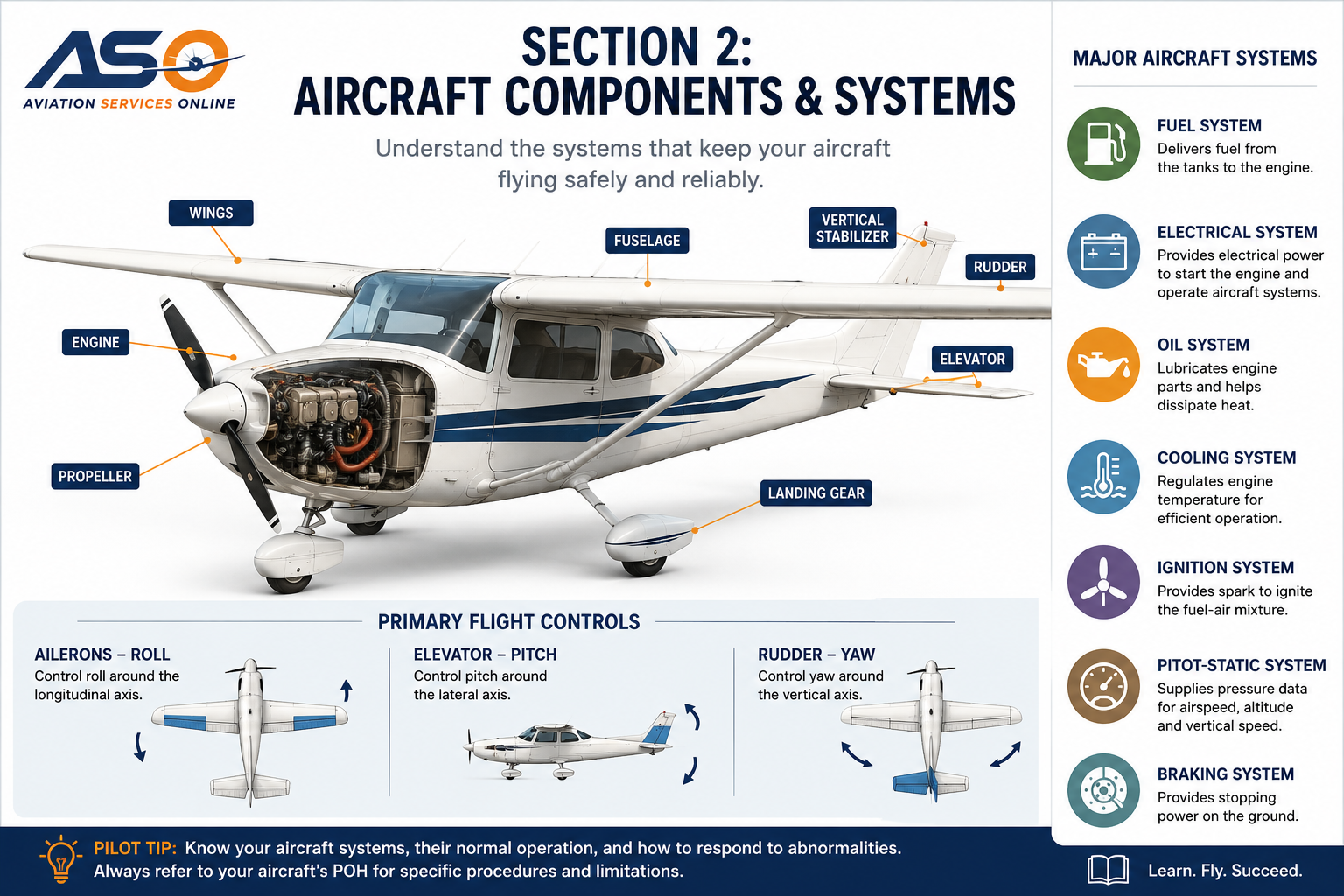
1. The Airframe
The airframe is the basic physical structure of the aircraft.
Its job is to withstand aerodynamic forces and support the weight of:
-
The aircraft itself
-
Fuel
-
Occupants
-
Baggage
-
Equipment
-
Other payload
The major structural components of a typical airplane include:
Fuselage
The fuselage is the main body of the airplane.
It commonly contains:
-
Cockpit
-
Seats
-
Cabin
-
Baggage compartment
-
Flight controls
-
Instrument panel
-
Electrical components
-
Fuel or control-system components
-
Attachment points for wings and empennage
Think of it as the central structure connecting the major components of the airplane.
Wings
The wings generate most of the lift that supports the airplane in flight.
Wing designs vary considerably.
You may train in a:
High-Wing Airplane
Examples include many Cessna aircraft.
The wing is mounted above the cabin.
Potential characteristics include:
-
Excellent downward visibility
-
Easier access in some loading situations
-
Gravity-fed fuel systems on certain aircraft
-
Shade from the wing while parked
Low-Wing Airplane
Examples include many Piper and Diamond aircraft.
The wing is mounted below the fuselage.
Potential characteristics include:
-
Excellent upward visibility
-
Different ground-handling and boarding arrangements
-
Fuel systems that may require engine-driven and electric fuel pumps
-
Different sight pictures during turns and landing
Neither design is inherently "better."
Pilots should understand the systems and handling characteristics of the aircraft they actually fly.
Empennage
The tail assembly is called the:
EMPENNAGE
It commonly includes:
-
Vertical stabilizer
-
Rudder
-
Horizontal stabilizer
-
Elevator
Some airplanes use a stabilator instead of a separate fixed horizontal stabilizer and elevator.
The empennage provides stability and control around the aircraft's vertical and lateral axes.
Landing Gear
Landing gear supports the airplane while:
-
Taxiing
-
Taking off
-
Landing
-
Parked on the ground
Two common configurations are:
Tricycle Gear
The aircraft has:
-
Two main wheels
-
One nose wheel
This is extremely common in modern training aircraft.
Examples include many Cessna, Piper, and Diamond trainers.
Conventional Gear
Often called:
TAILWHEEL GEAR
The aircraft has:
-
Two main wheels
-
A smaller wheel or skid at the tail
Tailwheel airplanes require additional training and a logbook endorsement before acting as Pilot in Command when required by regulation.
2. Flight Controls
Aircraft controls allow the pilot to control movement around three axes.
Understanding this relationship is fundamental.
The three primary flight controls are:
AILERONS
ELEVATOR
RUDDER
Ailerons — Roll
Ailerons are normally located near the outer trailing edges of the wings.
They move in opposite directions.
When one aileron moves upward, the other moves downward.
Ailerons primarily control:
ROLL
around the aircraft's:
LONGITUDINAL AXIS
If you move the control wheel or stick to the right:
-
The right aileron generally moves upward
-
The left aileron generally moves downward
-
The airplane rolls right
Elevator — Pitch
The elevator is normally located on the horizontal tail.
It controls:
PITCH
around the:
LATERAL AXIS
Pulling back on the control wheel or stick generally moves the elevator upward.
This changes the aerodynamic force on the tail and causes the airplane's nose to pitch upward.
Pushing forward generally causes the nose to pitch downward.
Rudder — Yaw
The rudder is attached to the vertical stabilizer.
It controls:
YAW
around the:
VERTICAL AXIS
The rudder is controlled with the rudder pedals.
Pressing the right rudder pedal moves the rudder in a way that yaws the nose to the right.
Pressing the left pedal yaws the nose to the left.
The Three Axes
Memorize this relationship:
| Aircraft Motion | Axis | Primary Control |
|---|---|---|
| Roll | Longitudinal | Ailerons |
| Pitch | Lateral | Elevator |
| Yaw | Vertical | Rudder |
But don't stop at memorization.
In actual flight, these controls frequently work together.
A coordinated turn, for example, requires proper use of both aileron and rudder.
3. Secondary Flight Controls
Aircraft may also have secondary controls that improve performance or reduce pilot workload.
Common examples include:
-
Flaps
-
Trim systems
-
Spoilers on some aircraft
-
Leading-edge devices on some aircraft
For most Private Pilot training aircraft, two of the most important are:
FLAPS
and
TRIM
Flaps
Flaps are normally located along the inboard trailing portion of the wings.
Extending flaps changes the shape of the wing.
Depending on configuration, flap extension generally increases:
-
Lift
-
Drag
Flaps are particularly useful during:
-
Takeoff on some aircraft
-
Approach
-
Landing
Additional flap extension usually creates greater drag.
That can allow a steeper descent without an excessive increase in airspeed.
However, flap limitations are aircraft-specific.
Your POH tells you:
-
Approved flap settings
-
Maximum flap-extension speeds
-
Normal procedures
-
Short-field procedures
-
Go-around procedures
-
Limitations
Never assume flap procedures from one airplane apply to another.
Trim
Trim helps reduce the amount of continuous control pressure the pilot must hold.
Suppose you're climbing and constantly pulling backward on the control wheel.
Instead of maintaining that pressure throughout the climb, you can adjust the trim to relieve the control force.
Remember:
Trim does not replace proper aircraft control.
First:
Set the desired attitude and airspeed.
Then:
Trim away the control pressure.
A useful sequence is:
PITCH → POWER → TRIM
as appropriate to the maneuver and aircraft.
4. The Aircraft Engine
Most common primary trainers use a:
RECIPROCATING PISTON ENGINE
The basic principle is similar to the engine found in many automobiles, although aircraft engines are designed and operated specifically for aviation.
Aircraft piston engines commonly convert the energy released by burning fuel into mechanical power that turns the propeller.
The Four-Stroke Engine Cycle
A four-stroke reciprocating engine completes four major events:
1. Intake
The intake valve opens.
The piston moves downward.
The fuel-air mixture enters the cylinder.
2. Compression
Both valves close.
The piston moves upward.
The fuel-air mixture is compressed.
3. Power
The spark plugs ignite the compressed fuel-air mixture.
Combustion rapidly increases pressure.
The piston is forced downward.
This produces power.
4. Exhaust
The exhaust valve opens.
The piston moves upward.
Burned gases leave the cylinder.
A common memory aid is:
SUCK — SQUEEZE — BANG — BLOW
Informal, but memorable.
Horizontally Opposed Engines
Many general aviation piston airplanes use horizontally opposed engines.
Cylinders are arranged on opposite sides of the crankcase.
Advantages can include:
-
Relatively compact design
-
Air cooling
-
Favorable power-to-weight characteristics
-
Simpler construction than some alternatives
Common aircraft-engine manufacturers include companies such as Lycoming and Continental.
5. Propellers
The propeller converts engine power into thrust.
A propeller is essentially a rotating airfoil.
As it turns, its blades create aerodynamic forces that help pull or push the airplane through the air.
The FAA emphasizes that propellers are matched to aircraft and powerplant combinations to achieve useful efficiency at particular operating conditions. (Federal Aviation Administration)
Fixed-Pitch Propeller
Many training airplanes use a:
FIXED-PITCH PROPELLER
The blade angle is fixed and cannot be changed by the pilot in flight.
It's mechanically simple and works well for basic training.
A fixed-pitch propeller represents a compromise between:
-
Climb performance
-
Cruise performance
Constant-Speed Propeller
More advanced airplanes may use a:
CONSTANT-SPEED PROPELLER
The pilot typically selects a desired propeller RPM using a propeller control.
A governor automatically adjusts blade angle to maintain the selected RPM within the operating range.
These systems are common in higher-performance airplanes.
They require additional system knowledge and operating technique.
6. Fuel Systems
Without fuel, your engine will not continue producing power.
That makes fuel-system knowledge essential.
A typical general aviation fuel system can include:
-
Fuel tanks
-
Fuel selector
-
Fuel lines
-
Fuel vents
-
Fuel strainer
-
Sumps and drains
-
Fuel pump
-
Fuel quantity indicators
-
Carburetor or fuel-injection system
The exact arrangement varies by aircraft.
Gravity-Feed Fuel Systems
Some high-wing airplanes use gravity to help deliver fuel from wing tanks to the engine.
Fuel tanks are located above the engine.
Gravity assists the flow.
This can reduce reliance on fuel pumps in certain designs.
Fuel Pump Systems
Many low-wing airplanes cannot rely entirely on gravity.
Fuel may need to be moved upward from wing tanks to the engine.
These aircraft may use:
-
Engine-driven fuel pump
-
Electric auxiliary fuel pump
The electric pump may be required during certain operations such as:
-
Engine start
-
Takeoff
-
Landing
-
Fuel-tank changes
-
Failure of the engine-driven pump
Procedures vary.
Use the POH.
Fuel Selector
A fuel selector may have positions such as:
-
LEFT
-
RIGHT
-
BOTH
-
OFF
Not every aircraft has the same selector.
Incorrect fuel-selector positioning can cause:
ENGINE FUEL STARVATION
even when usable fuel remains onboard.
That's why fuel-selector position is part of many checklists.
Fuel Quantity
Pilots must never rely blindly on a fuel gauge.
Proper fuel management includes:
-
Visually checking tanks when possible
-
Reviewing fuel quantity before flight
-
Calculating planned fuel burn
-
Monitoring time
-
Managing tank selection
-
Maintaining legal and personal reserves
You'll study fuel planning in much greater detail later.
Fuel Contamination
Fuel can become contaminated by:
-
Water
-
Dirt
-
Debris
-
Incorrect fuel grade
-
Other substances
During preflight, pilots commonly drain fuel samples from specified sumps or strainers.
You are checking for:
-
Correct fuel color
-
Correct fuel grade
-
Water
-
Sediment
-
Contamination
Never skip fuel sampling simply because the airplane flew earlier that day.
7. Aviation Fuel
Many piston aircraft use aviation gasoline, commonly known as:
AVGAS
The correct fuel depends on the aircraft and engine.
The aircraft's POH, placards, fuel caps, and approved documentation identify appropriate fuel.
Using incorrect fuel can cause serious engine damage or failure.
Some aircraft are approved for additional fuels under applicable certifications or supplemental approvals.
Again:
KNOW YOUR AIRPLANE.
8. Carburetor Systems
Some piston aircraft engines use a carburetor to mix fuel and air before the mixture enters the cylinders.
The pilot typically has:
-
Throttle
-
Mixture control
-
Carburetor heat control
One particularly important hazard is:
CARBURETOR ICE
Carburetor Icing
Carburetor ice can form even when outside temperatures are well above freezing.
Why?
Air accelerating through the carburetor experiences a pressure drop, and fuel vaporization also causes cooling.
The temperature inside the carburetor can therefore fall enough for moisture to freeze.
Ice can restrict airflow and reduce engine power.
Signs of Carburetor Ice
In an airplane with a fixed-pitch propeller, one common indication is:
A gradual decrease in engine RPM.
Depending on the aircraft and propeller system, other indications may differ.
The proper response is aircraft-specific, but many carbureted trainers use:
FULL CARBURETOR HEAT
when carburetor ice is suspected.
Applying carburetor heat may initially produce additional roughness as ice melts and water passes through the engine.
Follow the POH and checklist.
9. Fuel Injection
Some aircraft use fuel injection rather than a carburetor.
Fuel-injected engines meter fuel directly into the induction system near the cylinders.
Potential advantages include:
-
More precise fuel distribution
-
Reduced susceptibility to traditional carburetor icing
-
Better fuel metering
However, fuel-injected engines have their own operating considerations.
These may include:
-
Hot-start procedures
-
Vapor-related issues
-
Electric fuel-pump procedures
-
Specific priming techniques
Never assume a fuel-injected engine is "the same, just without carb heat."
10. Mixture Control
Air becomes less dense as altitude increases.
If the engine continues receiving the same amount of fuel while less air enters the cylinders, the fuel-air mixture becomes excessively rich.
The:
MIXTURE CONTROL
allows the pilot to adjust the amount of fuel relative to incoming air.
This process is called:
LEANING
Proper leaning can improve:
-
Engine efficiency
-
Fuel economy
-
Engine operation
-
Spark-plug condition
But mixture procedures vary by engine and aircraft.
Use the POH.
11. Ignition System and Magnetos
Aircraft piston engines commonly use:
MAGNETOS
A magneto produces electrical energy for the spark plugs independently of the aircraft's main electrical system.
This is extremely important.
It means that:
Losing the alternator or battery does not necessarily stop the engine.
Many aircraft piston engines use two magnetos.
Typical ignition-switch positions include:
-
OFF
-
R
-
L
-
BOTH
-
START
Each magneto normally powers one spark plug in each cylinder.
Dual ignition improves:
-
Reliability
-
Combustion efficiency
-
Redundancy
Magneto Check
During run-up, pilots commonly test:
-
LEFT magneto
-
RIGHT magneto
-
BOTH
A small RPM drop is usually expected.
The POH establishes:
-
Maximum allowable RPM drop
-
Maximum difference between magnetos
If indications are outside limits, the aircraft may require maintenance before flight.
Important Magneto Safety
Because magnetos are mechanically driven and independent of the aircraft battery:
A propeller may produce ignition even when the master switch is OFF.
Treat every propeller as if the engine could start.
Never casually move or rotate a propeller.
12. Electrical System
The aircraft electrical system powers equipment such as:
-
Radios
-
Lights
-
Navigation equipment
-
Electronic flight displays
-
Flaps on some aircraft
-
Fuel pumps
-
Pitot heat
-
Transponders
-
GPS systems
-
Engine instruments
-
Cabin accessories
The FAA describes the primary functions of an aircraft electrical system as generating, regulating, and distributing electrical power throughout the aircraft. (Federal Aviation Administration)
Battery
The battery stores electrical energy.
It may provide power for:
-
Engine start
-
Electrical equipment when the engine isn't running
-
Limited backup power after alternator failure
Battery capacity is limited.
Alternator or Generator
Once the engine is running, an:
-
Alternator
-
Generator
typically supplies electrical power and recharges the battery.
Many newer general aviation airplanes use alternators.
Electrical Bus
An electrical bus distributes electrical power to different systems.
More sophisticated aircraft may have:
-
Main bus
-
Essential bus
-
Avionics bus
-
Battery bus
-
Emergency bus
The architecture varies widely by aircraft.
Circuit Breakers and Fuses
Electrical systems are protected by circuit breakers or fuses.
If excessive current flows, the protective device opens the circuit.
A circuit breaker that pops is telling you:
SOMETHING MAY BE WRONG.
Repeatedly resetting a circuit breaker can worsen an electrical problem or fire hazard.
Follow the POH and checklist.
13. Alternator Failure
If the alternator fails:
The engine may continue running normally.
Remember:
Magnetos usually power the engine ignition independently.
But electrical equipment begins operating from battery power.
Eventually, the battery can discharge.
You may lose:
-
Radios
-
Transponder
-
GPS
-
Lights
-
Electric flaps
-
Electronic instruments
-
Other electrically powered systems
The safe response depends on the aircraft and situation.
Priorities may include:
-
Confirming failure
-
Following the checklist
-
Reducing electrical load
-
Preserving battery power
-
Planning an appropriate landing
14. Oil System
Engine oil does much more than simply lubricate moving parts.
Oil can:
-
Reduce friction
-
Carry away heat
-
Help clean engine components
-
Provide sealing
-
Protect internal surfaces
Pilots monitor indications such as:
-
Oil pressure
-
Oil temperature
Low Oil Pressure
Low oil pressure can indicate a serious problem.
If low oil pressure is accompanied by rising oil temperature, an engine lubrication failure may be developing.
Never ignore abnormal engine indications.
Use the checklist and consider the safest course of action.
15. Engine Cooling
Many piston-powered training airplanes use:
AIR-COOLED ENGINES
Air flowing around the engine cylinders helps remove heat.
Cooling fins increase surface area.
Aircraft may also use:
-
Engine baffling
-
Cowling design
-
Oil circulation
to assist cooling.
Engine temperature is affected by:
-
Power setting
-
Airspeed
-
Outside air temperature
-
Mixture
-
Climb angle
-
Ground operation
A prolonged high-power, low-airspeed climb on a hot day can produce more engine heat than cruise flight.
16. Exhaust System
The exhaust system routes hot combustion gases away from the engine and cabin.
It may also provide heat for:
-
Cabin heating
-
Carburetor heat
depending on the aircraft.
Because exhaust gases contain:
CARBON MONOXIDE
damage or leaks in the exhaust or cabin-heat system can create a serious hazard.
Carbon monoxide is:
-
Colorless
-
Odorless
-
Potentially fatal
Symptoms can include:
-
Headache
-
Dizziness
-
Drowsiness
-
Confusion
-
Nausea
If carbon monoxide is suspected:
-
Turn cabin heat off if applicable
-
Increase fresh-air ventilation
-
Use supplemental oxygen if available and appropriate
-
Land as soon as practical or necessary based on severity
-
Follow the aircraft checklist
We'll cover carbon monoxide again during aeromedical training.
17. Pitot-Static System
The pitot-static system provides pressure information to several important flight instruments.
A traditional system generally uses:
Pitot Pressure
Collected from the forward-facing pitot tube.
Static Pressure
Collected from one or more static ports.
These pressures support instruments such as:
-
Airspeed indicator
-
Altimeter
-
Vertical speed indicator
We'll study these instruments in depth in the next section.
For now, understand this:
A blocked pitot tube or static port can cause incorrect instrument indications.
That's why the pitot tube and static ports are inspected during preflight.
Pitot Heat
Many aircraft have:
PITOT HEAT
which electrically heats the pitot tube to help prevent ice blockage.
Pitot heat is not designed to make an aircraft approved for flight into known icing conditions.
It protects one component.
It does not protect the entire airplane.
18. Vacuum Systems
Some traditional aircraft use an engine-driven vacuum or pressure system to power gyroscopic flight instruments.
Depending on aircraft design, these can include:
-
Attitude indicator
-
Heading indicator
Newer glass-cockpit aircraft may use electrically powered solid-state instruments instead.
A vacuum-system failure can therefore affect some traditional instruments while leaving other aircraft systems functioning.
This is another reason pilots must understand the specific aircraft being flown.
19. Brakes
Many light airplanes use independent hydraulic brakes on the main landing-gear wheels.
They may be operated by:
-
Toe brakes
-
Heel brakes
depending on aircraft design.
Differential braking can assist with steering during taxi.
Excessive braking can cause:
-
Tire damage
-
Brake overheating
-
Loss of directional control
Brakes are particularly important during:
-
Taxi
-
Short-field operations
-
Crosswind taxiing
-
Aborted takeoffs
20. Nosewheel Steering
Tricycle-gear airplanes may steer using:
-
Direct mechanical linkage
-
Spring linkage
-
Differential braking
-
Rudder aerodynamic effectiveness
often in combination.
Steering response changes with speed.
At higher taxi or takeoff speeds, aerodynamic rudder effectiveness becomes increasingly important.
21. Cabin Heat
Many piston aircraft use heat from around the exhaust system to warm cabin air.
This design is effective but introduces carbon-monoxide risk if the exhaust system develops a leak.
During preflight, pilots should inspect:
-
Exhaust components when visible
-
Cabin heat operation when appropriate
-
Carbon monoxide detector status if installed
22. Aircraft Doors, Windows, and Cabin Systems
Doors and windows may seem simple compared with engines and fuel systems.
But an unsecured door can create:
-
Noise
-
Distraction
-
Airflow changes
-
Passenger concern
-
Increased pilot workload
In many light aircraft, a door opening in flight is more distracting than aerodynamically catastrophic.
The key is:
FLY THE AIRPLANE FIRST.
Do not allow an open door or window to cause loss of aircraft control.
Follow the checklist.
23. The POH — Your Aircraft's Operating Manual
One of the most important documents you'll use throughout pilot training is the:
PILOT'S OPERATING HANDBOOK
or
FAA-APPROVED AIRPLANE FLIGHT MANUAL
depending on the aircraft.
The POH contains aircraft-specific information such as:
-
Limitations
-
Airspeeds
-
Operating procedures
-
Emergency procedures
-
System descriptions
-
Performance charts
-
Weight and balance information
-
Servicing information
General ground school teaches principles.
The POH tells you how your airplane works.
Know the Difference Between General Knowledge and Aircraft-Specific Knowledge
Ground school might teach:
“Some airplanes use electric auxiliary fuel pumps.”
Your POH tells you:
Whether your airplane has one and when you must use it.
Ground school might teach:
“Flap operating speeds are limited.”
Your POH tells you:
Exactly what those speeds are.
Ground school might teach:
“A magneto RPM drop is expected during run-up.”
Your POH tells you:
How much RPM drop is acceptable.
That distinction is critical.
24. Systems Knowledge and the ACS
Aircraft systems aren't merely academic information.
The current FAA Private Pilot Airplane ACS is FAA-S-ACS-6C, effective since May 31, 2024 and still listed by the FAA as the current Private Pilot Airplane standard in 2026. (Federal Aviation Administration)
During practical-test preparation, you'll be expected to demonstrate understanding of the aircraft and its systems.
That means being able to answer more than:
“What does this switch do?”
You should be able to explain:
-
What the system does
-
How it operates
-
What powers it
-
How you know it's working
-
What happens when it fails
-
What indications you may see
-
What risks the failure creates
-
What action you should take
Think Like the ACS
For every aircraft system, ask:
KNOWLEDGE
How does this system work?
Example:
What powers the aircraft ignition system?
RISK MANAGEMENT
What could happen if it fails or is operated incorrectly?
Example:
What risks are created if the fuel selector is positioned incorrectly?
SKILL
What must I be able to do?
Example:
Can I recognize an alternator failure and correctly use the checklist?
25. Common Aircraft-System Scenarios
Let's apply systems knowledge to realistic flying.
Scenario 1: Falling RPM in Cruise
You're flying a carbureted trainer with a fixed-pitch propeller.
The engine slowly begins losing RPM.
No other obvious problem is apparent.
What should you consider?
Possible carburetor icing.
You should:
-
Recognize the indication
-
Follow the applicable checklist
-
Apply carburetor heat when appropriate
-
Monitor engine response
-
Consider landing options if power isn't restored
Scenario 2: LOW VOLTS Light
The engine sounds normal.
But the LOW VOLTS or alternator warning illuminates.
What does that tell you?
The engine may still be operating on independent magneto ignition, while the airplane's electrical system is now depending primarily on battery power.
Think:
How much electrical equipment do I really need?
How long will the battery last?
Where should I land?
Scenario 3: Fuel Gauge Shows Fuel — Engine Quits
Suppose one tank is empty but the other still contains usable fuel.
The fuel selector is positioned to the empty tank.
The engine stops producing power.
Is this:
Fuel exhaustion?
Not necessarily.
It may be:
FUEL STARVATION
Fuel exists onboard, but it isn't reaching the engine.
Systems knowledge matters.
Scenario 4: Open Door After Takeoff
The cabin door opens just after departure.
Your instinct may be to reach for it immediately.
What's the first priority?
FLY THE AIRPLANE.
Maintain:
-
Aircraft control
-
Airspeed
-
Direction
-
Safe altitude
Then deal with the door using the aircraft checklist and sound judgment.
26. Preflight Inspection and Aircraft Systems
Your preflight inspection isn't simply a ritual.
You're inspecting the systems you've just learned about.
When you inspect:
Fuel
You're looking for:
-
Quantity
-
Correct grade
-
Contamination
-
Leaks
-
Secure caps
-
Clear vents
Oil
You're checking:
-
Quantity
-
Leaks
-
General condition
Flight Controls
You're checking for:
-
Freedom of movement
-
Correct direction
-
Security
-
Damage
-
Binding
Tires and Brakes
You're checking for:
-
Tire condition
-
Inflation
-
Brake condition
-
Fluid leaks
Pitot Tube and Static Ports
You're checking for:
-
Blockage
-
Covers
-
Contamination
Propeller
You're looking for:
-
Damage
-
Cracks
-
Nicks
-
General condition
Airframe
You're looking for:
-
Structural damage
-
Loose fasteners
-
Fluid leaks
-
Missing components
-
Unusual conditions
The better you understand aircraft systems, the more meaningful your preflight becomes.
Section 2 Review
By the end of this section, you should understand:
-
The major parts of the airplane
-
How the fuselage, wings, empennage, and landing gear work together
-
The three primary flight controls
-
The relationship between roll, pitch, yaw, and the aircraft axes
-
How flaps and trim work
-
Basic operation of a reciprocating aircraft engine
-
The four-stroke engine cycle
-
Fixed-pitch and constant-speed propellers
-
Fuel-system basics
-
Fuel starvation versus fuel exhaustion
-
Carburetor icing
-
Fuel injection
-
Mixture control
-
Magnetos and dual ignition
-
Battery and alternator functions
-
Electrical buses and circuit breakers
-
Oil and cooling systems
-
Exhaust-system and carbon-monoxide risks
-
Pitot-static systems
-
Vacuum systems
-
Landing gear and brakes
-
Cabin heat
-
Why aircraft-specific POH knowledge is essential
-
How system knowledge connects to risk management and the ACS
Knowledge Check
1. What are the three primary flight controls?
Ailerons, elevator, and rudder.
2. What motion do ailerons primarily control?
Roll.
3. Around which axis does the airplane pitch?
The lateral axis.
4. What does the rudder primarily control?
Yaw around the vertical axis.
5. What are the four strokes of a four-stroke piston engine?
Intake, compression, power, and exhaust.
6. Does turning off the aircraft master switch necessarily stop a piston aircraft engine?
No. Many aircraft engines use magnetos that provide ignition independently of the aircraft's main electrical system.
7. What is carburetor icing?
Ice formation inside the carburetor that can restrict airflow and reduce engine power.
8. Can carburetor ice occur when the outside temperature is above freezing?
Yes.
9. What is fuel starvation?
Fuel is available somewhere onboard but is not reaching the engine.
10. What is fuel exhaustion?
The usable fuel supply has been depleted.
11. What does the alternator normally do?
It supplies electrical power while the engine is operating and normally recharges the battery.
12. If the alternator fails, must the engine immediately stop?
Not necessarily. In many piston aircraft, ignition is powered independently by magnetos.
13. What is one major hazard associated with an exhaust-system leak?
Carbon monoxide entering the cabin.
14. Which instruments commonly use the pitot-static system?
The airspeed indicator, altimeter, and vertical speed indicator in traditional instrument systems.
15. Where should you find the exact limitations and operating procedures for your specific airplane?
The POH or FAA-approved Airplane Flight Manual.
Scenario Knowledge Check
Scenario 1
You're climbing on a hot day at high power and low airspeed.
What system should you be particularly aware of?
Engine cooling.
High power combined with relatively low cooling airflow can increase engine temperature.
Scenario 2
You notice a gradual RPM loss in cruise in a carbureted airplane.
What should be high on your list of possible causes?
Carburetor ice.
Scenario 3
Your alternator fails at night.
What additional concern do you have compared with the same failure in daylight?
Electrical endurance.
Night operations may depend more heavily on electrical equipment such as:
-
Lighting
-
Radios
-
Navigation equipment
-
Electronic instruments
Battery conservation and landing planning become especially important.
Scenario 4
During preflight you find blue staining underneath a fuel drain on an aircraft using blue aviation gasoline.
What could that indicate?
A possible fuel leak.
Don't simply wipe it away and continue.
Investigate it before flight.
Pilot Decision-Making Exercise
Imagine you're preparing to fly a training airplane you've never flown before.
It appears very similar to the airplane you usually fly.
Should you assume the systems work the same way?
NO.
Similar airplanes can differ in:
-
Fuel systems
-
Flap systems
-
Electrical systems
-
Engine controls
-
Fuel-selector operation
-
Instrumentation
-
Emergency procedures
-
Limitations
-
Airspeeds
Before operating a new make or model:
Learn the airplane.
Review its:
-
POH
-
Checklists
-
Limitations
-
Systems
-
Emergency procedures
Familiar appearance does not guarantee familiar operation.
Key Takeaway
A safe pilot doesn't simply know how to move the controls.
A safe pilot understands:
WHAT POWERS THE AIRPLANE
WHAT CONTROLS THE AIRPLANE
WHAT KEEPS THE ENGINE RUNNING
WHAT INFORMATION THE SYSTEMS PROVIDE
WHAT CAN FAIL
and most importantly:
WHAT TO DO WHEN SOMETHING DOESN'T LOOK RIGHT.
Aircraft systems knowledge transforms a student from someone who can operate controls into someone who can begin managing an airplane as: