Section 1: Introduction to Aviation & the FAA
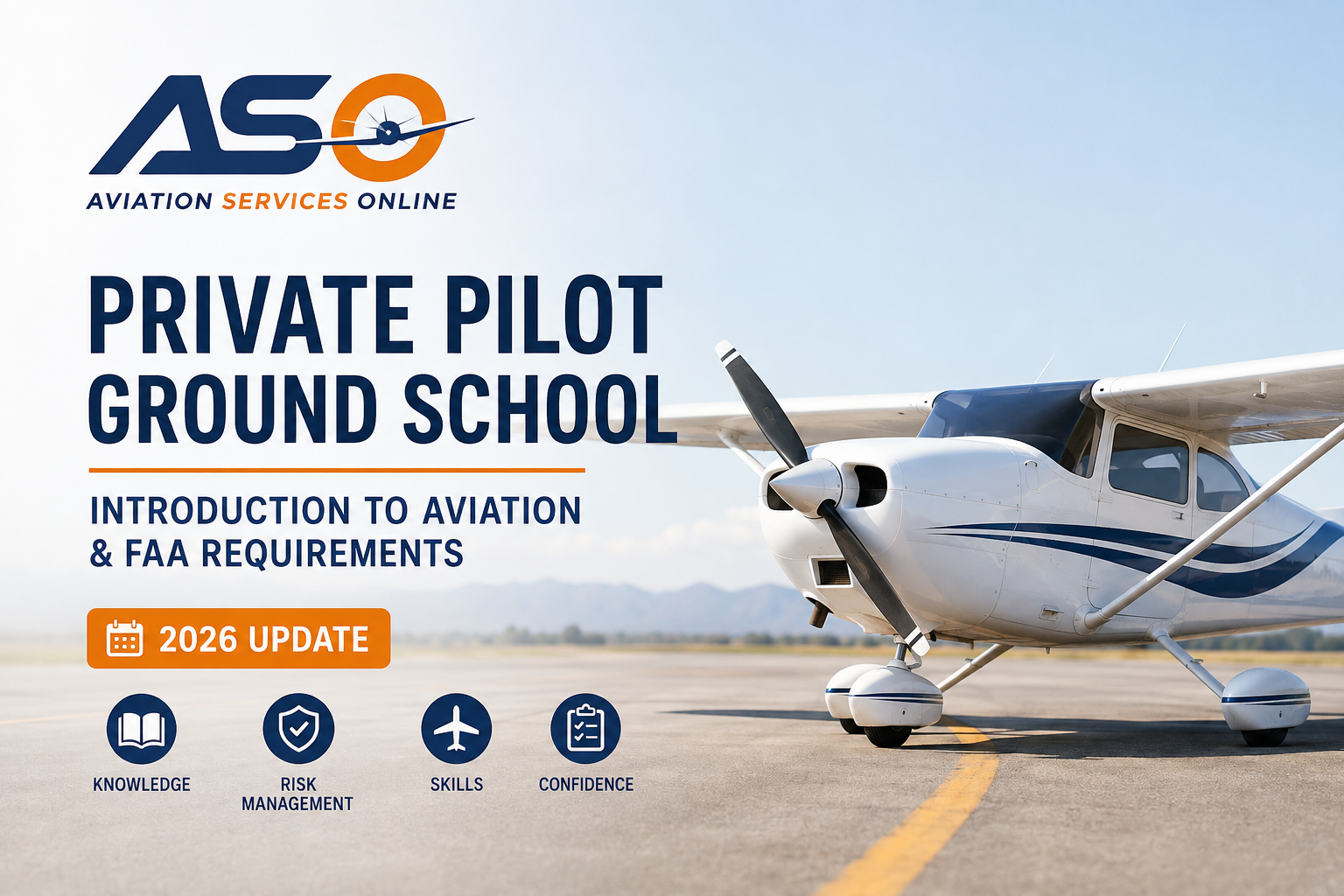
Private Pilot Ground School — Updated for 2026
Welcome to your first step toward becoming a pilot.
Before learning about weather, navigation, aerodynamics, aircraft systems, airport operations, performance, and flight planning, every student pilot should understand how flight training works and how the Federal Aviation Administration (FAA) regulates pilots and aviation in the United States.
This first section introduces the path from your first flight lesson through earning an FAA Private Pilot Certificate.
You'll learn about:
-
The Private Pilot training process
-
Current FAA flight-time requirements
-
Student Pilot Certificates
-
Private Pilot privileges and limitations
-
Pilot certificates and ratings
-
FAA medical certificates
-
BasicMed
-
Pilot logbooks
-
FAA regulations
-
The Airman Certification Standards
-
The FAA knowledge test
-
The Private Pilot practical test, or checkride
Your goal isn't simply to pass a written test or checkride.
You're beginning the process of learning how to think and make decisions like a Pilot in Command.
1. The Private Pilot Training Process
Becoming a Private Pilot requires a combination of:
Ground Training + Flight Training + Independent Study + Aeronautical Experience + FAA Testing
You don't need to know everything about aviation before taking your first flying lesson.
In fact, you can begin receiving flight instruction before obtaining your Student Pilot Certificate.
However, before operating an airplane solo, you'll need to satisfy the applicable certification, medical, training, proficiency, testing, and instructor-endorsement requirements.
A typical training progression looks something like this:
Discovery Flight → Ground School → Dual Flight Instruction → Pre-Solo Training → First Solo → Cross-Country Training → FAA Knowledge Test → Checkride Preparation → FAA Practical Test → Private Pilot Certificate
The exact sequence varies.
For example, many students complete their FAA knowledge test earlier in training rather than waiting until after cross-country training.
What matters is that you complete all applicable requirements before your practical test.
How Many Flight Hours Does It Take to Become a Private Pilot?
This is one of the most common questions new pilots ask.
For a Private Pilot Certificate with an Airplane Single-Engine Land rating under 14 CFR Part 61, the FAA requires a minimum of:
40 Total Flight Hours
That minimum must include at least:
20 Hours of Flight Training with an Authorized Instructor
and
10 Hours of Solo Flight
The FAA requirements also include specific experience involving areas such as:
-
Cross-country flight
-
Night flying
-
Instrument training
-
Takeoffs and landings
-
Solo cross-country flying
-
Practical-test preparation
However, 40 hours is the legal minimum—not necessarily the amount of time most students actually need.
The FAA reports that the U.S. average for applicants completing Private Pilot certification is approximately:
75 Flight Hours
That means students should be careful when budgeting based solely on the 40-hour regulatory minimum.
Some students finish close to the minimum.
Others require considerably more time.
Training frequency, weather, aircraft availability, instructor availability, student preparation, aptitude, and continuity can all affect completion time.
Student Tip
Flying consistently can make a significant difference.
Students who fly only once every few weeks may spend part of each lesson relearning skills from their previous flight.
Whenever practical, a consistent training schedule can help maintain proficiency and training momentum.
Ground Training
Ground school teaches you the knowledge behind flying.
During Private Pilot Ground School, you'll study subjects including:
-
Principles of flight and aerodynamics
-
Aircraft systems
-
Flight instruments
-
Airports
-
Airport markings and signs
-
Airspace
-
Federal Aviation Regulations
-
Aviation weather
-
Weather services
-
Aircraft performance
-
Weight and balance
-
Navigation
-
Cross-country flight planning
-
Radio communications
-
Aeromedical factors
-
Aeronautical decision-making
-
Risk management
-
Emergency procedures
-
Night operations
-
National Airspace System
-
Aeronautical charts
The goal isn't simply to memorize correct answers for the FAA knowledge test.
Good ground training teaches you how to understand, apply, and evaluate aviation information.
Consider the difference:
Memorization asks:
“What is the correct answer?”
Pilot judgment asks:
“What does this information mean for the flight I'm about to make?”
That distinction will become increasingly important throughout this course.
Flight Training
Flight training takes your ground-school knowledge into the airplane.
A Certificated Flight Instructor, commonly called a CFI, will teach you how to:
-
Conduct preflight inspections
-
Use checklists
-
Start and operate the aircraft
-
Taxi
-
Communicate by radio
-
Perform takeoffs
-
Climb
-
Maintain straight-and-level flight
-
Turn
-
Descend
-
Perform slow flight
-
Recognize and recover from stalls
-
Navigate
-
Fly traffic patterns
-
Land
-
Conduct cross-country operations
-
Manage abnormal situations
-
Respond to emergencies
-
Make sound aeronautical decisions
Early lessons are conducted with your instructor aboard.
As your skills and judgment develop, you'll begin working toward one of aviation's most memorable milestones.
Your First Solo Flight
Your first solo is the first time you operate the airplane without your instructor aboard.
It is an enormous milestone.
But your instructor doesn't simply decide one morning that you're probably ready.
Before authorizing solo flight, your instructor must determine that you have received the required training and demonstrated satisfactory proficiency and safety.
You must also complete the required pre-solo aeronautical knowledge test administered by your instructor.
Before solo flight, you must have the applicable:
-
Student Pilot Certificate
-
Medical qualification
-
Training
-
Pre-solo knowledge test
-
Instructor endorsements
-
Aircraft make-and-model endorsement
Your instructor may also establish operating limitations for your solo flights.
How Long Is a Student Pilot Solo Endorsement Valid?
The FAA states that the applicable initial solo endorsement is valid for:
90 Days
If you continue conducting solo operations after that period, your instructor must provide another applicable endorsement.
Also remember:
An endorsement to fly solo locally does NOT automatically authorize you to fly a solo cross-country.
Additional cross-country training and instructor endorsements are required.
Solo doesn't mean you've finished training.
It means you've demonstrated enough knowledge, judgment, and aircraft-control ability to begin operating independently under your instructor's supervision and limitations.
Cross-Country Flight Training
After learning to operate safely in your local training environment, you'll begin preparing for flights to other airports.
Cross-country training teaches you how to combine nearly everything you've learned.
You'll work with:
-
Aviation weather
-
Airport information
-
Aeronautical charts
-
Airspace
-
Aircraft performance
-
Fuel planning
-
Weight and balance
-
Navigation systems
-
Flight planning
-
Regulations
-
Communications
-
Diversion planning
-
Risk management
Eventually, you'll conduct qualifying solo cross-country flights after receiving the appropriate training and instructor endorsements.
Cross-country training is where aviation begins to feel much larger.
You're no longer simply learning how to operate an airplane.
You're learning how to plan and safely complete an entire flight as Pilot in Command.
FAA Private Pilot Knowledge Test
Private Pilot applicants must demonstrate the required aeronautical knowledge.
The FAA knowledge test is computer-based and covers subjects you've studied during ground training.
You'll need the appropriate instructor or course endorsement before taking the test.
A passing knowledge-test result is generally valid for:
24 Calendar Months
If you don't complete your practical test within the applicable validity period, you may need to retake the knowledge test.
Don't treat the knowledge exam as an exercise in memorizing a bank of questions.
A pilot who can recognize the correct answer on a computer screen but can't apply that information in an airplane isn't adequately prepared for real-world flying.
FAA Practical Test — The Checkride
The final major certification step is the FAA practical test, commonly known as the:
CHECKRIDE
Your flight instructor recommends you for the practical test when you've completed the applicable requirements and demonstrated that you're prepared.
The practical test generally includes two major portions:
Oral Evaluation
You'll demonstrate your understanding of aeronautical knowledge and your ability to apply that knowledge to realistic flight situations.
Flight Evaluation
You'll demonstrate your ability to safely perform applicable flight tasks and maneuvers while exercising sound judgment and risk management.
The checkride is typically conducted by an FAA inspector or an authorized Designated Pilot Examiner (DPE).
The standards used to evaluate you are established through the applicable FAA Airman Certification Standards.
Remember:
Your objective isn't merely to pass the checkride.
Your objective is to become a:
Safe • Competent • Knowledgeable • Responsible Private Pilot
2. Student Pilot and Private Pilot Privileges & Limitations
Understanding what your certificate allows—and doesn't allow—is fundamental to becoming a responsible pilot.
Student Pilot Certificate
A Student Pilot is a pilot in training who may operate solo only under specific regulatory requirements and instructor authorizations.
You don't need a Student Pilot Certificate just to begin taking lessons.
However, you need the appropriate Student Pilot Certificate before solo flight.
Minimum Student Pilot Age
For airplanes, the minimum age to obtain a Student Pilot Certificate is generally:
16 Years Old
For gliders and balloons, the minimum is generally 14.
To qualify for a Student Pilot Certificate, an applicant must also be able to read, speak, write, and understand English, subject to applicable FAA provisions.
Applications can be processed through FAA-authorized channels, including IACRA and authorized individuals such as a CFI, DPE, FAA office, or applicable Airman Certification Representative.
One important point for new students:
Your Student Pilot Certificate and FAA medical certificate are separate documents.
Since 2016, Aviation Medical Examiners no longer issue a combined medical/student pilot certificate.
Student Pilot Solo Limitations
Before your first solo, your flight instructor must determine that you're prepared and provide the required endorsements.
A Student Pilot cannot simply decide:
“The weather looks good. I'm going flying.”
Solo operations must comply with FAA regulations and the limitations established through your instructor's endorsements.
Your instructor may establish restrictions involving:
-
Weather
-
Wind
-
Crosswind component
-
Visibility
-
Airports
-
Routes
-
Aircraft
-
Runway conditions
-
Time of day
-
Other operational factors
These limitations aren't designed to hold you back.
They're part of a structured training system that allows you to gradually develop independence while managing risk.
Private Pilot Certificate
After completing the applicable aeronautical knowledge, training, experience, and testing requirements, you can earn an FAA Private Pilot Certificate.
For an airplane Private Pilot Certificate, an applicant must generally be at least:
17 Years Old
Once certificated, you're no longer operating as a Student Pilot under your instructor's solo authorization.
You may exercise the privileges of your Private Pilot Certificate within the category and class ratings you hold and subject to applicable regulations, currency, medical qualification, aircraft requirements, and operating limitations.
A Private Pilot can generally:
-
Act as Pilot in Command
-
Carry passengers
-
Fly for personal transportation
-
Conduct recreational flights
-
Fly to airports throughout the United States
-
Conduct qualifying flights internationally subject to applicable requirements
-
Fly at night when appropriately qualified and current
-
Share certain flight expenses under applicable FAA regulations
-
Conduct certain limited business-related operations allowed by regulation
However:
A Private Pilot Certificate is NOT a Commercial Pilot Certificate.
Private Pilots generally may not act as Pilot in Command carrying persons or property for compensation or hire except in specific situations permitted by regulation.
You'll study those distinctions in greater detail later.
Privilege vs. Proficiency
One of the most important lessons you'll learn in aviation is this:
Being legal to make a flight doesn't automatically mean you're proficient enough to make that flight safely.
Imagine that you satisfy every regulatory currency requirement.
But you haven't flown at night for months.
Tonight's flight involves:
-
A short runway
-
Gusty crosswinds
-
Mountainous terrain
-
Marginal visibility
-
An unfamiliar airport
You might satisfy a legal currency requirement.
That doesn't automatically mean making the flight is a good decision.
A responsible pilot continually asks:
Am I legal to make this flight?
and
Am I truly prepared to make this flight safely?
Those questions aren't always answered the same way.
3. Pilot Certificates and Ratings
New students frequently use the words certificate, license, and rating interchangeably.
You'll often hear:
“Private Pilot License”
or
“PPL.”
Those terms are commonly used throughout aviation, but the FAA formally issues a:
Private Pilot Certificate
Think of a pilot certificate as a level of pilot qualification.
Ratings identify additional aircraft categories, classes, or operating privileges for which you've qualified.
A professional pilot's progression might eventually look like:
Student Pilot → Private Pilot → Instrument Rating → Commercial Pilot → Flight Instructor → Airline Transport Pilot
Not every pilot follows that path.
If your goal is personal or recreational flying, the Private Pilot Certificate may provide exactly the privileges you want.
If your goal is a professional aviation career, the Private Pilot Certificate is generally one of the first major building blocks.
Category and Class Ratings
Your pilot privileges depend partly on the category and class ratings shown on your certificate.
A student training in aircraft such as a:
-
Cessna 152
-
Cessna 172
-
Piper Warrior
-
Piper Archer
-
Diamond DA20
-
Diamond DA40
will commonly be working toward:
Category: Airplane
Class: Single-Engine Land
Combined:
Airplane Single-Engine Land
Later, you might add:
-
Airplane Multi-Engine Land
-
Instrument Airplane
-
Seaplane ratings
-
Other aircraft qualifications
A Private Pilot Certificate doesn't automatically authorize you to fly every aircraft.
Aircraft may also require additional endorsements, ratings, or type ratings depending on their characteristics.
4. FAA Medical Certification and BasicMed — 2026 Update
Pilots must be medically qualified for the operations they conduct.
For most new Private Pilot airplane students, that means understanding the FAA medical-certification system early.
The FAA recommends addressing your medical qualification before investing heavily in flight training.
That's good advice.
Discovering a medical-certification issue after spending thousands of dollars on training can create unnecessary complications.
When Does a Student Pilot Need a Medical Certificate?
For a typical airplane student:
You don't need an FAA medical certificate simply to take your first flight lessons.
However:
You generally need the appropriate medical qualification before your first solo flight.
When an FAA medical certificate is required, a Student Pilot normally needs at least a:
Third-Class Medical Certificate
A higher class can also satisfy the requirement.
FAA Medical Certificate Classes
You'll commonly encounter three classes:
First-Class Medical
Generally associated with exercising Airline Transport Pilot privileges.
Second-Class Medical
Generally associated with exercising Commercial Pilot privileges.
Third-Class Medical
Generally associated with Student, Recreational, and Private Pilot privileges.
The class you need depends upon the pilot privileges you're exercising—not simply the certificate printed in your wallet.
What Is BasicMed?
BasicMed provides an alternative medical qualification pathway for certain eligible pilots.
It has become increasingly important to general aviation.
But BasicMed isn't simply an alternative that every brand-new student can automatically choose instead of addressing FAA medical certification.
Among other eligibility requirements, a pilot generally must have held an FAA medical certificate at some point after:
July 14, 2006
and must satisfy other FAA eligibility requirements.
A qualifying pilot must generally:
-
Hold a valid U.S. driver's license
-
Complete the Comprehensive Medical Examination Checklist
-
Receive the required examination from a state-licensed physician
-
Complete an approved BasicMed medical education course
-
Maintain the required documentation
-
Continue to meet applicable BasicMed requirements
BasicMed Expanded Limits in 2026
This is an important update for pilots using older ground-school materials.
BasicMed's aircraft limitations were expanded effective November 2024.
Under the current 2026 rules, qualifying BasicMed operations can involve aircraft authorized to carry:
Up to 7 Occupants
with:
No More Than 6 Passengers
and an aircraft maximum certificated takeoff weight of:
Up to 12,500 Pounds
BasicMed operations remain subject to other limitations.
Generally, qualifying operations must be conducted:
-
Under VFR or IFR
-
At or below 18,000 feet MSL
-
At no more than 250 knots indicated airspeed
-
Within the United States or where BasicMed is otherwise authorized
-
Not for compensation or hire
These expanded limits significantly increased the range of aircraft that may qualify for BasicMed operations.
New Student Warning
If you've never held an FAA medical certificate, don't assume BasicMed means you can simply skip the FAA medical-certification process.
Discuss your situation with your CFI and, when appropriate, an Aviation Medical Examiner before solo flight.
5. Pilot Logbooks and Required Documents
Your pilot logbook becomes an official record of your aviation training and experience.
Treat it accordingly.
Your logbook can document:
-
Date of flight
-
Aircraft identification
-
Aircraft make/model
-
Flight duration
-
Dual instruction
-
Solo flight
-
Pilot-in-command time
-
Cross-country time
-
Night experience
-
Instrument training
-
Simulator or training-device experience when applicable
-
Instructor endorsements
-
Ground training
-
Practical-test preparation
Accurate records become increasingly important as you progress through aviation.
Instructor Endorsements
Instructor endorsements are particularly important during Student Pilot training.
Depending on the operation, endorsements may be required for things such as:
-
Pre-solo aeronautical knowledge
-
Solo flight
-
Specific aircraft make and model
-
Solo cross-country training
-
Individual solo cross-country flights
-
Knowledge-test preparation
-
Practical-test preparation
Your CFI will help ensure you have the endorsements required for the operation you're conducting.
But part of becoming Pilot in Command is eventually learning to understand these requirements yourself.
Why Accurate Logbook Records Matter
Your logbook isn't merely a diary of where you've flown.
It documents that you've completed required training and aeronautical experience.
Later, it can become evidence supporting eligibility for:
-
Instrument Rating
-
Commercial Pilot Certificate
-
Flight Instructor Certificate
-
Airline Transport Pilot Certificate
-
Aviation employment
-
Insurance requirements
Develop good recordkeeping habits from your first lesson.
6. Understanding FAA Regulations
Aviation operates within a structured regulatory system.
As a new student, you don't need to memorize every Federal Aviation Regulation.
You do need to learn how to find, understand, and apply the regulations relevant to your flight.
Two areas you'll encounter constantly are:
14 CFR Part 61
Part 61 addresses subjects involving:
-
Pilot certification
-
Training
-
Aeronautical experience
-
Instructor endorsements
-
Ratings
-
Currency
-
Privileges
-
Limitations
For someone working toward a Private Pilot Certificate, Part 61 is fundamental.
14 CFR Part 91
Part 91 contains many of the general operating and flight rules pilots follow.
You'll encounter rules involving:
-
Pilot responsibilities
-
Preflight action
-
Aircraft operation
-
Right-of-way
-
Speed limitations
-
Minimum safe altitudes
-
VFR weather minimums
-
Fuel requirements
-
Aircraft equipment
-
Passenger operations
-
Flight rules
-
Emergency authority
-
Airspace operations
You'll become much more familiar with these rules as this course progresses.
Regulations Are Minimum Standards
This concept is worth remembering from your first day of ground school:
LEGAL does not automatically mean SAFE.
Suppose the weather technically satisfies the minimum VFR requirement for the airspace you're flying in.
That establishes a regulatory threshold.
It doesn't necessarily mean the weather is appropriate for:
-
Your experience
-
Your aircraft
-
Your airport
-
Your route
-
Your personal proficiency
Good pilots combine:
Regulations + Training + Experience + Aircraft Capability + Risk Management + Personal Minimums
That's how regulations become practical aeronautical decision-making.
7. Airman Certification Standards — ACS
The Airman Certification Standards, commonly called the ACS, should become familiar to you early in training.
Don't wait until the week before your checkride to discover them.
For applicable Private Pilot airplane practical tests, the ACS establishes the standards used to evaluate applicants.
One of the most important features of the ACS is that it integrates three elements:
KNOWLEDGE
What do you know?
Can you understand and explain the applicable:
-
Regulation
-
Aircraft system
-
Weather concept
-
Performance calculation
-
Flight-planning concept
-
Aeronautical principle?
RISK MANAGEMENT
Can you recognize and manage risk?
Knowing an aviation fact isn't enough.
You need to understand what that fact means for the decisions you're making.
SKILLS
Can you perform the task?
This is where knowledge and judgment become aircraft control and practical pilot performance.
Think Like the ACS
Throughout ground school, use three questions:
KNOWLEDGE — What must I understand?
RISK — What could go wrong?
SKILL — What must I be able to do?
This is much more valuable than simply studying to pass a test.
It prepares you to make real decisions in an airplane.
Section 1 Review
By the end of this lesson, you should understand:
-
The overall Private Pilot training process
-
The 40-hour Part 61 minimum for Private Pilot airplane applicants
-
Why the FAA reports that actual completion averages approximately 75 hours
-
The difference between dual instruction and solo training
-
Student Pilot certification requirements
-
The 90-day solo-endorsement period
-
Why local solo authorization doesn't automatically permit solo cross-country flights
-
The difference between Student Pilot and Private Pilot privileges
-
Pilot certificates versus ratings
-
FAA medical-certificate classes
-
BasicMed eligibility and its expanded 2026 operating limits
-
Why pilot logbooks and endorsements matter
-
The roles of 14 CFR Parts 61 and 91
-
How the ACS integrates knowledge, risk management, and skills
-
The purpose of the FAA knowledge and practical tests
2026 Knowledge Check
1. Do you need a Student Pilot Certificate before taking your first flight lesson?
No. You can begin receiving flight instruction before obtaining the certificate. You'll need the applicable Student Pilot Certificate before solo flight.
2. What is the Part 61 minimum flight time for a Private Pilot Airplane Certificate?
40 hours, including applicable instructor and solo requirements.
3. Does that mean most students finish in exactly 40 hours?
No. The FAA reports that the U.S. average is approximately 75 hours.
4. How long is the applicable Student Pilot initial solo endorsement valid?
90 days.
5. Does a local solo endorsement automatically authorize solo cross-country flight?
No. Additional cross-country training and instructor authorization are required.
6. What class of FAA medical certificate does a Student Pilot normally need when an FAA medical is required?
At least a third-class medical certificate, although a higher class can satisfy the requirement.
7. What is the current BasicMed maximum certificated aircraft takeoff weight?
12,500 pounds, subject to all other applicable BasicMed requirements.
8. How many occupants may a qualifying BasicMed aircraft be authorized to carry?
Up to seven occupants, with no more than six passengers carried during the operation.
9. What three elements are integrated throughout the ACS?
Knowledge, Risk Management, and Skills.
10. Is being legally current always the same as being proficient?
No.
A pilot may satisfy a regulatory currency requirement without having the proficiency appropriate for a particular flight.
Key Takeaway
Becoming a Private Pilot involves much more than learning how to manipulate the controls of an airplane.
You're learning to become the:
PILOT IN COMMAND
The person ultimately responsible for understanding:
The Aircraft
The Regulations
The Weather
The Environment
The Risks
The Passengers
The Flight
The Decisions
Every section of ASO Private Pilot Ground School that follows builds upon that responsibility.