Section 4: Principles of Flight & Aerodynamics
Private Pilot Ground School — Updated for 2026
Aerodynamics explains why an airplane flies, how it responds to control inputs, and what happens as speed, angle of attack, weight, configuration, and load factor change.
This section is based primarily on Chapters 4: Principles of Flight and 5: Aerodynamics of Flight in the FAA’s current Pilot’s Handbook of Aeronautical Knowledge, FAA-H-8083-25C. The FAA currently lists that handbook as the active edition and also lists an October 2025 addendum. (Federal Aviation Administration)
The current Private Pilot Airplane ACS, FAA-S-ACS-6C, also specifically requires applicants to understand aerodynamic relationships involving angle of attack, airspeed, load factor, aircraft weight, center of gravity, power, attitude, yaw, slow flight, and stalls. (Federal Aviation Administration)
What You’ll Learn
By the end of this section, you should understand:
-
The four forces of flight
-
Lift, weight, thrust, and drag
-
Newton’s laws as they apply to flight
-
Bernoulli’s principle
-
Airfoil terminology
-
Angle of attack
-
Relative wind
-
Center of pressure
-
Lift production
-
Induced and parasite drag
-
The drag curve
-
Ground effect
-
Aircraft stability
-
Longitudinal, lateral, and directional stability
-
Center of gravity effects
-
Load factor
-
Turning flight
-
Slow flight
-
Stalls
-
Accelerated stalls
-
Spins
-
Adverse yaw
-
Left-turning tendencies
-
Maneuvering speed
-
Why an airplane can stall at any airspeed
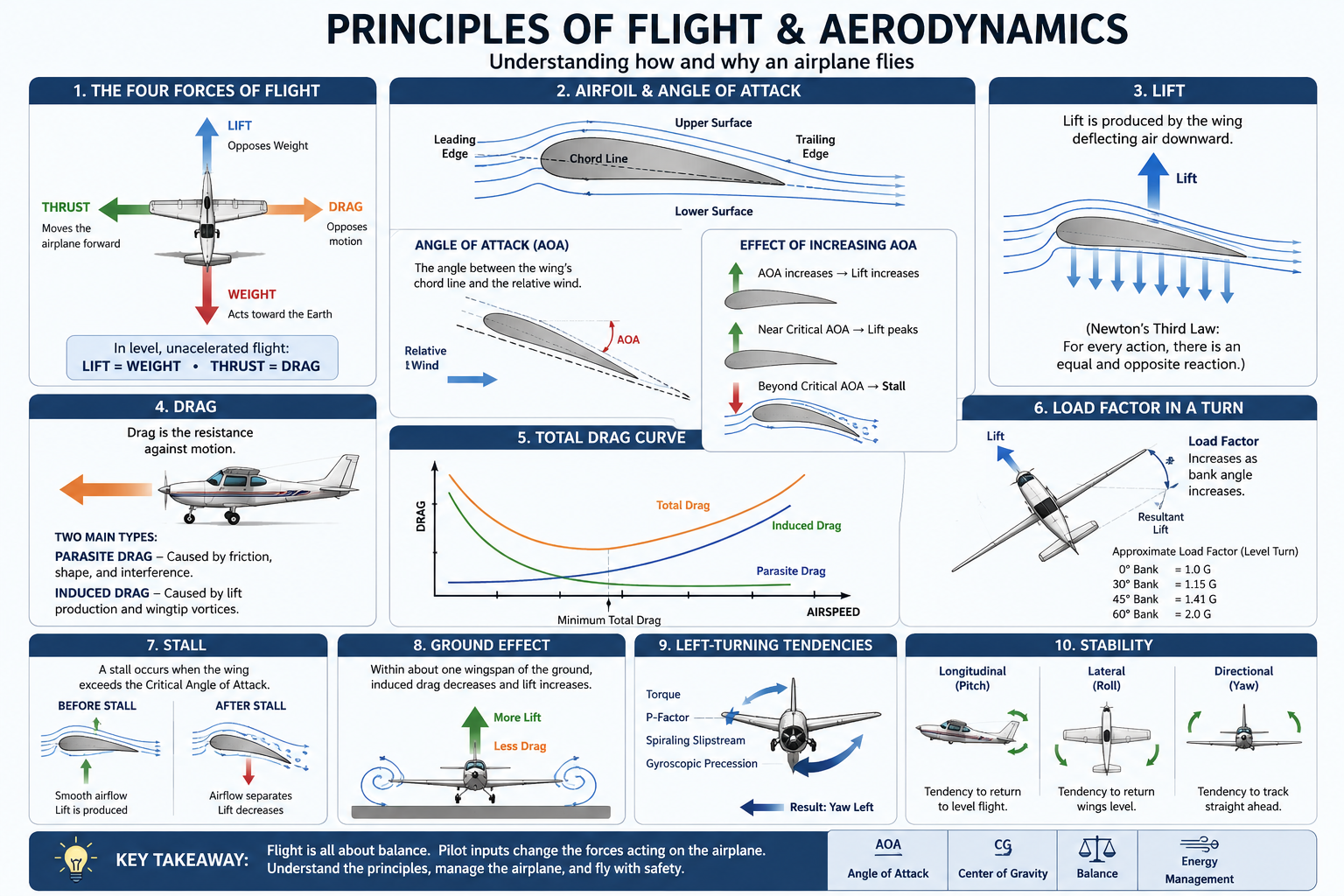
1. The Four Forces of Flight
Four basic aerodynamic forces act on an airplane in flight:
LIFT
WEIGHT
THRUST
DRAG
These forces constantly interact.
Lift
Acts generally upward and opposes weight.
Weight
Acts toward the center of the Earth.
Thrust
Acts generally forward and is produced by the propulsion system.
Drag
Acts generally rearward and opposes the aircraft’s movement through the air.
In steady, unaccelerated straight-and-level flight:
Lift = Weight
and
Thrust = Drag
But during climbs, descents, turns, acceleration, and deceleration, the relationships change.
2. Newton’s Laws and Flight
Aircraft motion can be understood partly through Newton’s laws of motion.
Newton’s First Law
An object at rest tends to remain at rest, and an object in motion tends to remain in motion unless acted upon by an outside force.
This is the principle of:
INERTIA
An airplane will not change speed or direction unless forces acting on it become unbalanced.
Newton’s Second Law
Force is related to mass and acceleration.
A larger force acting on the same mass produces a greater acceleration.
This helps explain why aircraft accelerate, decelerate, climb, descend, or turn when forces become unbalanced.
Newton’s Third Law
For every action, there is an equal and opposite reaction.
One aviation example is the wing deflecting airflow downward while the airflow exerts an upward reaction on the wing.
3. Bernoulli’s Principle
Bernoulli’s principle also helps explain pressure differences around an airfoil.
As airflow accelerates over portions of an airfoil, static pressure can decrease.
The pressure distribution around the wing contributes to lift.
But it is important not to teach lift as though Bernoulli alone explains flight.
Lift results from the overall aerodynamic interaction between the wing and airflow.
That includes:
-
Pressure differences around the airfoil
-
Airflow acceleration
-
Downward deflection of air
-
Angle of attack
-
Wing shape
-
Air density
-
Airspeed
A good pilot understands the whole system—not just one simplified explanation.
4. Airfoil Terminology
An:
AIRFOIL
is a structure designed to produce a useful aerodynamic force when moving through the air.
Important airfoil terms include:
Leading Edge
The front of the airfoil.
Trailing Edge
The rear of the airfoil.
Chord Line
An imaginary straight line extending from the leading edge to the trailing edge.
Camber
The curvature of the airfoil.
Upper Surface
The top surface of the wing.
Lower Surface
The bottom surface.
Understanding the chord line becomes especially important when discussing:
ANGLE OF ATTACK.
5. Relative Wind
Relative wind is the airflow that moves opposite the aircraft’s flight path through the surrounding air mass.
A simple way to think about it:
The airplane moves one way.
The relative wind comes from the opposite direction.
The direction of relative wind changes as the aircraft’s flight path changes.
6. Angle of Attack
One of the most important concepts in all of aviation is:
ANGLE OF ATTACK — AOA
Angle of attack is the angle between:
The wing’s chord line
and
The relative wind
Angle of attack is not the same as pitch attitude.
An airplane can have the nose:
-
Above the horizon
-
On the horizon
-
Below the horizon
and still have different angles of attack depending on its actual flight path.
This distinction becomes extremely important during stalls.
7. Increasing Angle of Attack
As angle of attack increases within the normal operating range, lift generally increases.
But only up to a point.
Eventually, the wing reaches its:
CRITICAL ANGLE OF ATTACK
Beyond this point, airflow over the wing separates enough that lift decreases substantially.
The wing:
STALLS.
This is the fundamental definition of an aerodynamic stall.
8. What Actually Causes a Stall?
A stall is caused by:
EXCEEDING THE CRITICAL ANGLE OF ATTACK.
Not simply:
-
Flying too slowly
-
Pulling the nose too high
-
Losing engine power
-
Flying with flaps extended
Low airspeed is often associated with stalls because the pilot must generally increase angle of attack to maintain sufficient lift as speed decreases.
But the true aerodynamic cause is:
EXCESSIVE ANGLE OF ATTACK.
That is why an airplane can stall at:
-
Low airspeed
-
High airspeed
-
In a climb
-
In a descent
-
During a steep turn
-
In almost any attitude
9. Lift
Lift depends on several variables, including:
-
Air density
-
Airspeed
-
Wing area
-
Airfoil characteristics
-
Angle of attack
Conceptually:
More airflow over the wing can increase lift.
Increasing angle of attack can increase lift—until critical AOA is exceeded.
Greater air density can increase aerodynamic force.
This is why temperature, altitude, speed, configuration, and aircraft loading all matter.
10. Center of Pressure
The aerodynamic forces acting on a wing are distributed over its surface.
For instructional purposes, their combined effect can be represented at the:
CENTER OF PRESSURE
As angle of attack changes, the center of pressure can move.
Aircraft design and tail forces help manage the pitching effects associated with these changes.
11. Weight
Weight acts downward through the airplane’s:
CENTER OF GRAVITY — CG
The CG is the point at which the airplane would theoretically balance if suspended.
CG location affects:
-
Stability
-
Control
-
Stall characteristics
-
Takeoff performance
-
Landing characteristics
-
Elevator authority
-
Spin recovery
-
Cruise performance
You’ll study weight and balance in detail in a later section.
12. Thrust
Thrust is produced by the propulsion system.
In a typical piston trainer, the engine turns a propeller.
The propeller accelerates air and produces a forward aerodynamic force.
Thrust available can vary with:
-
Power setting
-
Engine condition
-
Propeller design
-
Air density
-
Aircraft speed
-
Altitude
-
Temperature
13. Drag
Drag opposes an airplane’s motion through the air.
Two broad categories are especially important:
PARASITE DRAG
and
INDUCED DRAG
14. Parasite Drag
Parasite drag includes drag not directly associated with producing lift.
It includes:
Form Drag
Caused by the shape of objects moving through the air.
Skin-Friction Drag
Produced by airflow moving across aircraft surfaces.
Interference Drag
Created where different airflow patterns interact, such as around junctions between components.
Parasite drag generally increases substantially as airspeed increases.
15. Induced Drag
Induced drag is associated with the production of lift.
It is strongly influenced by wingtip vortices and pressure differences around the wing.
Induced drag is greatest when:
-
Airspeed is low
-
Angle of attack is high
-
The aircraft is producing substantial lift
As airspeed increases and angle of attack decreases, induced drag generally decreases.
16. The Total Drag Curve
At lower airspeeds:
INDUCED DRAG DOMINATES.
At higher airspeeds:
PARASITE DRAG DOMINATES.
Total drag is the combination of both.
There is an intermediate speed at which total drag reaches a minimum.
This relationship becomes important for:
-
Aircraft performance
-
Glide performance
-
Endurance
-
Slow flight
-
Approach planning
17. The Region of Reversed Command
At sufficiently low airspeeds, maintaining altitude may require more power as speed decreases.
This is commonly called:
THE REGION OF REVERSED COMMAND
or sometimes:
THE BACK SIDE OF THE POWER CURVE.
The airplane is operating at a higher angle of attack and higher induced drag.
This concept becomes very important during:
-
Slow flight
-
Approaches
-
Short-field operations
-
Energy management
18. Slow Flight
Slow flight teaches the pilot how an airplane behaves near the lower end of its normal speed range.
The current Private Pilot ACS requires maneuvering during slow flight in the cruise configuration at an airspeed where any further increase in angle of attack, increase in load factor, or reduction in power would result in a stall warning, while maintaining flight without the warning activating. (Federal Aviation Administration)
At slow airspeeds, you may notice:
-
Higher angle of attack
-
Reduced control effectiveness
-
Greater control deflection
-
Increased rudder requirements
-
Greater induced drag
-
Smaller margin above stall
-
Increased sensitivity to coordination
19. Why Rudder Becomes Important in Slow Flight
At high power and low airspeed, several yawing tendencies can become more noticeable.
The pilot may need significant rudder input to maintain coordinated flight.
Failure to stay coordinated near the stall can increase the risk of:
SPIN ENTRY.
20. Left-Turning Tendencies
Propeller-driven airplanes can experience several effects that tend to yaw or roll the airplane left under certain conditions.
Commonly taught effects include:
Torque
Engine and propeller rotation produce an opposite reaction on the airplane.
P-Factor
At high angle of attack, the descending propeller blade can produce more thrust than the ascending blade.
Spiraling Slipstream
Propeller wash can spiral around the fuselage and strike the vertical tail.
Gyroscopic Precession
Can become important when the propeller disk is rapidly tilted, particularly in some tailwheel operations.
These effects vary with aircraft design and operating condition.
21. Adverse Yaw
When the pilot applies aileron to begin a roll, the airplane can initially yaw opposite the desired direction of turn.
This tendency is called:
ADVERSE YAW.
The wing with the downward-deflected aileron generally produces more lift—and also more drag.
Coordinated rudder helps counter this effect.
That is one reason proper turns use:
AILERON + RUDDER
rather than aileron alone.
22. Aircraft Stability
Stability describes the airplane’s tendency to respond after being disturbed from an equilibrium condition.
Aircraft can demonstrate:
Positive Stability
A tendency to return toward the original condition.
Neutral Stability
A tendency to remain in the new condition.
Negative Stability
A tendency to move farther away from the original condition.
23. Longitudinal Stability
Longitudinal stability concerns movement around the:
LATERAL AXIS
This primarily relates to:
PITCH.
The relationship between CG, wing lift, and horizontal-tail forces plays an important role in longitudinal stability.
24. Lateral Stability
Lateral stability concerns motion around the:
LONGITUDINAL AXIS
This primarily relates to:
ROLL.
Aircraft designers use features such as:
-
Dihedral
-
Wing placement
-
Sweep
-
Keel effect
to contribute to lateral stability.
25. Directional Stability
Directional stability concerns motion around the:
VERTICAL AXIS
This primarily relates to:
YAW.
The vertical stabilizer plays a major role in directional stability.
26. Center of Gravity and Stability
CG location strongly affects handling.
Forward CG
Generally provides greater longitudinal stability but may:
-
Require more tail-down force
-
Increase control forces
-
Increase stall speed in some conditions
-
Reduce performance
-
Make rotation or flare more difficult if excessively forward
Aft CG
Can:
-
Reduce longitudinal stability
-
Reduce control forces
-
Make stall recovery more difficult
-
Make spin recovery more difficult
-
Increase the risk of loss of control if beyond limits
An aft-CG condition beyond approved limits can be particularly hazardous.
Always operate within the aircraft’s approved CG envelope.
27. Load Factor
Load factor is the ratio of the aerodynamic load supported by the wings to the actual weight of the airplane.
It is commonly expressed in:
Gs
In straight-and-level unaccelerated flight:
Load factor ≈ 1 G.
In a turn, additional lift is needed because part of the lift vector is directed horizontally.
As bank angle increases, required total lift increases.
Therefore:
LOAD FACTOR INCREASES.
28. Bank Angle and Load Factor
In a level coordinated turn:
-
0° bank ≈ 1 G
-
30° bank ≈ 1.15 G
-
45° bank ≈ 1.41 G
-
60° bank ≈ 2 G
At 60° of bank, the wings must produce approximately twice the aircraft’s weight in lift to maintain altitude.
This is why steep turns require increased angle of attack and/or speed.
29. Load Factor and Stall Speed
As load factor increases:
STALL SPEED INCREASES.
This is extremely important.
An airplane that stalls at a certain speed in straight-and-level 1-G flight will stall at a higher airspeed under increased load factor.
For example, at approximately 2 G:
Stall speed is about 1.41 times the 1-G stall speed.
That means an aircraft with a 50-knot 1-G stall speed would stall at roughly:
71 knots at 2 G.
This is why high-speed stalls can occur during aggressive maneuvering.
30. Accelerated Stalls
An:
ACCELERATED STALL
occurs when the airplane exceeds critical angle of attack while operating at a load factor greater than 1 G.
Accelerated stalls can occur:
-
At higher-than-normal stall speeds
-
During steep turns
-
During abrupt pull-ups
-
During aggressive maneuvering
-
During poorly managed recovery from a dive
Remember:
THE WING STALLS BECAUSE OF ANGLE OF ATTACK—not because of one specific airspeed.
31. Maneuvering Speed — VA
Maneuvering speed is commonly designated:
VA
A common misconception is:
“Below VA, you can move the controls however you want and nothing can happen.”
That is not correct.
VA is related to structural protection against certain full, abrupt control inputs in one axis under specified conditions, but it is not a universal protection against:
-
Repeated inputs
-
Combined control inputs
-
Turbulence
-
Structural overload in every circumstance
-
Loss of control
Another important point:
VA DECREASES AS AIRCRAFT WEIGHT DECREASES.
Use the POH/AFM for the aircraft-specific value and guidance.
32. Stalls
A stall occurs when the wing exceeds its critical angle of attack.
Common stall indications may include:
-
Stall warning horn
-
Buffet
-
Reduced control effectiveness
-
Nose-high attitude in many training demonstrations
-
Increased control deflection
-
Changes in aircraft feel
-
Loss of altitude if not corrected
But the exact indications vary by aircraft.
33. Stall Recovery
The essential aerodynamic requirement for stall recovery is:
REDUCE ANGLE OF ATTACK BELOW CRITICAL.
Then, as appropriate:
-
Apply power
-
Level the wings
-
Minimize altitude loss
-
Reconfigure according to aircraft procedures
-
Establish a safe climb
Always follow the approved aircraft procedure and instructor guidance.
The first aerodynamic priority is not simply “add power.”
It is:
REDUCE AOA.
34. Power-Off Stalls
Power-off stalls are commonly used to simulate stall conditions that can develop during:
-
Approaches
-
Landings
-
Descents
-
Traffic-pattern operations
The Private Pilot ACS includes a specific Power-Off Stalls task within Area VII. (Federal Aviation Administration)
35. Power-On Stalls
Power-on stalls commonly simulate conditions associated with:
-
Takeoff
-
Departure
-
Climb
Because power is applied and airspeed is low, left-turning tendencies and coordination become particularly important.
36. Spins
A spin requires:
A STALL
plus
YAW.
Both wings are stalled, but one is generally more deeply stalled than the other.
The airplane then autorotates while descending.
This is why:
COORDINATION MATTERS.
37. Base-to-Final Stall/Spin Risk
One of the most serious situations for a Private Pilot occurs when overshooting the final approach course.
Imagine a pilot:
-
Overshoots final.
-
Increases bank.
-
Adds excessive inside rudder.
-
Pulls back to keep the nose from dropping.
-
Increases angle of attack.
-
Stalls while skidding.
This combination can produce rapid spin entry at an altitude too low for recovery.
The correct response to an unstable or overshot approach may be:
GO AROUND.
38. Ground Effect
When flying very close to the ground, the interaction between the wing and surface reduces certain aerodynamic effects associated with wingtip vortices.
This is called:
GROUND EFFECT.
Within ground effect:
-
Induced drag decreases
-
Lift efficiency increases
-
The airplane may become airborne before reaching normal climb speed
-
The airplane may float farther during landing
Ground effect becomes especially significant within approximately one wingspan of the surface, with its influence increasing substantially as height decreases.
39. Ground Effect During Takeoff
An airplane may lift off the runway while still:
BELOW A SAFE CLIMB SPEED.
It may seem to fly adequately while remaining close to the runway because ground effect reduces induced drag.
If the pilot then attempts to climb out of ground effect too early, the airplane may:
-
Fail to climb
-
Settle back toward the runway
-
Require additional acceleration
This becomes especially important with:
-
High density altitude
-
Heavy aircraft
-
Short runways
-
Soft-field takeoffs
-
Obstacles
40. Ground Effect During Landing
During landing, ground effect can cause the airplane to:
FLOAT.
If approach speed is excessive, reduced induced drag near the surface can significantly increase landing distance.
That's one reason stabilized airspeed control matters.
41. Wingtip Vortices
Pressure is generally higher beneath a lifting wing and lower above it.
Near the wingtip, airflow tends to move around the tip from the high-pressure area toward the lower-pressure region.
This creates:
WINGTIP VORTICES.
Vortex strength generally increases with greater lift production.
The classic conditions associated with strongest wake turbulence are a:
HEAVY, CLEAN, SLOW AIRCRAFT.
Wake turbulence will be covered in greater detail during airport and traffic operations.
42. Angle of Attack vs. Pitch Attitude
This is worth repeating because it causes so much confusion.
Pitch attitude is the airplane’s orientation relative to the horizon.
Angle of attack is the relationship between the wing chord and relative wind.
Therefore:
NOSE LOW DOES NOT MEAN LOW ANGLE OF ATTACK.
A pilot can pull aggressively from a descent, exceed critical AOA, and stall with the nose still below the horizon.
43. Scenario: Steep Turn
You're in a 60° banked level turn.
To maintain altitude, you increase back pressure.
Why?
Because at 60° bank:
-
Load factor is approximately 2 G
-
The airplane needs greater total lift
-
Angle of attack must increase unless speed is increased sufficiently
What happens to stall speed?
IT INCREASES.
This is one reason steep turns must be managed carefully.
44. Scenario: Slow Final Approach
You're on final approach.
Airspeed continues decreasing.
To prevent descent, you keep pulling back.
What happens?
Angle of attack increases.
Eventually, if you continue increasing AOA:
THE WING WILL STALL.
Adding power may be necessary, but stall prevention still depends fundamentally on keeping angle of attack below critical.
45. Scenario: Hot, High Airport
You're departing a mountain airport on a hot afternoon.
The airplane accelerates slowly.
Climb performance is poor.
Why?
High density altitude reduces:
-
Engine performance
-
Propeller efficiency
-
Wing performance for a given true airspeed relationship
Aerodynamics and aircraft performance are tightly connected.
46. Scenario: Overshooting Final
You're turning from base to final and realize you've overshot the runway centerline.
Should you apply strong inside rudder to make the nose turn faster?
NO.
That can create a dangerous skid.
If the approach cannot be safely stabilized:
GO AROUND.
47. Think Like the ACS
For aerodynamics, ask three questions.
KNOWLEDGE
What aerodynamic principle is occurring?
RISK MANAGEMENT
What could happen if I mishandle the airplane?
SKILL
Can I recognize the condition and respond correctly?
The current ACS explicitly applies this framework to slow flight and stalls, including angle of attack, airspeed, load factor, aircraft weight and CG, power, attitude, yaw effects, stall warnings, coordination, environmental factors, and loss-of-control risks. (Federal Aviation Administration)
Section 4 Review
By the end of this section, you should understand:
-
Lift, weight, thrust, and drag
-
Newton’s laws
-
Bernoulli’s principle
-
Airfoil terminology
-
Relative wind
-
Angle of attack
-
Critical angle of attack
-
Lift production
-
Parasite drag
-
Induced drag
-
Total drag
-
Region of reversed command
-
Slow flight
-
Left-turning tendencies
-
Adverse yaw
-
Aircraft stability
-
CG effects
-
Load factor
-
Bank angle
-
Accelerated stalls
-
Maneuvering speed
-
Stall recognition
-
Stall recovery
-
Spins
-
Ground effect
-
Wingtip vortices
-
Base-to-final stall/spin risk
2026 Knowledge Check
1. What are the four forces of flight?
Lift, weight, thrust, and drag.
2. What is angle of attack?
The angle between the wing chord line and relative wind.
3. What causes an aerodynamic stall?
EXCEEDING THE CRITICAL ANGLE OF ATTACK.
4. Can an airplane stall with the nose below the horizon?
Yes.
5. Which type of drag is usually greatest at low airspeeds?
Induced drag.
6. Which type of drag increases strongly as speed increases?
Parasite drag.
7. What happens to stall speed as load factor increases?
STALL SPEED INCREASES.
8. Approximately how much load factor exists in a level 60° banked turn?
2 G.
9. At 2 G, how does stall speed compare with the 1-G stall speed?
It is approximately 1.41 times greater.
10. What two aerodynamic conditions are required for a spin?
A stall and yaw.
11. What is the first aerodynamic requirement for stall recovery?
Reduce angle of attack below critical.
12. What is adverse yaw?
The tendency for an airplane to yaw opposite the initial direction of roll because of unequal drag.
13. What happens to induced drag in ground effect?
It decreases.
14. Does maneuvering speed guarantee the airplane cannot be damaged?
No.
15. What should you do if you seriously overshoot final and cannot safely reestablish a stabilized approach?
GO AROUND.
Key Takeaway
Nearly everything an airplane does can be traced back to the relationship between:
AIRFLOW
ANGLE OF ATTACK
ENERGY
LOAD FACTOR
WEIGHT
DRAG
CONTROL INPUTS
If you remember only one aerodynamic principle from this section, make it this:
AN AIRPLANE STALLS WHEN THE WING EXCEEDS ITS CRITICAL ANGLE OF ATTACK.
Not because of one particular airspeed.
Not because the nose is high.
Not because the engine quit.
Understanding that concept will make slow flight, stalls, turns, approaches, and emergency maneuvering much easier to understand.