A&P Aircraft Mechanic Schools in New Mexico
Cities in New Mexico with Aviation Schools:
- Alamogordo
- Albuquerque
- Anthony
- Artesia
- Aztec
- Belen
- Bernalillo
- Bloomfield
- Carlsbad
- Chaparral
- Clovis
- Corrales
- Deming
- Edgewood
- El Cerro Mission
- Eldorado At Santa Fe
- Espanola
- Farmington
- Gallup
- Grants
- Hobbs
- Las Cruces
- Las Vegas
- Lee Acres
- Los Alamos
- Los Chaves
- Los Lunas
- Los Ranchos De Albuquerque
- Lovington
- North Hobbs
- North Valley
- Paradise Hills
- Portales
- Raton
- Rio Communities
- Rio Rancho
- Roswell
- Ruidoso
- Santa Fe
- Santa Teresa
- Shiprock
- Silver City
- Socorro
- South Valley
- Sunland Park
- Taos
- Truth Or Consequences
- Tucumcari
- White Rock
- Zuni Pueblo
Aircraft Mechanic Schools New Mexico
If you are a veteran, your veteran's benefits, especially the Post 9/11 GI Bill, are the best sources of funding available to pay for aircraft mechanic schools in New Mexico. With the Post 9/11 GI Bill, you can be reimbursed for up to 100% of your aviation aircraft mechanic training expenses in New Mexico. This is a sizeable amount of funding that goes a long way toward making you an A&P mechanic, but there are a few things to consider before taking the leap.
For Veterans, aviation mechanic training expenses in New Mexico can be covered up to $10,000 dollar per academic year! Qualified veterans can use Post 9/11 GI Bill benefits to cover 100% of their training costs up to $10,000 dollars per academic year. Depending on the program, this is a big portion of the expense of aviation mechanic school in New Mexico.
While it is worth noting this limitation, it is hardly causing alarm since it covers or severely reduces the costs of most aviation mechanic school courses.
A&P Mechanic Schools in New Mexico
A&P Mechanic Schools in New Mexico require VA approval for reimbursement. An arguably more important consideration before beginning your aviation A&P mechanic training in New Mexico is whether a particular training provider is approved by the VA. The good news is there is a pretty standard process and it isn't a secret whether an Aircraft Mechanic School is approved.
The only potential catch is that the VA must also approve individual courses before they will reimburse your flight training costs. This means that while an aviation mechanic school in New Mexico may have approval, every course they offer isn't necessarily covered by your Post 9/11 GI Bill benefits.
A&P Mechanic School Training Requirements
To be a certified A&P mechanic or avionics technician you need to meet several qualifications:
- Age 18 or older
- Read, write, speak, and understand the English language
- Have a high school diploma or equivalent
- Display the required technical skills
Aircraft Mechanic Trade School in New Mexico
Today, the FAA has approximately 170 approved Aircraft Mechanic Trade Schools on their website. You can attend one or a combination of these schools to gain the practical experience you'll need to become an aircraft mechanic. These schools are mandated by the FAA to offer at least 1900 class-hours of training, and the courses last about 18 months, on average.
Some of these schools offer Associate or Bachelor degrees in conjunction with the Aircraft Mechanic Training Certification.
Many A&P mechanics today were trained in the military. As a military mechanic, you could be working on anything from large airliners and transports to jet fighters and attack helicopters. 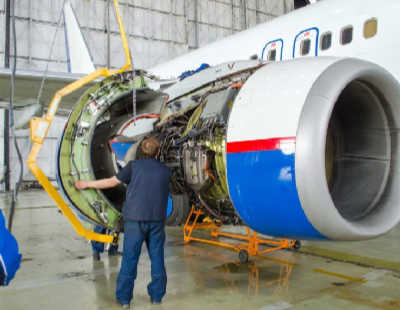 If you decide to go this route, upon your discharge from the military, you'll need to take the necessary FAA tests and have the proper documentation of your practical experience.
Once you have passed the required tests, you'll be eligible to apply for A&P mechanic jobs in New Mexico. However, please note that military experience can sometimes be too specific, and not meet the broad specifications required by the FAA. Even after your discharge, you may have to attend one of the FAA-approved Aircraft Mechanic Trade Schools in New Mexico.
On the job training... a very few people earn the required minimum coursework and skill set needed to pass the A&P certification tests through on the job training.
Typically, you must be under the direct supervision of an A&P for at least 30 months and be logging all of your hours to go this route. Your time log must be notarized by your employer or signed off by the supervising A&P.
A&P Mechanic Training is Improved by the VA Approval Process
The requirements for receiving an aviation mechanic certificate are standardized, but there is still a lot of variation in training programs. Since the VA mandates a fairly stringent approval process and there are ongoing paperwork requirements, most schools have a VA representative who is very familiar with the system.
The FAA demand, the approval process, and the paperwork have a net effect of improving the quality of your aviation mechanic training by weeding out weak training courses and keeping you active in your training. Once you start training, most of the paperwork can be managed for you, allowing you to focus on your aviation mechanic training.
In fact, this is the most important takeaway. The stringent requirements of the Post 9/11 GI Bill create better-equipped schools, more efficient training courses, and save you money during your aviation mechanic training. For more information and to verify your eligibility, call 1-888-GIBILL-1 or check out the GI Bill website.
FAA - A History of Aircraft Structures Facts for New Mexico
Aircraft structural members are designed to carry a load or to resist stress. In designing an aircraft, every square inch of wing and fuselage, every rib, spar, and even each metal fitting must be considered in relation to the physical characteristics of the material of which it is made. Every part of the aircraft must be planned to carry the load to be imposed upon it.
Aviation Facts - Stability and Control of an Aircraft
An aircraft must have sufficient stability to maintain a uniform flightpath and recover from the various upsetting forces. Also, to achieve the best performance, the aircraft must have the proper response to the movement of the controls. Control is the pilot action of moving the flight controls, providing the aerodynamic force that induces the aircraft to follow a desired flightpath. When an aircraft is said to be controllable, it means that the aircraft responds easily and promptly to movement of the controls. Different control surfaces are used to control the aircraft about each of the three axes. Moving the control surfaces on an aircraft changes the airflow over the aircraft’s surface. This, in turn, creates changes in the balance of forces acting to keep the aircraft flying straight and level.
Aircraft Mechanic Schools in New Mexico
How to get your A&P Aircraft Mechanic certification in New Mexico; training requirements, eligibility, and more. To earn your A&P Aircraft Mechanic Training Certificate in New Mexico (A&P License in New Mexico), you must attend a Federal Aviation Administration (FAA) certified Aircraft Mechanic School in New Mexico OR have at least 30 months of relevant civilian or military work experience (supervised by a certified aviation mechanic from New Mexico).
The FAA issues the A&P certificates (airframe and powerplant certificates), and A&P mechanics from New Mexico can get either an airframe rating or a power plant rating or both--most aviation mechanics from New Mexico get both. Those who want a certificate with just a single rating and who base their application on practical experience must demonstrate 18 months of work experience applicable to the chosen rating. Learn more about the training and experience requirements to become an A&P mechanic near New Mexico.
After your aircraft mechanic school qualifications are met, you'll be eligible to take the required oral, practical, and written tests. You must pass all these tests within 24 months. The tests cover 43 technical subjects. Typically, tests for one certificate--airframe or power plant--take about 8 hours. (Get more details about the Aircraft A&P Mechanics Tests)
When you pass, you will have earned your FAA A&P mechanic license with airframe and/or powerplant certificates (A&P license in New Mexico), and you'll be on your way to a successful career in aviation maintenance! Learn more about aviation maintenance A&P technician schools near New Mexico.
A&P Mechanic Schools in New Mexico
Although your certificates earned from A&P mechanic schools in New Mexico don't expire, aviation mechanics from New Mexico must remain "current" by meeting several criteria, including completing a minimum of 1,000 hours of hands-on work experience during the previous 24 months (or completing a refresher course) and completing at least 16 hours of additional training every 24 months.
The additional training requirement is usually satisfied by attending manufacturer events or training with outside contractors hired to conduct the training.
Avionics Technician Specialty Training
As an A&P mechanic in New Mexico, if you have the training, qualifications, and tools, the FAA will allow you to work on avionics as well. Avionics technicians are not specifically required to have FAA certification if they received their avionics training in the military or from working for an avionics manufacturer.
Aircraft Mechanic Trade Schools in New Mexico
Aviation maintenance technicians keep aircraft in the air by inspecting, replacing, and fixing nearly every part of an airplane or helicopter. The term aviation maintenance technician (or A&P Mechanic) is very broad and applies to nearly anyone who works on aircraft in New Mexico.
However, as an aspiring Aviation Mechanic in training, you'll quickly learn that there are several different types of aviation mechanics out there in New Mexico.
First of all, airframe mechanics in New Mexico are licensed to perform repair work on the entire aircraft with the exception of the engine(s), propellers, and instruments. Powerplant mechanics in New Mexico are authorized to work on engines and in some cases, propellers.
Although Aviation A&P Mechanics from New Mexico can earn either an airframe or powerplant certificate, the vast majority of Aviation Mechanic near New Mexico earn both certificates and are hereafter referred to as A&P (airframe and powerplant) mechanics. Avionics technicians work exclusively on aircraft radios, instruments, navigation, weather, traffic, and ground proximity systems. Learn more about aviation maintenance technician jobs.
Aviation Maintenance Technician Career Paths Near New Mexico
As an A&P mechanic in New Mexico, you are eligible to work in a huge variety of settings. You can work as a freelance mechanic at your local airfield in New Mexico, get a job working for a local airport near New Mexico, work for a corporate aviation department maintaining one or a fleet of aircraft in New Mexico, or end up at a major airline working on passenger jets and turboprops.
After three years of operating as an A&P mechanic in New Mexico (with 24 months of hands-on experience), you're eligible to move up and become an inspection authorization mechanic (IA). IA's are A&Ps with the authority to return aircraft to service after certain types of thorough inspections.
Aviation Maintenance Technician Key Points
Aircraft Mechanic Trade Schools in New Mexico must be detail-oriented. Aircraft mechanics perform a variety of complex tasks where mistakes can be costly in terms of money and human life. When the tools are put away, the job is not complete; aircraft mechanics must also be excellent record keepers.
Paperwork for all inspections and work completed must be filed and logged appropriately for each task completed. The larger and more complex the aircraft, the more paperwork. Find out more about aviation maintenance technician training.
Helicopter Facts for Alamogordo
The biggest helicopter was the Russian Mil Mi-12 Homer of 1968 which could lift 40,204 kg up to 2255 m.
At the end of 2011, Bell had approximately 10,700 employees, of which 19% were located outside the U.S. Major facilities are located in Fort Worth, Texas; Amarillo, Texas; Corpus Christi, Texas; Ozark, Alabama; Bristol, Tennessee; and Mirabel, Quebec, Canada. One third of the world fleet carry the Bell Helicopter brand.
Fun Helicopter and Airplane Facts for Alamogordo
Helicopters were developed and built during the first half-century of flight, with the Focke-Wulf Fw 61 being the first operational helicopter in 1936. Some helicopters reached limited production, but it was not until 1942 that a helicopter designed by Igor Sikorsky reached full-scale production, with 131 aircraft built.
Fun Helicopter Facts for Albuquerque
The R-22 is a single-engined helicopter with a semi-rigid two-bladed main rotor and a two-bladed tail rotor. The main rotor has a teetering hinge and two coning hinges, the tail rotor has only a teetering hinge.
Only 5% of the worlds population have ever been on an airplane. Flight is not the safest form of travel. The bus is on all measures. The motorcycle is the most dangerous on all measures.
Fun Helicopter Facts for Albuquerque
Helicopters can be flown across oceans if additional fuel is made available or in-flight refueling is employed.
As the helicopter approaches the ground, the pilot must then get rid of most of their forward motion and slow the decent using the stored up kinetic energy in the rotors. If done perfectly, the landing will be quite gentle. They accomplish this by executing a flare, pitching the nose up, at the right moment.
In fact, you have a better chance at surviving in a helicopter when the engine fails than you do in an airplane. Helicopters are designed specifically to allow pilots to have a reasonable chance of landing them safely in the case where the engine stops working during flight, often with no damage at all.
Helicopter Facts for Clovis
Globally recognized for world-class customer service, innovation and superior quality, Bell's international workforce serves customers flying Bell aircraft in more than 140 countries. Though most earlier designs used more than one main rotor, it is the single main rotor with anti-torque tail rotor configuration that has become the most common helicopter configuration.
Fun Helicopter and Airplane Facts for Clovis
Helicopters were developed and built during the first half-century of flight, with the Focke-Wulf Fw 61 being the first operational helicopter in 1936. Some helicopters reached limited production, but it was not until 1942 that a helicopter designed by Igor Sikorsky reached full-scale production, with 131 aircraft built.
Helicopter Facts for Farmington
Bell Helicopter is an American rotorcraft manufacturer headquartered in Hurst, Texas, near Fort Worth. A division of Textron, Bell manufactures military helicopter and tiltrotor products in and around Fort Worth, as well as in Amarillo, Texas, and commercial rotorcraft products in Mirabel, Quebec, Canada. Bell provides training and support services worldwide.
Fun Helicopter Facts for Farmington
Two piston-engined prototypes were built followed by a single example of a turbine-engined variant designated A.104BT. No production resulted.
Helicopter Spotlight for Farmington
Agusta A.104 Helicar was an Italian prototype light helicopter flown in December 1960. It was a slightly enlarged version of the A.103 and added a second seat beside the pilot's seat. The cockpit was enclosed by a perspex bubble with the engine at the rear and the tail rotor carried on an enclosed boom.
Owing to their versatility in flight, helicopters have a wide variety of applications. They are used for traffic surveillance, transportation, news gathering, aerial photography, crop-spraying, tourism, searching and rescuing etc.
Helicopter Facts for Hobbs
Helicopters are safest to fly in bad weather because they can slow down, stop and/or fly backwards or sideways.
Every Bell Helicopter is backed by around-the-clock, award winning customer support. Bell Helicopters comprehensive, global service network is rated #1 in the industry. On every continent, in every region, we stand behind each aircraft with the expertise, parts and service needed to meet your mission requirements.
Helicopter Spotlight for Hobbs
The Bell AH-1Z Viper is a twin-engineattack helicopter based on the AH-1W SuperCobra, that was developed for theUnited States Marine Corps. The AH-1Z features a four-blade, bearingless, composite main rotor system, uprated transmission, and a new target sighting system. The AH-1Z is part of the H-1 upgrade program. It is also called \Zulu Cobra in reference to its variant letter.
Fun Helicopter Facts for Las Cruces
The first version was produced as the R22, followed by the R22 HP, R22 Alpha, R22 Beta and R22 Beta II. Superficially, the aircraft appear similar. The R22 HP was fitted with a 160 bhp Lycoming 0-320-B2C engine, an increase of 10 bhp (7.5 kW) over the original R22.
Fun Helicopter and Airplane Facts for Las Cruces
Become a commercial helicopter pilot: Apply for a flight instructor job at a flight school. An air ambulance company may require its pilots to have a minimum of 1000 hours flight time. Teaching people how to fly is a legitimate way of building up your flight hours.
FAA - A History of Aircraft Structures Factoid
There are five major stresses to which all aircraft are subjected: Bending. Bending stress is a combination of compression and tension. The rod in Figure 1-14E has been shortened (compressed) on the inside of the bend and stretched on the outside of the bend. A single member of the structure may be subjected to a combination of stresses. In most cases, the structural members are designed to carry end loads rather than side loads. They are designed to be subjected to tension or compression rather than bending.
Fun Helicopter Facts for Rio Rancho
Instead of a floor-mounted cyclic stick between the pilot's knees, the R22 uses a unique teetering T-Bar control connected to a stick that emerges from the console between the seats. This makes it easier for occupants to enter and exit the cabin and reduces chances for injury in the event of a hard landing.
Fun Helicopter and Airplane Facts for Rio Rancho
Every U.S. military branch puts men and women applying for pilot training through its version of an initial flight training course. U.S. military pilot selection and initial flight training is typically designed to weed out unqualified applicants.
Fixed-Wing Aircraft Factoid
Truss-Type: A truss is a rigid framework made up of members, such as beams, struts, and bars to resist deformation by applied loads. The truss-framed fuselage is generally covered with fabric. The truss-type fuselage frame is usually constructed of steel. A truss-type fuselage. A Warren truss uses mostlydiagonal bracing.An airframe using monocoque construction. The most common airframe construction issemimonocoque tubing welded together in such a manner that all members of the truss can carry both tension and compression loads.In some aircraft, principally the light, single engine models, truss fuselage frames may be constructed of aluminum alloy and may be riveted or bolted into one piece, with cross-bracing achieved by using solid rods or tubes.
Fun Helicopter and Airplane Facts for Roswell
By derating the engine at sea level, the R22 achieves acceptable high-altitude performance without use of supercharging or turbocharging, thus saving the weight, complexity, unreliability, and shortened engine life of a forced induction system.
Fun Facts About Helicopters
While light-weight, general-purpose helicopters often have a two-bladed main rotor, heavier craft may use a four-blade design or two separate main rotors to accommodate heavy loads.
The first reference to a rotor system is credited to inventor Leonardo da Vinci, who designed an aerial screw in 1480. No full-scale variant was constructed during his lifetime.
During World War I, Hungarian engineer Theodore von Karman constructed a helicopter that, when tethered, was able to hover for extended periods. Several years later, Spaniard Juan de la Cierva developed a machine he called an autogiro in response to the tendency of conventional airplanes to lose engine power and crash while landing.
R22 Helicopter Trivia for Santa Fe
The R22 uses a horizontally mounted Lycoming O-320 (O-360-J2A on the Beta II), four-cylinder, air-cooled, normally aspirated, carburetor-equipped piston engine. It is fueled with 100LL grade aviation gasoline.
The capability to efficiently hover for extended periods of time allows a helicopter to accomplish tasks that fixed-wing aircraft and other forms of vertical takeoff and landing aircraft cannot perform.
Fun Helicopter and Airplane Facts for Santa Fe
U.S. military primary flight training teaches the basics of flight and flying applicable to most aviation situations. Depending on the military branch, once primary flight training is completed the trainee requests intermediate training in an aircraft type, such as jets.
Fixed-Wing Aircraft Factoid - Wing Configurations
Both the leading edge and the trailing edge of the wing may be straight or curved, or one edge may be straight and the other curved. One or both edges may be tapered so that the wing is narrower at the tip than at the root where it joins the fuselage. The wing tip may be square, rounded, or even pointed. Figure 1-19 shows a number of typical wing leading and trailing edge shapes.
Fun Helicopter and Airplane Facts for South Valley
Bell Helicopter is an industry-leading producer of commercial and military helicopters and the pioneer of tiltrotor aircraft. One-third of the world's operating vertical lift aircraft are made by Bell, including advanced military aircraft and a variety of commercial single- and twin-engine helicopters.
Helicopter Structures
Airframe The airframe, or fundamental structure, of a helicopter can be made of either metal or wood composite materials, or some combination of the two. Typically, a composite component consists of many layers of fiber-impregnated resins, bonded to form a smooth panel. Tubular and sheet metal substructures are usually made of aluminum, though stainless steel or titanium are sometimes used in areas subject to higher stress or heat. Airframe design encompasses engineering, aerodynamics, materials technology, and manufacturing methods to achieve favorable balances of performance, reliability, and cost.